


On paper, the Democratic Progressive Party (DPP) enters this year’s nine-in-one elections with almost nowhere to go but up. Yet, there are fears in the pan-green camp that they may not do much better then they did in 2022.
Though the DPP did somewhat better at the city and county councillor level in 2022, at the “big six” municipality mayoral and county commissioner level, it was a disaster for the party. Then-president and party chairwoman Tsai Ing-wen (蔡英文) made a string of serious strategic miscalculations that led to the party’s worst-ever result at the top executive level.
That year, the party only won five top spots. Unsurprisingly, they held their strongholds of Tainan and Kaohsiung and held out in Chiayi County. They won in a nail-biter of a race in Pingtung by a surprisingly narrow margin, partly due to an acrimonious primary, partly due to a New Power Party candidate syphoning off some pan-green votes, and because the Chinese Nationalist Party (KMT) is not as weak in the south as many assume. The DPP won Penghu only after a KMT member quit the party to run as an independent, splitting the vote.
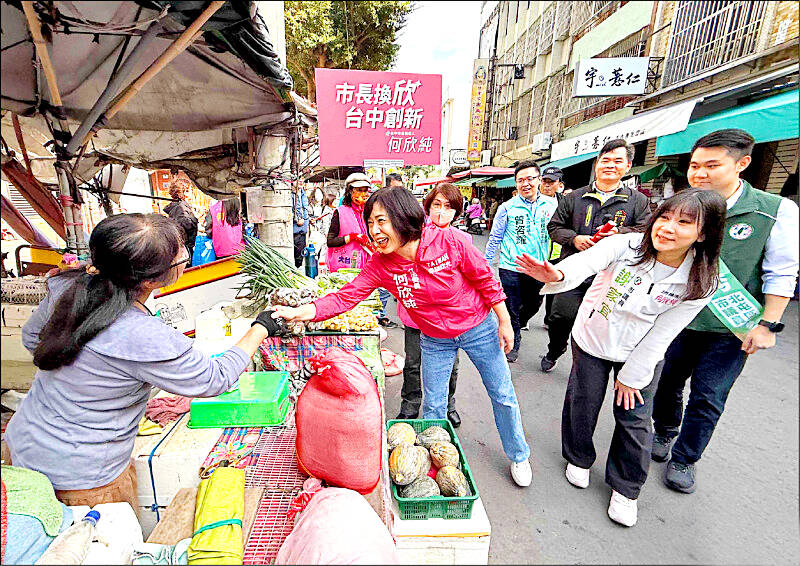
Photo: Tsai Shu-yuan, Taipei Times
This time the DPP cannot rely on popular incumbents in Kaohsiung, Tainan or Chiayi County. Their only incumbents are in Pingtung and Penghu.
The KMT is historically far stronger at the local level and can draw on a larger pool of talent. The only local election where the DPP won in a landslide was in 2014, following the Sunflower movement, which moved the political center of gravity closer to the pan-green camp.
In all other local election years, the DPP has struggled to gain traction.
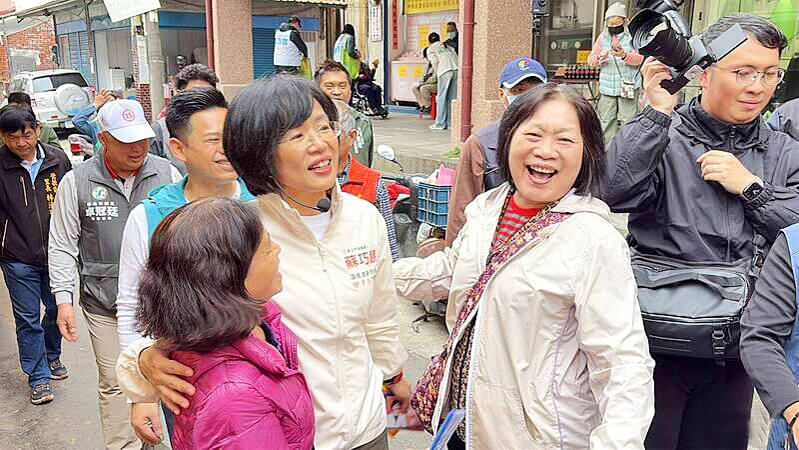
Photo: Huang Tzu-yang, Taipei Times
LOW TO NO HOPE REGIONS
Of the 22 cities and counties, in three the DPP has never stood a chance. For most elections, the DPP does not even bother to try and field a candidate in Kinmen and Matsu. They have never won in Miaoli, and still managed to lose in 2022 against a split pan-blue camp and against the eventual winner Chung Tung-chin (鍾東錦), who kicked off his campaign by holding a press conference to announce he is an adulterer and once stabbed his classmate — not a rapist and a murderer, as was rumored.
Of the remaining 19 regions, some have been historically tough. The KMT has strong incumbents in Nantou, Keelung and Taoyuan. Keelung Mayor George Hsieh (謝國樑) easily fended off a recall attempt in 2024, and in Taoyuan, the DPP is still weighed down by the arrest of Cheng Wen-tsan (鄭文燦), a formerly popular mayor who is now on trial for corruption.
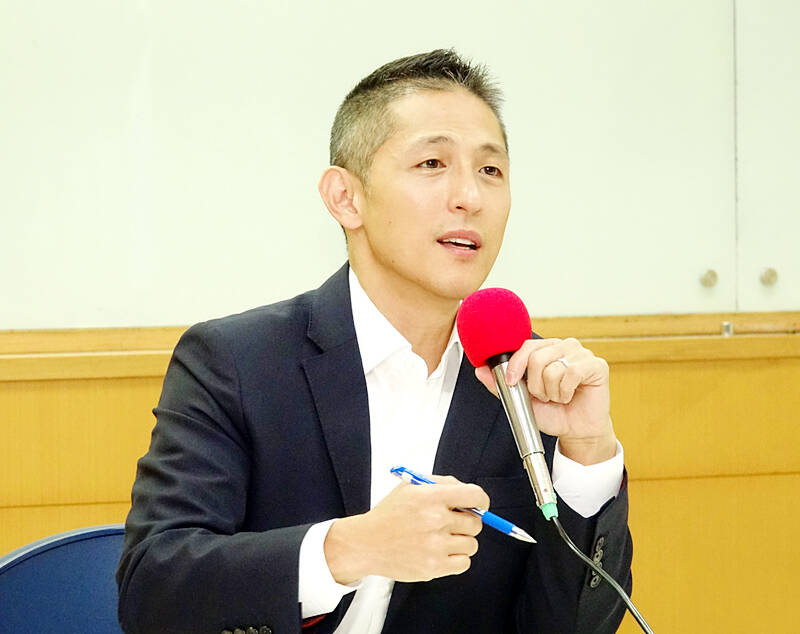
Photo: TT file photo
In Hsinchu City, it appears that the KMT and the Taiwan People’s Party (TPP) have lined up behind incumbent Ann Kao (高虹安), who survived a recall attempt last year. She was found guilty of corruption and quit the TPP, but has since been exonerated on the most serious charges on appeal. Technically, she is still an independent and could choose to remain one, or rejoin the TPP or even the KMT. Regardless, the DPP does not appear to consider Hsinchu in play, and no viable candidate has stepped forward.
The DPP has only ever won Taipei once, when Chen Shui-bian (陳水扁) eked out a victory in a three-way race in 1994. He only served one term. KMT incumbent Mayor Chiang Wan-an (蔣萬安) is looking strong, and all the people put forward as potential candidates keep running for the exits, including the premier, vice premier and the ever-entertaining Wang Shih-chien (王世堅).
The only declared DPP candidate in Taipei is Enoch Wu (吳怡農), who has a stellar resume and previously put up a good fight against Chiang in a legislative race — though he still lost. Yet, the press is almost entirely ignoring him. Reports suggest insiders in the DPP find him “too American,” despite having renounced his American citizenship to devote his life to public service in Taiwan.
POTENTIALLY IN PLAY
In Taichung, DPP candidate Ho Hsin-chun (何欣純) has a strong base in her legislative district but little name recognition elsewhere in the city. Yunlin is also an uphill battle, but not impossible. Taitung is also potentially in play.
Some interesting places to watch include Hsinchu County, Yilan and Chiayi. A pan-blue split is very possible in Hsinchu County, and in Yilan and Chiayi, the pan-blue camp has weak candidates, and may split between the TPP and KMT if negotiations are not fruitful.
Superficially, the DPP look strong in their traditional strongholds of Tainan and Kaohsiung. Fears there would be a split in the party leading to figures bolting the party and running as independents have not come to pass, and their candidates are leading in the polls.
The bad news for the DPP is that those two primaries were ugly, and in Tainan, especially, there are very real concerns that the party will not fully rally behind their candidate. The KMT has strong candidates in both cities.
The one bright spot for the DPP is their candidate for New Taipei City, Su Chiao-hui (蘇巧慧). She is holding up well in polling, and there is potential for the pan-blue camp to split, with both the TPP and KMT running candidates. However, this is a blue-leaning city, and if the KMT can convince the delightfully named Hammer Lee (李四川) — currently vice mayor of Taipei — to run, it could be a tight race.
CHAIRMAN LAI
Another key factor is DPP Chairman William Lai (賴清德). He is far more politically experienced and savvy than Tsai Ing-wen. On the other hand, being concurrently the president and presumably distracted, how much attention can he spare for the election?
He will need to motivate the pan-green base to counteract the superior KMT get-out-the-vote machine. This will be tough; the collapse of the largely pro-DPP Bluebird movement has left many activists demoralized.
On the plus side for the DPP, KMT Chairwoman Cheng Li-wun (鄭麗文) has little electoral experience, unlike her formidable predecessor, Eric Chu (朱立倫) in 2022.
The KMT’s large talent pool can also be a curse, leading to ambitious politicians bolting to run as independents.
The KMT also has a TPP problem. The TPP wants to run candidates in Chiayi City, Yilan and New Taipei City and wants to run unopposed by the KMT. If the KMT does that, they could win less top spots than in 2022, which would look bad. On the other hand, TPP support could help them win in other races.
Relying on the other side making mistakes is not a strategy, however.
The DPP has two advantages: better finances and stronger message discipline.
The temptation will be to focus messaging on the opposition’s obstructionism in the legislature, and Cheng’s unpopular comments on China, which will likely be the gift that keeps on giving for the DPP.
However, this will be a tough needle to thread. Local elections are primarily about local issues and personalities; playing up national issues too strongly can backfire. In 2022, Tsai used the 2020 national election slogan “resist China, protect Taiwan” (抗中保台). That worked well in a national election, but made little sense when electing someone to fix the potholes, and voters saw through it as a blatant attempt to win them over with slogans and not substance.
Cheng will almost certainly say and do things that will offend the swing voters who decide elections. DPP candidates will need to resist the temptation to focus too much on attacking her. The press will put the KMT candidates on the defensive all on their own every time she makes a controversial comment.
Lai will need to shore up defenses and unify the party in Tainan and Kaohsiung and carefully allocate attention and resources to those areas where they are competitive.
Donovan’s Deep Dives is a regular column by Courtney Donovan Smith (石東文) who writes in-depth analysis on everything about Taiwan’s political scene and geopolitics. Donovan is also the central Taiwan correspondent at ICRT FM100 Radio News, co-publisher of Compass Magazine, co-founder Taiwan Report (report.tw) and former chair of the Taichung American Chamber of Commerce. Follow him on X: @donovan_smith.
Ajay Verma, a consultant gastroenterologist at Kettering general hospital in Northamptonshire, says our gut is a “complex machine.” “It is constantly providing us with the nutrition we need, initially to grow and develop, and then for us to survive, thrive and repair from injury and illness.” How can we keep it functioning well? Put simply: “Make sure what you put into it is balanced, and that you clear out its waste products adequately,” Verma says. “In a general gastroenterology clinic, the most common conditions we see are irritable bowel syndrome (IBS), gastroesophageal reflux disease, inflammatory bowel disease and constipation,” says Nisha
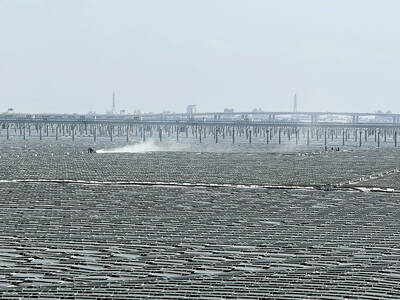
The arithmetic is straightforward and uncomfortable. By the end of 2025, Taiwan had committed itself to a 50-30-20 electricity mix — half natural gas, 30 per cent coal, 20 per cent renewables. The Ministry of Economic Affairs’s (MOEA) own monthly energy reports tell a different story. Natural gas reached 47.8 per cent of generation last year. Coal stood at 35.4 per cent, comfortably above its target ceiling. Renewables came in at 13.1 per cent, well short of the 20 per cent Taipei had pledged a decade earlier. Installed renewable capacity reached roughly half of the 12 gigawatts (GW) the government

Last week US President Donald Trump was asked by a reporter whether he would speak on the phone to the President of Taiwan. “l’ll speak to him. I speak to everybody. We have that situation very well in hand,” Trump said. This marked the second time in a couple of weeks he had said he would talk to the President of Taiwan. In 2016 he famously took a call from then-president Tsai Ing-wen (蔡英文), when he was president-elect. Despite warnings that the apocalypse was nigh because of a phone call, the world quickly forgot about the conversation between two democratically-elected presidents.
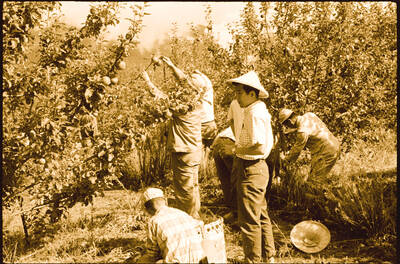
May 25 to May 31 Few believed that apples could be cultivated on a commercial scale in Taiwan’s high mountains. When horticulturalist Cheng Chao-hsiung (程兆熊) first proposed the idea in 1955, both American and Taiwanese colleagues dismissed it as implausible, arguing that temperate fruit could not be reliably grown on a subtropical island, especially on rugged terrain. However, it was this terrain in the Central Mountain Range where many Chinese Civil War veterans were resettled in the late 1950s. With limited job prospects and no family in Taiwan, they were placed on cooperative farms aimed toward self-sufficiency. Some say the conditions


 RSS
RSS