


China’s military news agency yesterday warned that Japanese militarism is infiltrating society through series such as Pokemon and Detective Conan, after recent controversies involving events at sensitive sites.
In recent days, anime conventions throughout China have reportedly banned participants from dressing as characters from Pokemon or Detective Conan and prohibited sales of related products.
China Military Online yesterday posted an article titled “Their schemes — beware the infiltration of Japanese militarism in culture and sports.”
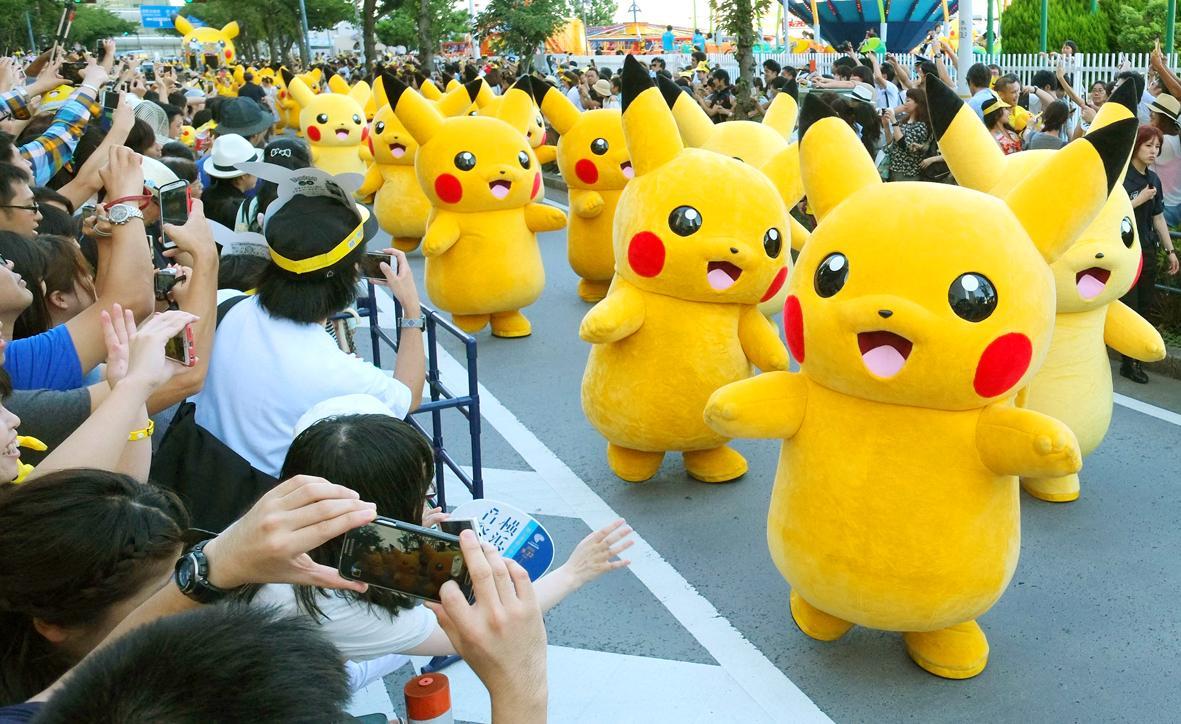
Photo: AFP
The article referenced recent controversies around the popular anime series Pokemon, Detective Conan and My Hero Academia, saying that “the evil influence of Japanese militarism lives on in sports and culture.”
Last month, a Pokemon card game event that was scheduled at the Yasukuni Shrine in Tokyo for Jan. 31 was canceled after Chinese backlash.
The shrine commemorates the 2.5 million Japanese soldiers who died in war, including 30,304 Taiwanese.
Countries that were targets of Japanese aggression, especially China and the Koreas, see visits to the shrine as a lack of remorse about Japan’s wartime past.
China condemned the Pokemon Co for holding an event at a shrine, with the People’s Daily saying that enterprises “must not make light of the heavy weight of history in the name of entertainment.”
The article also condemned table tennis player Tomokazu Harimoto for praying at the Togo Shrine, which is dedicated to Togo Heihachiro, an admiral in the First Sino-Japanese War who China sees as a pioneer of Japanese militarist expansionism.
It also referenced the Japanese boy band Rampage, whose choreography was previously criticized for resembling the Nazi salute.
The Japanese right wing is using mediums widely consumed by young people — such as sports, idols, anime and textbooks — to instill a fictional version of history that lays the groundwork for a revival of Japanese militarism, the article said.
Additional reporting by CNA and AP

‘CROSSING THE LINE’: China’s embassy in Seoul criticized US Forces Korea Commander General Xavier Brunson, asking if his ‘hostile’ remarks were authorized by Washington South Korea and the US are in talks over recent public remarks by the commander of US Forces Korea, Seoul’s presidential office said yesterday, after the comments drew sharp criticism from China. In a recent podcast interview, US Forces Korea Commander General Xavier Brunson described South Korea as “the dagger in the heart of Asia” from China’s east coast, prompting the Chinese embassy in Seoul to say that he had “truly crossed the line.” The interview came amid growing speculation that Washington might seek to expand the role of US Forces Korea in countering the growing regional influence of China, a key

SEEKING ORDER: Rodrigo Paz said that ‘anyone who wants to destroy the nation will have to deal with this president and the full force of the constitution’ Bolivian President Rodrigo Paz on Wednesday said that the nation was at a “breaking point” after nearly a month of protests that have caused shortages of food, fuel and medicine. Paz, who took office six months ago amid the worst economic crisis there in four decades, is battling a groundswell of fury over his policies. The political capital, La Paz, has been besieged by low-income workers and members of the indigenous majority calling for his resignation. “The country needs order and is reaching breaking point,” the 58-year-old said at a public event in La Paz, renewing his appeal for dialogue. On Tuesday, the Bolivian

Forecasters in Europe yesterday warned of exceptional heat as record temperatures driven by a “heat dome” push temperatures well above seasonal norms across the continent. The surge follows a record-breaking Monday, with France logging its hottest day in the month of May on record, its weather agency said, and the UK also posting unprecedented highs. A so-called “heat dome” of warm air from northern Africa trapped under a high-pressure system over western Europe is behind the high temperatures not usually seen until high summer. Restrictions on outdoor work were imposed in parts of Italy, beaches in southwest France filled earlier than usual and

SEARCH ONGOING: Officials said that the half-full paper mill tank spilled more than 1.9 million liters of ‘white liquor,’ a highly destructive chemical mixture Crews on Wednesday resumed a search for nine people presumed killed at a Washington state paper mill, where a chemical tank ruptured a day earlier in one of the deadliest US workplace incidents in years. The likely death toll rose to 11, including those missing, after another person who was injured died, authorities said. There was no hope of finding more survivors following Tuesday’s tank failure at Nippon Dynawave Packaging Co in Longview, which also injured another eight people, including a firefighter who was treated and released by a hospital, authorities said. If the 11 deaths are confirmed, it would be one of


 RSS
RSS