


Taiwan has made progress when it comes to reducing the prevalence of smoking. According to the 2020 Taiwan Tobacco Control Annual Report, just 11.5 percent of adults smoked on a daily basis in 2018, compared to 18.9 percent a decade earlier. And thanks to rules that prohibit smoking in workplaces, on public transportation and in most public places, secondhand smoking is less of a problem than it was.
Unfortunately, members of the smoking minority still inflict economic, environmental, and aesthetic costs on society by discarding cigarette butts where they shouldn’t. It’s hard to know how many of these litterbugs are simply too lazy to find an ashtray or a trashcan, and how many wrongly believe that cigarette butts will quickly biodegrade.
According to a 2019 paper by scientists at Spain’s University of Extremadura, butts represent 22 to 46 percent of visible trash throughout the world. They’re very often washed down to coastal areas, where they’re “consistently the most numerous element of litter collected” — that’s if they’re not eaten by birds or sea creatures, many of which die because their intestines are clogged.
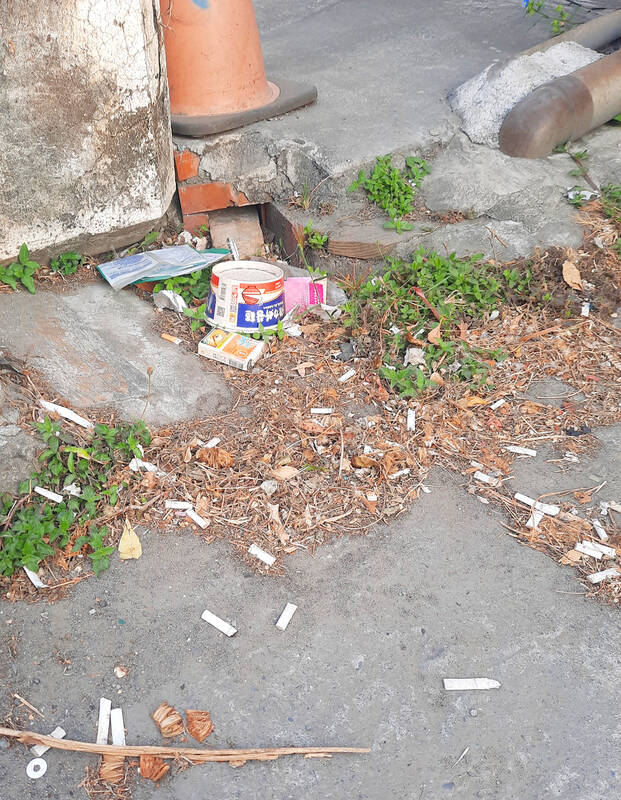
Photo: Steven Crook
Butts contain toxins such as iron, lead, manganese, strontium, aluminum, arsenic, copper, chromium, cadmium and nicotine, all of which may leach into the surrounding environment. Soaking cigarette stubs in water overnight makes an effective pesticide, so it’s not hard to see how they might harm ecosystems when thrown down drains and into waterways.
By far the greater part of each butt is fibrous cellulose acetate (CA). This is a kind of bioplastic, yet, as a pair of Sweden-based researchers point out in a 2021 paper, while its degradation “can be accelerated by additives or favorable degradation conditions … full degradation of CA-based materials or [cigarette butts] under ‘normal natural conditions’ has not been shown.”
ECO FILTERS?
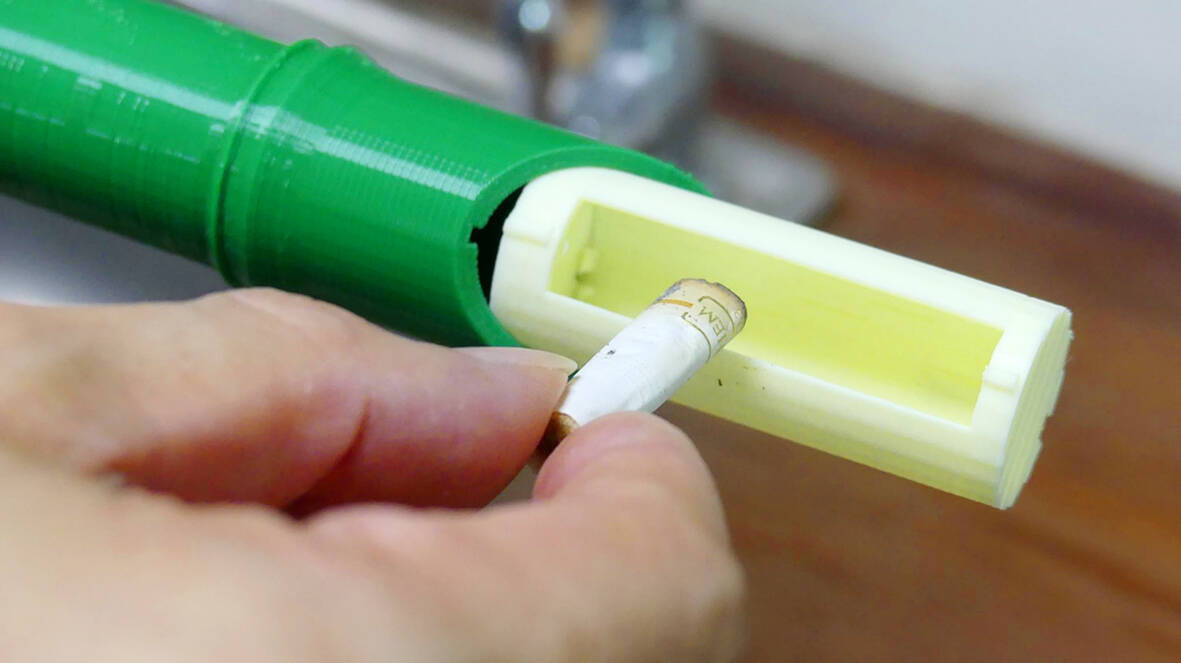
Photo: CNA
According to one estimate from Taiwan’s Environmental Protection Administration, local smokers improperly dispose of around 10 billion cigarette butts per year. In 2015, Taipei City Government Department of Environmental Protection disclosed that cigarette-butt littering accounted for more than half of the fines it had levied. And in 2020, of the 27,418 cases of littering handled by Kaohsiung City Government’s Environmental Protection Bureau, 51.3 percent concerned cigarette butts.
Replacing the CA in cigarette filters with biodegradable materials would ameliorate the problem of cigarette-stub pollution, and around the world several teams have tried to devise an eco-friendly filter. California-based Greenbutts has patented a filter made of abaca fiber, cotton flock and industrial hemp that’s held together with a starch-based binder. They claim it’s 100-percent biodegradable and non-toxic, yet “maintains the sensory experience that smokers expect.”
On the whole, however, cigarette companies have been unwilling to switch from CA to a greener alternative. One reason is cost. Another is that it’d require resetting complex sourcing and manufacturing processes.
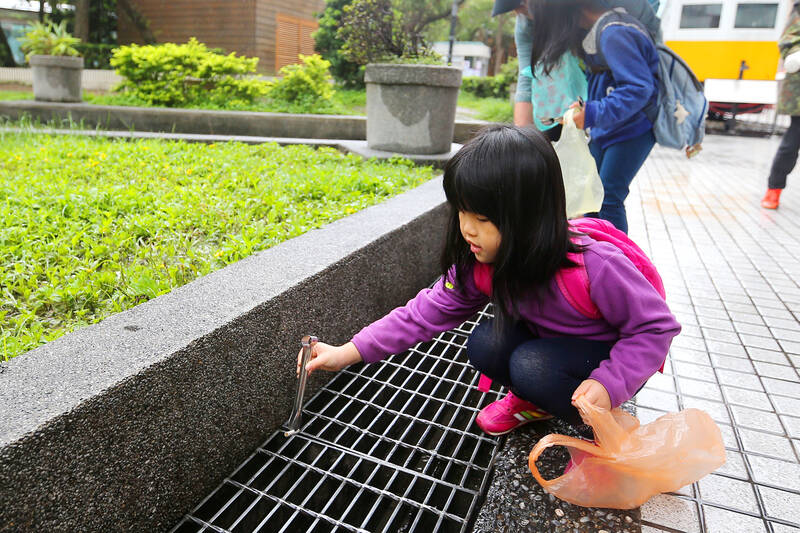
Photo: CNA
This is beginning to change, in part because new EU rules stipulate the phasing out of most CA filters by 2030.
In Taiwan, there’s been at least one push to make biodegradable filters mandatory. However, the 2020 proposal by lawmakers Tsai Pi-ru (蔡壁如) of the Taiwan People’s Party and Liu Chien-kuo (劉建國) of the Democratic Progressive Party came to nothing. Had it become law, from this year onward, the filter in every cigarette sold in Taiwan would be made entirely of materials that can decompose within six months.
POLICY CHANGES
As an executive at a major multinational cigarette manufacturer points out, suggestions by lawmakers who hope to reduce the problem of cigarette-butt pollution that ashtrays and trash cans be provided in places where people often smoke have also failed to gain traction.
The same executive — who advised the Taipei Times not to mention their company by name, in case anti-smoking campaigners accuse it of improperly promoting itself in contravention of the Tobacco Hazards Prevention Act — says most cigarette manufacturers do make an effort to educate smokers about the importance of properly disposing of butts. Their company organizes occasional clean-up events in Taiwan, but cannot publicize these activities lest it be accused of stealth advertising.
Jason Huang (黃之揚), co-founder of RE-THINK, a nonprofit organization that aims to protect Taiwan’s coastal and marine environments, expresses doubt that biodegradable filters would make much of a difference. If they’re to break down, such materials typically require certain temperature and humidity levels which may not exist in drains, oceans and other places often polluted by cigarette butts, Huang says. Before advocating for legislation on the issue, additional research is needed, he adds.
Since earlier this year, the authorities in Spain have been empowered to recover the cost of cleaning butts off streets and beaches from tobacco companies. The government of Catalonia has proposed a system under which cigarette ends could be redeemed for 0.20 euros (NT$6.5) each. If the entire cost of such a scheme was passed onto smokers, the price of cigarettes would go up by around 80 percent.
Asked if a similar reform should be implemented in Taiwan, Huang says: “As an environmental group, RE-THINK’s goal is not to reduce smoking, but to reduce the littering problem. However, given the seriousness and the scale of the littering problem, we do agree that either smokers or brands should bear more responsibility.”
The OECD calls the latter “extended producer responsibility” or EPR — a policy approach in which manufacturers’ responsibilities extend to the post-consumer stage of a product’s life cycle.
PROPER PENALITIES
Some citizens think that current penalties for littering, which range from NT$1,200 to NT$6,000, are too light.
On Dec. 8, 2020, the Taipei Times reported that a resident of Fongshan District (鳳山) in Kaohsiung had been fined a total of NT$26,400 (US$925) for throwing 22 cigarette butts out of his car over a two-hour period. In 2015, Singaporean authorities fined a man 19,800 Singapore dollars — at that time about NT$452,000 — for throwing more than 30 cigarette ends out of his apartment window. He also had to clean public areas for five hours while wearing a bright vest bearing the humiliating words “corrective work order,” Reuters reported.
Huang says that, when RE-THINK surveyed smokers in Taipei’s Ximending in 2019, gathering 563 valid responses, 93 percent said they knew they could be penalized for dropping butts, but the risk of being fined wasn’t effective in stopping them from littering. According to interviews conducted as part of the survey, the accessibility and convenience of smoking zones and cigarette disposal receptacles are the main factors which influence smokers’ behavior.
The biggest problem when it comes to combating cigarette-stub pollution isn’t the toughness of the law, Huang suggests, but reporting and verification mechanisms. If the litterer’s identity or the license-plate number of the car from which the butt was tossed can’t be confirmed, no penalty can be issued. “This sets the bar too high,” he says.
There are other options.
One is to outlaw cigarette filters altogether, a course of action backed by some health experts as well as environmentalists. According to nysmokefree.com, which is backed by New York State’s Department of Health, “Filtered cigarettes are no safer than non-filtered… Filters do not block all the bad chemicals in smoke, and filtered smoke feels milder on the throat, making it easier to take bigger and deeper puffs.”
The other is to follow New Zealand’s lead, and make it illegal for those who’ve not yet reached adulthood to purchase cigarettes in their lifetimes. If that’s too radical a step for Taiwan’s government, perhaps it might embrace another of New Zealand’s anti-smoking policies, and slash the number of retailers eligible to sell tobacco products.
Steven Crook, the author or co-author of four books about Taiwan, has been following environmental issues since he arrived in the country in 1991. He drives a hybrid and carries his own chopsticks. The views expressed here are his own.

Taiwan’s English education system is being pulled apart by three opposing forces. Bilingual Nation 2030 pulls students toward English and global communication. Artificial Intelligence (AI) readiness pulls them toward digital judgment, verification and AI-mediated work. But Taiwan’s old exam culture pulls them back toward memorization, grammar drills, timed reading and correct answers. If the education system keeps using old exams to define success, it risks producing graduates who are neither genuinely bilingual nor genuinely AI-ready, but trained for tasks machines can already perform. The first force is Bilingual Nation 2030. Launched in 2018, the policy aimed to “help Taiwan’s workforce connect

It seems every few days one bumps into one of those “real man” comments in which Taiwan is urged to “face reality” or similar, and “make a deal,” with the speaker implying that soon it will be too late. “Deal” advocates always present themselves as having a superior grip on reality, and the manly ability to make the “hard choice.” Their testosterone-laden language often echoes that of Taiwan sellout advocates. Note that such commentary always specifies a process (“make a deal, work with, make progress”), never the end state of what occupation by a violent authoritarian colonialist state will entail. In
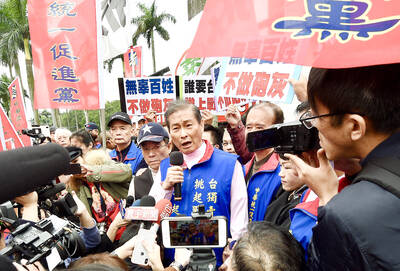
There are shadowy cabals plotting to sell out Taiwan to be annexed by China, by invasion if necessary. Fortunately, they are buffoons. In 2019, former Bamboo Union gangster and founder of the China Unification Promotion Party (CUPP), Chang An-le (張安樂, colorfully known as “White Wolf”), led a protest at the Legislative Yuan against comments made by then-premier Su Tseng-chang (蘇貞昌) that in the event of an attack by China, he would never surrender, but would protect the nation by fighting to the end, even if he only had a broom. Chang had party members bring a wooden casket that they
June 1 to June 7 "If all Taiwanese were as afraid of dying as you, then what would happen?” Physician Shih Chiang-nan (施江南) reportedly said this to his wife Chen Chiao-tung (陳焦桐) after she urged him to stop intervening on behalf of Taiwanese soldiers stranded overseas after serving in the Japanese Army during World War II. Shih had clashed with high-ranking officials over the issue, engaged in several heated arguments with Taiwan governor-general Chen Yi (陳儀) and allegedly shouted at general Ko Yuan-fen (柯遠芬), chief of staff of the Taiwan Garrison Command, over


 RSS
RSS