


From roasting temperatures to rocketing energy prices and millions of refugees fleeing Ukraine, 2022 was a year of extremes.
AFP looks back at some of the records smashed:
FOOD AND ENERGY PRICES

Photo: AP
Russia’s invasion of Ukraine in February caused a massive jump in energy and food costs, with the UN Food and Agriculture Organization’s Food Price Index hitting a historic peak in March and the cost of gas in Europe reaching record highs.
The eurozone annual inflation climbed steadily to 10.6 percent in October, the biggest increase since the index began in 1997. It then slowed in November for the first time in a year and a half.
REFUGEES
The war also triggered the biggest wave of refugees in Europe since the end of World War II. More than 7 million Ukrainians fled to other European countries and a further 6.9 million were displaced internally, according to the UN refugee agency UNHCR.
Globally, the number of displaced people exceeded 100 million for the first time.
BURNING UP
Europe sweated through its hottest summer on record, with records tumbling in many countries, including England where the mercury topped 40 degrees Celsius (104 degrees Fahrenheit) for the first time. Forest fires linked to the hotter, drier conditions also scorched more land than ever before in Europe — over 600,000 hectares.
HAIL OF MISSILES
North Korea fired a record number of missiles into the Sea of Japan in response to large-scale joint military exercises staged by South Korea and the United States.
A particularly intense peak saw 23 missiles fired in 24 hours on November 2.
FAREWELL QUEEN
After 70 years on the throne, Britain’s longest-serving monarch, Queen Elizabeth II, passed away on September 8, aged 96.
Before her massive state funeral, an estimated quarter of a million people queued round the clock to view the coffin as it lay in state.
MUSK MAYHEM
It was a big year for Elon Musk, although he ended it being knocked off his perch as the world’s richest man on Forbes’ billionaire list by French businessman Bernard Arnault of global luxury empire LVMH.
Musk, the CEO of Tesla and SpaceX added Twitter to his portfolio for $44 billion in October and swiftly caused controversy by firing half the staff and lifting bans of people who had been thrown off the platform, including Donald Trump.
In December Musk said he would resign as chief executive once he found a replacement, in apparent response to a poll he launched that suggested users wanted him to step down.
NEW ARTISTIC HEIGHTS
The art collection of Microsoft’s co-founder Paul Allen, which included works by Cezanne, Klimt and Van Gogh, was sold by Christie’s for $1.62 billion, the biggest amount ever for an art auction.
Marilyn Monroe was a big hitter too, with one of her photo portraits by Andy Warhol selling for $195 million, making it the most expensive 20th century artwork.
JET-SETTING SWIFT
The 10th album by the US megastar, “Midnights”, caused such a frenzy that Spotify broke down as more fans sought to listen to it over a single day than any other album.
Ten of its tracks were listed in the top ten Billboard Hot 100, also a first.
Less glorious for Swift was her topping the list for the “worst private jet CO2 emission offenders” among celebrities for her extensive private jet use.
In August when she was awarded the unenviable prize, she had already clocked up 170 flights in her private jet.
EIGHT BILLION HUMANS
In November the world’s population — which numbered 2.5 billion in 1950 — exceeded eight billion, according to the UN.
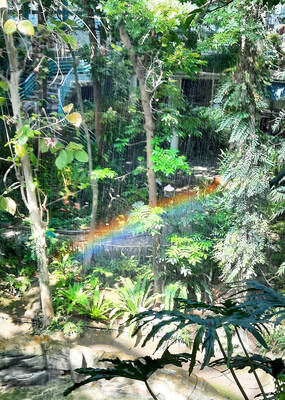
It’s only half the size of its more famous counterpart in Taipei, but the Botanical Garden of the National Museum of Nature Science (NMNS, 國立自然科學博物館植物園) is surely one of urban Taiwan’s most inviting green spaces. Covering 4.5 hectares immediately northeast of the government-run museum in Taichung’s North District (北區), the garden features more than 700 plant species, many of which are labeled in Chinese but not in English. Since its establishment in 1999, the site’s managers have done their best to replicate a number of native ecosystems, dividing the site into eight areas. The name of the Coral Atoll Zone might
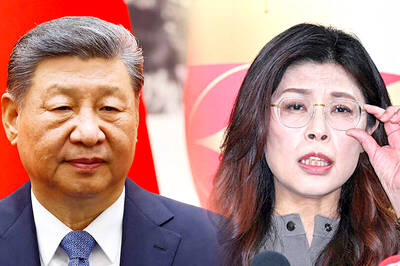
On Monday morning, in quick succession, the Chinese Communist Party (CCP) and the Chinese Nationalist Party (KMT) released statements announcing “that the Central Committee of the Communist Party of China and General Secretary Xi Jinping (習近平) have invited KMT Chairwoman Cheng Li-wun (鄭麗文) to lead a delegation on a visit to the mainland” as the KMT’s press release worded it. The KMT’s press release added “Chairwoman Cheng expressed her gratitude for the invitation and has gladly accepted it.” Beijing’s official Xinhua news release described Song Tao (宋濤), head of the Taiwan Work Office of the CCP Central Committee, as
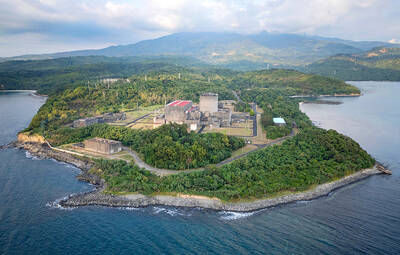
Nuclear power is getting a second look in Southeast Asia as countries prepare to meet surging energy demand as they vie for artificial intelligence-focused data centers. Several Southeast Asian nations are reviving mothballed nuclear plans and setting ambitious targets and nearly half of the region could, if they pursue those goals, have nuclear energy in the 2030s. Even countries without current plans have signaled their interest. Southeast Asia has never produced a single watt of nuclear energy, despite long-held atomic ambitions. But that may soon change as pressure mounts to reduce emissions that contribute to climate change, while meeting growing power needs. The
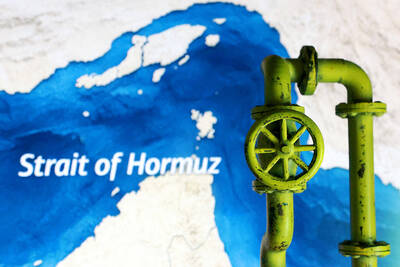
The US war on Iran has illuminated the deep interdependence of Asia on flows of oil and related items as raw materials that become the basis of modern human civilization. Australians and New Zealanders had a wake up call. The crisis also emphasizes how the Philippines is a swatch of islands linked by jet fuel. These revelations have deep implications for an invasion of Taiwan. Much of the commentary on the Taiwan scenario has looked at the disruptions to world trade, which will be in the trillions. However, the Iran war offers additional specific lessons for a Taiwan scenario. An insightful


 RSS
RSS