


Returning to Hukou Old Street (湖口老街) in Hsinchu County for the first time in a decade and a half, I searched my brain for recollections of the former movie theater — and came up with nothing.
Now a Hakka-themed restaurant called Hukou Style (湖口風情, 155 Hukou Old Street), it’s the tiniest standalone theater I’ve ever seen. The footprint of this building, which is less than 4m in height, isn’t much bigger than that of a typical townhouse.
The two little windows through which tickets were sold would be a strong clue as to its original function, even if they weren’t labeled for the benefit of tourists. Whoever worked the ticket booth wouldn’t have been able to stand up, as the projection equipment was directly above. Cross-shaped vents near the roof reduced the risk of the projector overheating.
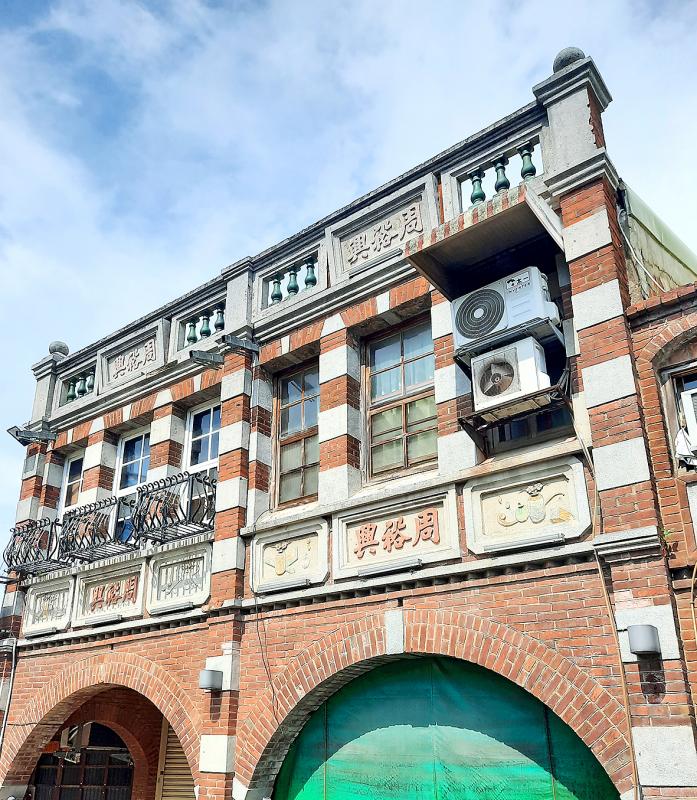
Photo: Steven Crook
The ex-theater is exceptional in another sense. Almost every other building on this narrow thoroughfare, between Sanyuan Temple (三元宮) to the east and a former Roman Catholic Church to the west — a distance of about 350m — is a century-old two-story shophouse.
Hukou Old Street owes its gorgeously traditional appearance to economic development, historical misfortune and government money.
The completion in 1908 of the north-south railroad, linking Taipei to Kaohsiung, brought prosperity to several towns in Taiwan’s western half. Hukou (湖口) was one of them.
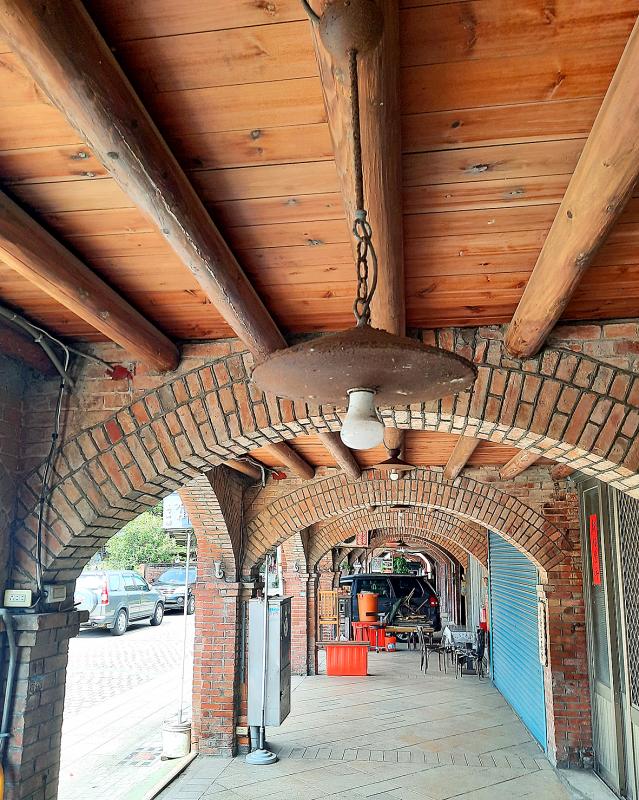
Photo: Steven Crook
There used to be a train station where the Catholic church now stands, and this neighborhood soon became a bustling center of commerce.
Merchants flocked to the area to set up shops. By 1920, every plot of land along what’s now the old street had been developed. Sanyuan Temple had also been founded, then soon torn down and rebuilt because (it’s said, but historical accounts aren’t clear) the fengshui of the original structure was undesirable.
The neighborhood prospered until 1929. That year, the Japanese colonial government decided part of the railroad had to be relocated closer to the Taiwan Strait, because the section between Yangmei (楊梅) and Hukou was on a slope that engineers regarded as prone to instability.
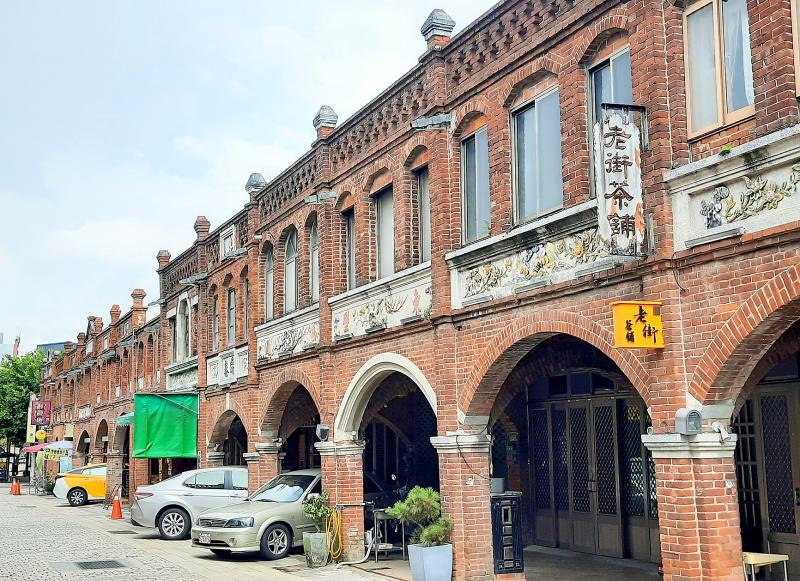
Photo: Steven Crook
With the station’s closure, what’s now called Old Hukou became a backwater. The area around Hukou’s new railway station (3.2km to the northwest) offered much better opportunities. The growth of traffic along Provincial Highway 1 (which is just north of the old street) and, much later, Freeway 1 (just to the south) did nothing to reverse this trend.
QUAINT OLD STREET
In 1999, a repair-and-restoration project funded by the local and central governments was launched. Some 107 households had rotten timbers replaced with new beams and cracked archways reconstructed. Power lines were placed below street level; exteriors were cleaned and decorations touched up; and arcade flooring was redone to achieve consistency.
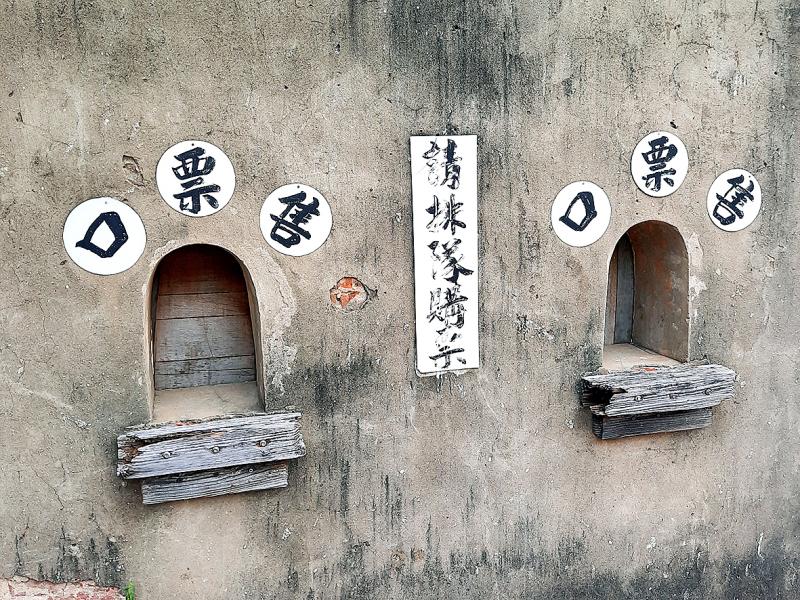
Photo: Steven Crook
Facets of modernity, such as air-conditioning units and stainless-steel doors, are still visible, however.
Red-brick walls are standard. Where concrete was used, it’s usually for a feature (such as a parapet or a relief panel) rather than a load-bearing element. A single arch on the first floor is standard, as are three arched or rectangular windows on the second floor.
The street has a pleasing uniformity. At the same time, differences in detail justify looking closely at every abode. And unlike the touristy old streets in Taoyuan’s Daxi District (大溪) and Changhua County’s Lukang Township (鹿港), perhaps three quarters of the houses along Hukou Old Street are purely residential properties.
Several parapets bear family names, among them Liu (劉), Luo (羅) and Wang (汪). The names of old firms are prominent, as are colored relief decorations.
Number 230 has a pair of elephants. The front of number 213 bears a trio of statuettes that resemble the three Taoist immortals (who represent good fortune, wealth and longevity) found atop countless temples. Other houses display bird, fish, insect or flower motifs.
Getting a nice photo of the arcade isn’t easy, I discovered. It being a weekday, many residents had parked their cars right before their front doors. On weekends, a vendor told me, neither locals nor outsiders are allowed to bring cars into the old street.
Between Sanyuan Temple and Provincial Highway 1, several old houses have just one floor. Number 249 bears fire damage. Patches of plaster have fallen from number 251, revealing mudbricks and rice-husk daub; these materials were often used in prewar construction because they were cheap. Number 275 is one of the few to still have traditional red-brown roof tiles, rather than the modern thicker dark-gray tiles or corrugated metal sheeting.
ARTS, ANTIQUES AND CRAFTS
Walking back toward the church, I was impressed by the number of arts, antiques and crafts stores. Old Hukou may not have a signature food like Daxi’s tofu, but it may yet become an artistic hub of some significance.
Many of the shops and galleries were closed, but through a window I saw a glass artist at work.
Guoyang Glass Art Studio (國揚琉璃藝術坊) at number 190 sells objects as small as a thimble and as large as a laptop. The majority, I was told, were crafted by Irene Chiu (邱小睿), who at that very moment was creating yet more objet d’art.
Chiu’s colleague introduced one of the studio’s signature products: A fountain pen made of colored glass and shaped like bamboo. It comes accompanied by an ornate rest decorated with white tung blossoms rendered in glass. The tung flower is a symbol of the Hakka people who dominate much of Hsinchu and Miaoli.
Despite my atrocious track record when it comes to preserving fragile objects, I was sorely tempted to buy one of these pens. Whether they appeal to you or not, if you’re the type of person who wants to know what urban Taiwan looked like before everything turned to concrete, you may well agree that Hukou Old Street is a place to write home about.
Steven Crook has been writing about travel, culture and business in Taiwan since 1996. He is the author of Taiwan: The Bradt Travel Guide and co-author of A Culinary History of Taipei: Beyond Pork and Ponlai.


 RSS
RSS