


Released 50 years ago this week, The Godfather broke all box office records, won best picture at the Oscars and introduced millions of fans to a world of mafia bosses, murder-for-hire and cannoli.
But when director Francis Ford Coppola — then “about 29 years old” — was offered the job of adapting Mario Puzo’s best-selling mob novel, he says he very nearly refused.
“I was greatly disappointed when I first started to read... it was really a potboiler that Mario Puzo had written to get some money (for) his kids,” Coppola told a 50th anniversary screening event at the Academy Museum of Motion Pictures in Los Angeles late Monday.
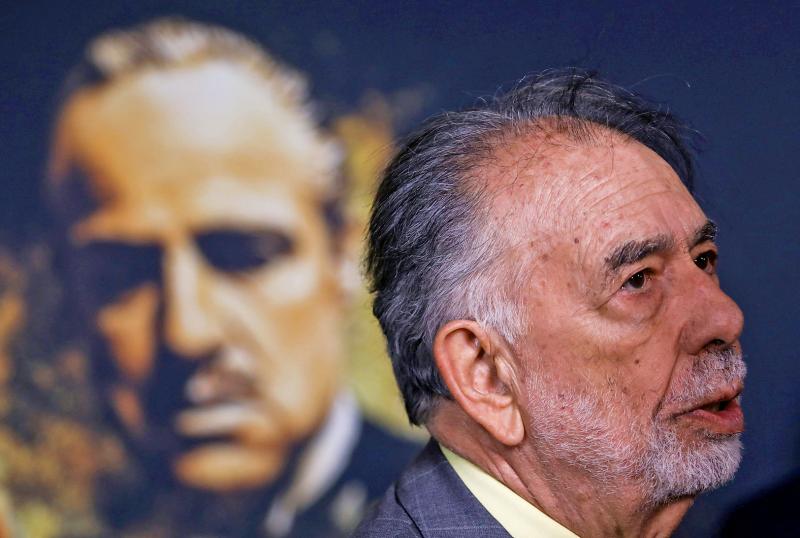
Photo: REUTERS
“When they did offer me the opportunity of doing it — mainly because everyone else had turned it down — I turned it down also.”
Fortunately, a young associate by the name of George Lucas insisted that Coppola take the job, as their fledgling, counter-cultural film studio American Zoetrope was heavily in debt.
“’Francis, we need the money! The tax authority is going to chain the front door... You’ve got to take a job like this,’” Coppola recalled the future Star Wars creator saying.
The rest, as they say, is history.
The Godfather — released on March 24, 1972, in an unusually large number of theaters from day one — was by September the highest grossing film of all time, supplanting Gone with the Wind.
In doing so, it helped usher in the blockbuster era, which truly took flight when Steven Spielberg’s Jaws took over the box office record three years later.
According to Peter Biskind’s book Easy Riders, Raging Bulls, Coppola won a bet that Paramount would buy him a stretch limo if the film grossed US$50 million. It grossed more than US$130 million.
Coppola became the first superstar director, with the financial clout to back up his artistic credentials.
“It was the beginning of a new era for directors,” wrote Biskind.
‘NOT HAPPY’
But in many ways, The Godfather was an unlikely hit.
By 1972, gangster films had fallen out of fashion. Paramount had released The Brotherhood starring Kirk Douglas four years earlier, and it had bombed.
But Mario Puzo’s mafia novel was soaring in popularity, and the same studio held the rights.
Still, Paramount had trouble finding a director — Hollywood’s reigning auteurs like Elia Kazan, Costa-Gavras and Peter Bogdanovich turned it down.
Though he was a leader in the New Hollywood movement of hot-shot, anti-establishment young directors, Coppola did not have a major hit to his name, and was approached in part due to his Italian ancestry.
“If it got a lot of pushback from offended Italian Americans who felt that it was casting aspersions on Italians, I would get the heat, you know?” said Coppola.
While Paramount wanted a quick, cheap adaptation, Coppola fought for a bigger budget, insisting the film be shot in New York, in its original 1940s setting rather than the present day.
“The budget was about US$2 million, US$2.5 million. And by my wanting to make it in New York and make it in period 1945, it meant that probably that was going to at least get doubled,” recalled Coppola.
“Which they were not happy about at all.”
‘UNIQUE’
Paramount production chief Robert Evans, a major Tinseltown player who had bought the film rights, battled with Coppola over casting.
The only star name attached — Marlon Brando — was washed up, while Al Pacino was a relative unknown, and not the “tall, handsome guy” Evans wanted.
“Al is very handsome, but in his own unique way,” joked Coppola.
He added: “All the women just liked him a lot. Al Pacino was very attractive to girls. I was wondering why exactly. But this has always been the case.”
“Nonetheless, when I suggested Al Pacino for the part, people at Paramount really started to wonder if they had chosen the wrong person.”
As it turned out, The Godfather won best picture, Brando won best actor, and Coppola and Puzo shared the Oscar for best adapted screenplay.
Pacino was one of three stars in the movie nominated for best supporting actor, along with James Caan and Robert Duvall. The film had 11 nominations overall.
In a sign of its enduring legacy, Coppola was honored with a star on Hollywood’s Walk of Fame this week in the run-up to Sunday’s Oscars, and the Academy Museum announced a new gallery devoted to the film.
“The Godfather was so much more successful than anyone thought it was going to be,” said Coppola.
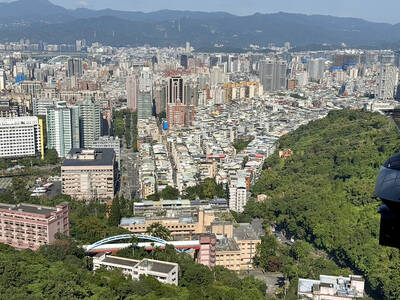
A recent report from the Environmental Management Administration of the Ministry of Environment highlights a perennial problem: illegal dumping of construction waste. In Taoyuan’s Yangmei District (楊梅) and Hsinchu’s Longtan District (龍潭) criminals leased 10,000 square meters of farmland, saying they were going to engage in horticulture. They then accepted between 40,000 and 50,000 cubic meters of construction waste from sites in northern Taiwan, charging less than the going rate for disposal, and dumped the waste concrete, tile, metal and glass onto the leased land. Taoyuan District prosecutors charged 33 individuals from seven companies with numerous violations of the law. This

What is the importance within the Chinese Nationalist Party (KMT) of the meeting between Xi Jinping (習近平), the leader Chinese Communist Party (CCP), and Cheng Li-wun (鄭麗文), the leader of the KMT? Local media is an excellent guide to determine how important — or unimportant — a news event is to the public. Taiwan has a vast online media ecosystem, and if a news item is gaining traction among readers, editors shift resources in near real time to boost coverage to meet the demand and drive up traffic. Cheng’s China trip is among the top headlines, but by no means

As mega K-pop group BTS returns to the stage after a hiatus of more than three years, one major market is conspicuously missing from its 12-month world tour: China. The omission of one of the group’s biggest fan bases comes as no surprise. In fact, just the opposite would have been huge news. China has blocked most South Korean entertainment since 2016 under an unofficial ban that also restricts movies and the country’s popular TV dramas. For some Chinese, that means flying to Seoul to see their favorite groups perform — as many were expected to do for three shows opening
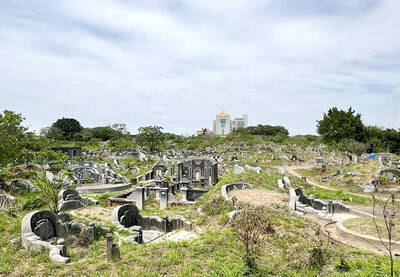
Apr. 13 to Apr. 19 From 17th-century royalty and Presbyterian missionaries to White Terror victims, cultural figures and industrialists, Nanshan Public Cemetery (南山公墓) sprawls across 95 hectares, guarding four centuries of Taiwan’s history. Current estimates show more than 60,000 graves, the earliest dating to 1642. Besides individual tombs, there are also hundreds of family plots, one of which is said to contain around 1,000 remains. As the cemetery occupies valuable land in the heart of Tainan, the government in 2018 began asking families to relocate the graves to make way for development. That


 RSS
RSS