


A handful of Myanmar nurses hiding from the junta have been running makeshift clinics to treat COVID-19 patients and resistance fighters with medicine smuggled past military checkpoints.
With bags packed, they are always ready to flee as healthcare workers find themselves at the forefront of a civil disobedience movement against the February coup and a crackdown on dissent that has killed more than 1,300, according to a local monitoring group.
A boycott of government institutions has left many hospitals without staff and the junta has arrested and killed scores of protesting health workers, rights groups say.
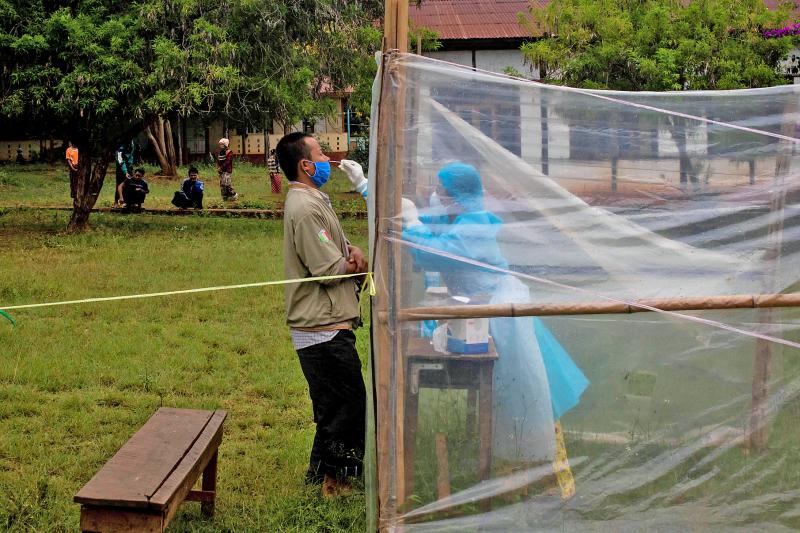
Photo: AFP
Aye Naing — not her real name — left her job in a public hospital soon after the coup and in June began volunteering in Kayah state in Myanmar’s east, where the military and anti-coup fighters have clashed repeatedly.
“When the fighting starts, we have to run and hide in the jungle,” she said at a clinic housed at a school abandoned because of fighting near the town of Demoso.
After a devastating COVID-19 wave in June and July — where new daily cases peaked at 40,000 — the junta has said new infections are down to around 150 per day, and that the Omicron variant is yet to appear in Myanmar.
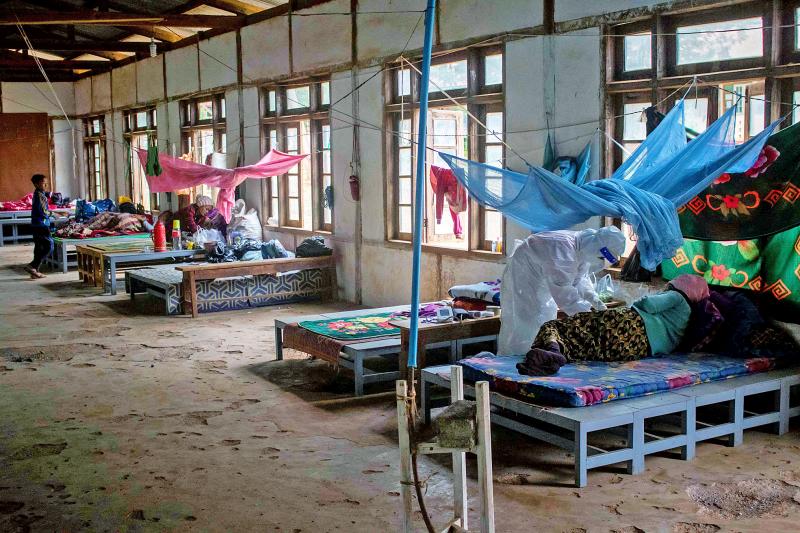
Photo: AFP
But with the struggling health system in shambles, limited testing is being done.
In Kayah around 85,000 people have been displaced by the violence, according to the UN’s refugee agency, with many crowded into camps where infections spread easily.
Most of Aye Naing’s patients are displaced families, she said, as well as fighters from local People’s Defense Force (PDF) groups — militias that have sprung up across the country to fight the junta.
“I was told there weren’t many doctors and medical workers in this area, and that villagers were asking for them,” she said. “So, I made the decision to come, and tried to get hold of some medical supplies.”
At one village, her team conducts swab tests through a small tear in a sheet of plastic stretched over a bamboo frame. Those who test positive are prescribed paracetamol or vitamins, the only medicine on offer. Donated oxygen must be used sparingly: refilling canisters involves a trip to the closest large town, passing junta checkpoints along the way.
After each shift, Aye Naing removes her plastic protective suit and disinfects it, along with her mask, ready for the next one.
In an empty classroom, an infected PDF fighter sits out his quarantine strumming a guitar.
In areas where resistance to its rule is strong, the military has blocked the delivery of humanitarian aid and medical supplies, according to a recent Human Rights Watch report.
“Burmese military check everyone at their gates and arrest people they find carrying medicines,” said Hla Aung, another nurse working at the clinic whose name has been changed to protect her identity.
“It’s like we are risking our lives.” In the six months following the coup, 190 health workers were arrested and 25 killed, according to a report by Insecurity Insight, Physicians for Human Rights, and Johns Hopkins University.
But Aye Naing said she will keep going.
“My parents’ support keeps me strong,” she said. “My father has sent as much medicine as he can.”

Taiwan’s English education system is being pulled apart by three opposing forces. Bilingual Nation 2030 pulls students toward English and global communication. Artificial Intelligence (AI) readiness pulls them toward digital judgment, verification and AI-mediated work. But Taiwan’s old exam culture pulls them back toward memorization, grammar drills, timed reading and correct answers. If the education system keeps using old exams to define success, it risks producing graduates who are neither genuinely bilingual nor genuinely AI-ready, but trained for tasks machines can already perform. The first force is Bilingual Nation 2030. Launched in 2018, the policy aimed to “help Taiwan’s workforce connect
It seems every few days one bumps into one of those “real man” comments in which Taiwan is urged to “face reality” or similar, and “make a deal,” with the speaker implying that soon it will be too late. “Deal” advocates always present themselves as having a superior grip on reality, and the manly ability to make the “hard choice.” Their testosterone-laden language often echoes that of Taiwan sellout advocates. Note that such commentary always specifies a process (“make a deal, work with, make progress”), never the end state of what occupation by a violent authoritarian colonialist state will entail. In
June 1 to June 7 "If all Taiwanese were as afraid of dying as you, then what would happen?” Physician Shih Chiang-nan (施江南) reportedly said this to his wife Chen Chiao-tung (陳焦桐) after she urged him to stop intervening on behalf of Taiwanese soldiers stranded overseas after serving in the Japanese Army during World War II. Shih had clashed with high-ranking officials over the issue, engaged in several heated arguments with Taiwan governor-general Chen Yi (陳儀) and allegedly shouted at general Ko Yuan-fen (柯遠芬), chief of staff of the Taiwan Garrison Command, over

“Taiwan’s Opposition Leader Comes to US With a Message Straight Out of Beijing” read a May 31 headline in the Wall Street Journal. Top US administration officials and members of Congress almost certainly read the WSJ, and if there was a bullet point takeaway that people in Washington should absorb ahead of Chinese Nationalist Party (KMT) Chair Cheng Li-wun’s (鄭麗文) arrival in DC on June 9, that headline is it. The last few columns have discussed this very topic, and the timing is not coincidental. While those top officials likely do not read the Taipei Times, judging by the number


 RSS
RSS