


Two women meet in a maternity ward and their lives become inextricably linked in Pedro Almodovar’s gentle but penetrating Parallel Mothers.
It’s a film that on one level plays like a melodrama, with wild twists and turns fitting of soap opera cliffhangers. But there is something deeper going on too, underneath the beautiful surface and base pleasures of plot and simply watching Penelope Cruz through Almodovar’s loving lens. Parallel Mothers, at its core, is about Spain and the lingering traumas of the Spanish Civil War, which robbed a generation of fathers, husbands and sons.
This loss haunts Cruz’s Janis, an accomplished magazine photographer, who takes it upon herself to ask the forensic anthropologist she’s photographing if he’d consider excavating the site where her great-grandfather and his peers were executed and dumped under Francisco Franco’s regime. They know who is in the grave and where it is and for decades have passed the story down hoping that at some point their ancestors will be given proper burials.

Photo: AP
Then we don’t hear anything about this project for quite some time. It might seem at first that Almodovar is abandoning this excavation plot rather quickly. The anthropologist, Arturo (Israel Elejalde), is very handsome, Janis begins an affair and next thing you know she’s about to give birth, alone. But Almodovar is just patiently building layers of life that he will eventually bring back around to this original loss.
Though Arturo is not in there to see the delivery of their child, Janis does have a roommate, a teenager, Ana (the fierce newcomer Milena Smit), who is also about to give birth without a partner. Janis wants a child. Ana does not. Soon they find themselves smitten with their daughters and start to negotiate life with a tiny, helpless attachment. Though they’re both single mothers, they are privileged ones. Ana’s family is wealthy and Janis can afford a maid and live-in nanny. Even if it’s all a little romanticized, Almodovar gives it room to breathe and it’s lifelike enough.
But of course things start to get complicated. Arturo doubts the child is his and Janis soon finds it’s not even hers. You can probably partially guess where this is going, but Parallel Mothers has more than a few surprises up its brightly colored sleeves. The dramatic turns are almost beside the point, since throughout Almodovar is also quietly planting a garden of family histories, nontraditional parenting arrangements, complicated mothers and absent fathers and many, many losses. It’s these details that build the film’s rich foundation. Aitana Sanchez-Gijon, as Ana’s actor mother, is a particular standout and would fit right in with the complex mothers of another of the year’s standouts, The Lost Daughter. And it’s a gorgeous showcase for Cruz. Hopefully she and Almodovar have more than a few more films in them.
Parallel Mothers might not be as transcendently cinematic as his last, Pain & Glory, and perhaps part of that has to do with the fact that it was filmed during a pandemic, but its emotional core is no less powerful even if it’s a little more subtle. This one takes a beat to sink in, but it’s worth it.
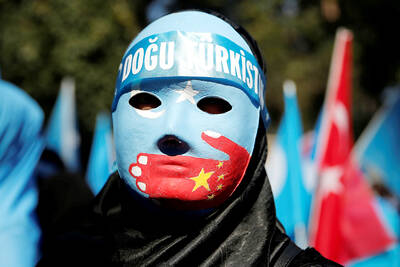
It seems every few days one bumps into one of those “real man” comments in which Taiwan is urged to “face reality” or similar, and “make a deal,” with the speaker implying that soon it will be too late. “Deal” advocates always present themselves as having a superior grip on reality, and the manly ability to make the “hard choice.” Their testosterone-laden language often echoes that of Taiwan sellout advocates. Note that such commentary always specifies a process (“make a deal, work with, make progress”), never the end state of what occupation by a violent authoritarian colonialist state will entail. In

There are shadowy cabals plotting to sell out Taiwan to be annexed by China, by invasion if necessary. Fortunately, they are buffoons. In 2019, former Bamboo Union gangster and founder of the China Unification Promotion Party (CUPP), Chang An-le (張安樂, colorfully known as “White Wolf”), led a protest at the Legislative Yuan against comments made by then-premier Su Tseng-chang (蘇貞昌) that in the event of an attack by China, he would never surrender, but would protect the nation by fighting to the end, even if he only had a broom. Chang had party members bring a wooden casket that they
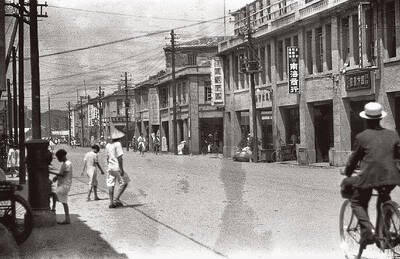
June 1 to June 7 "If all Taiwanese were as afraid of dying as you, then what would happen?” Physician Shih Chiang-nan (施江南) reportedly said this to his wife Chen Chiao-tung (陳焦桐) after she urged him to stop intervening on behalf of Taiwanese soldiers stranded overseas after serving in the Japanese Army during World War II. Shih had clashed with high-ranking officials over the issue, engaged in several heated arguments with Taiwan governor-general Chen Yi (陳儀) and allegedly shouted at general Ko Yuan-fen (柯遠芬), chief of staff of the Taiwan Garrison Command, over

Food prices have often played a major role in Taiwan’s history. The first major wave of migration from China occurred in 1628. A moderate drought, the Ming Dynasty maritime ban that prohibited fishing and trading (intended to reduce piracy) and a temporary tax, conspired to exhaust local resources, leading to famine in Fujian Province. The famed pirate and trader Zheng Zhilong (鄭芝龍), scooped up starving people from Fujian and transported them across the Taiwan Strait, where they settled under the Dutch. Two factors enabled Zheng. First, by 1624 he had settlements around today’s Beigang (北港) in Yunlin County with a small


 RSS
RSS