


There was a chance of rain in the afternoon, and the near-certainty of roasting sunshine. I wanted to get up on the ridge that separates Nantou County from Changhua County as early as possible, but the bus schedule didn’t give me a lot of options.
In each direction, just nine #6928 services connect Nantou City with Songboling (松柏嶺) per day. Six of them terminate at the village of Chihshuei (赤水). Only three of them go all the way to Tianjhong (田中), the nearest railway station.
TANAKA OR TIANJHONG
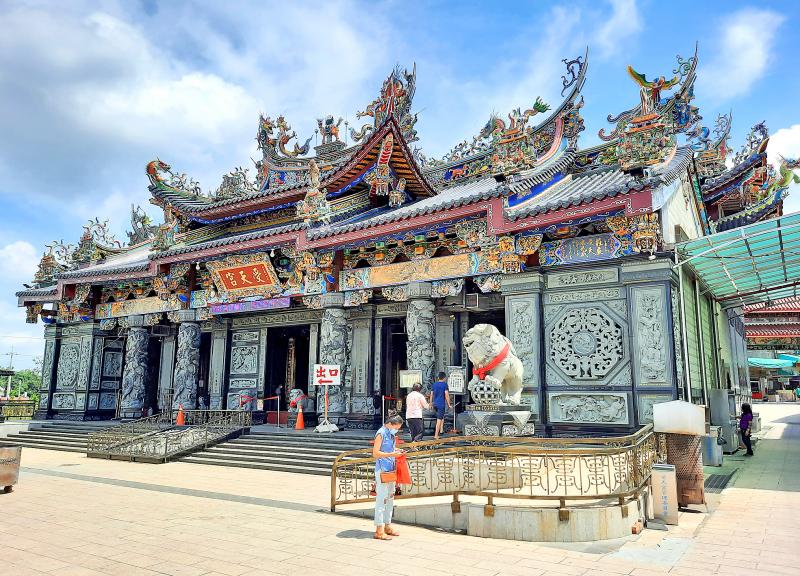
Photo: Steven Crook
Arriving at Tianjhong on a northbound express, I had time before the 9am bus to get breakfast, and to wonder why the most obvious sign at the bus stop read “Tanaka Train Station.”
Tanaka is the Japanese pronunciation of Tianjhong. What were the authorities thinking when they decided to use that version here? Isn’t there a risk that a foreign traveler might roll up, see it and conclude he was at the wrong bus stop?
If the intention was to help Japanese tourists, it was likely a wasted effort. They’d notice and understand the Chinese characters before paying attention to anything in Latin script.
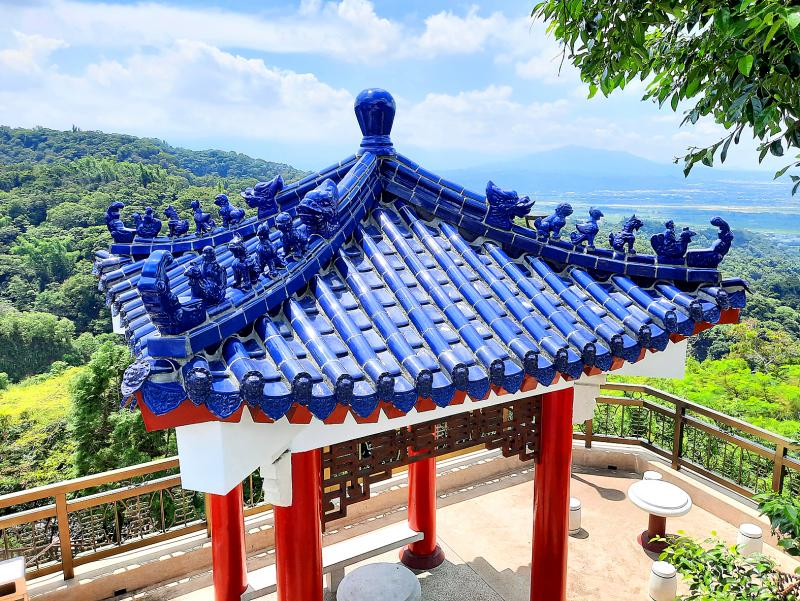
Photo: Steven Crook
Maybe wires got crossed. The order went out for a bilingual sign. This is what came back, and nobody bothered to check it before installation.
Despite being there well ahead of time, I still had to run for the bus. I wasn’t sure if it’d approach from the north or the south, and thanks to Murphy’s Law I was on the wrong side of the road. If you’re thinking of catching this bus, be ready on the western side of Singgong Road (興工路), the side farthest from the railway station.
The ride itself was a pleasure. In no time at all we were outside the town, heading uphill, and passing Tianjhong Forest Park (田中森林公園). The park is popular with hikers, but I’ve yet to have a proper look around it.
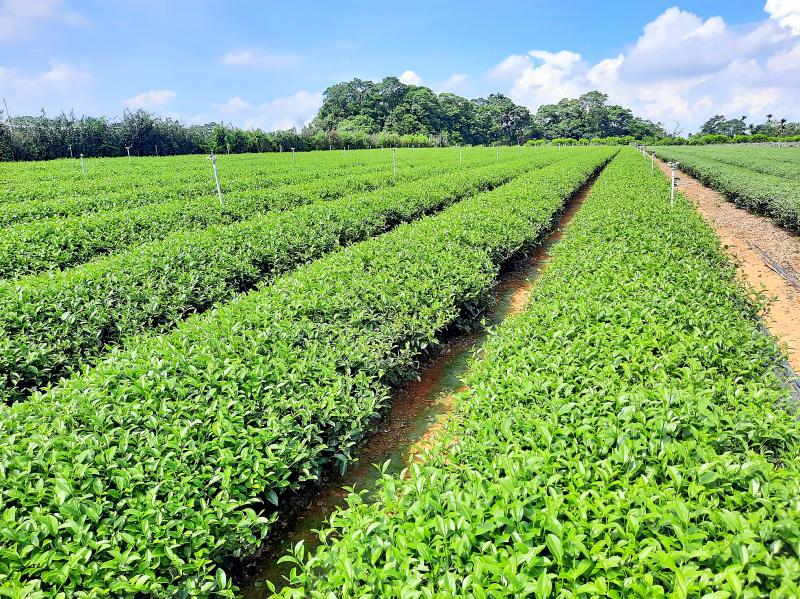
Photo: Steven Crook
The bus turned south onto Road 139B (139乙). This area is well known for its light oolong teas, but I was surprised how many fields were given over to pineapple cultivation. I don’t remember ever before seeing tea (which shrivels at sea level at this latitude) and pineapples (which dislike the coolness of the foothills) growing side by side.
Between Gongsie Elementary School (弓鞋國小) and Songboling Visitor Center
(松柏嶺遊客中心), there are several little shops and eateries — and, of course, places where you can buy local tea.
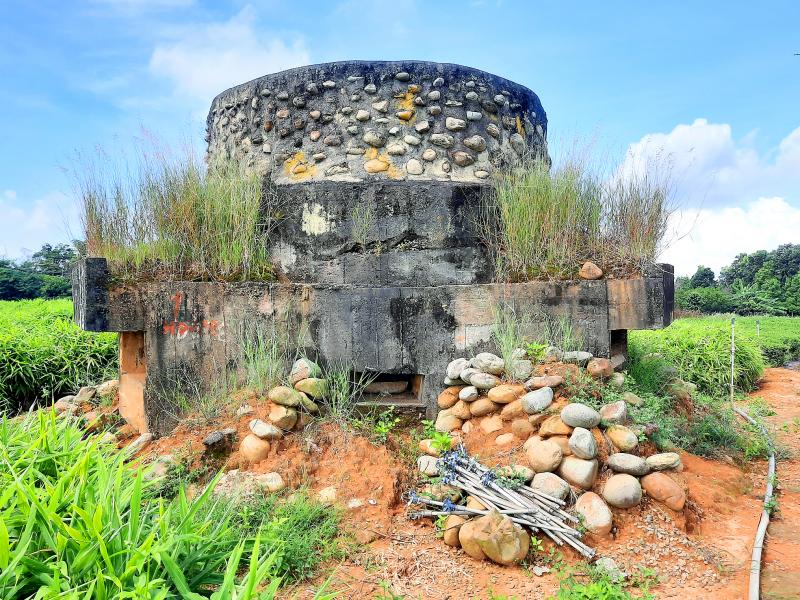
Photo: Steven Crook
Twenty-five minutes after boarding the bus, I walked up to the visitor center, only to find that it’s currently closed for renovations.
Cisingjhendi Park (七星陣地公園) — marked on some information boards as Seven Stars Battlefield Park or Blockhouse — is a few hundred meters south of the visitor center, just outside the cluster of houses and businesses.
It’s not a park in the conventional sense, but a collection of military relics scattered among the tea fields. These bunkers and gun emplacements were built in the 1960s in case the Chinese landed on the coast and tried to fight their way up either side of the Jhuoshuei River (濁水溪), which is less than 2km away.
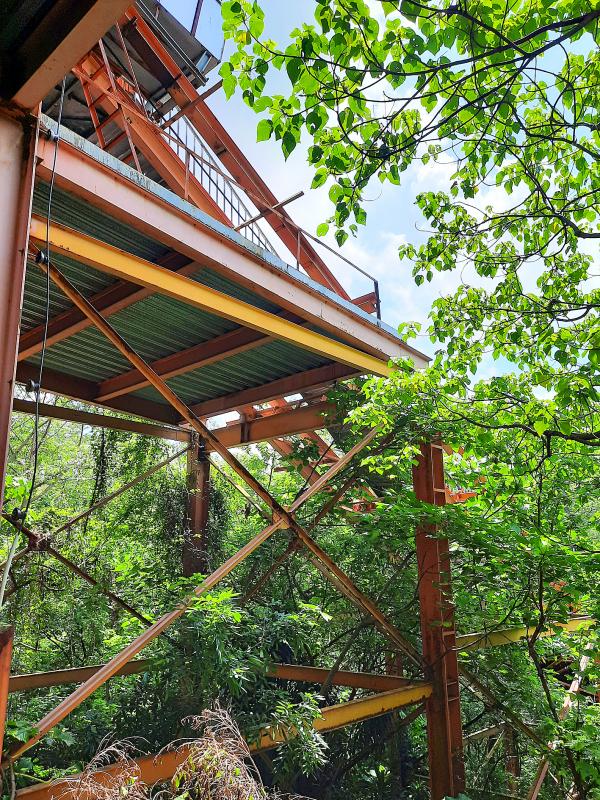
Photo: Steven Crook
Neither the fortifications nor decommissioned equipment are that special, but the park is worth a 20-minute detour before moving on to the area’s no. 1 attraction, Shoutian Temple (受天宮).
SHOUTIAN TEMPLE
This place of worship is said to have been founded in 1681 to worship the Emperor of the Mysterious Heaven (玄天上帝, Xuantian Shangdi). The current structure was completed in 1973, and renovated after a serious fire in 2000.
As temples go, it’s neither exceptionally large nor unusual in terms of decor. It does, however, have an unbeatable location. From its grounds, which are approximately 385m above sea level, the views to the south and the west are superb.
The little town of Ershuei (二水) lies at the bottom of the ridge, but the most direct trails between it and Shoutian Temple aren’t recommended. Cianmiaokeng Forest Trail (廟前坑森林步道) has been abandoned, and Dengmiao Trail (登廟步道, “Climbing to the temple path”) has been damaged by landslides.
Stairs lead from the temple down to a children’s play area, a butterfly-appreciation zone and a couple of pavilions. I followed what I assumed to be Dengmiao Trail for a short distance, until it became unsafe to go any further.
Instead of climbing back up to the temple, I followed a service road just below the ridge. Halfway along it, I came across a strange four-story-high steel frame built over the road.
I’d noticed this structure earlier, when walking to Shoutian Temple on the main road. From there, it looked like a simple platform. I guessed it’d been built so people could eat meals or drink tea while enjoying the scenery. It didn’t appear to have been used for quite some time. It was fenced off and the gate was chained up.
From the service road, another feature was visible. A stairway from the top of the platform descends past the road and into the forest below. I was so curious about it that, right then and there, I used my smartphone to call up a satellite image of the hillside.
The stairway is clearly visible. It doesn’t end at a road, however. Mysteriously, it seems to go into a building, or what could be a hole in the ground. From the way it appears on satellite photos, I’d guess it to be something like a debris chute.
I’ve not found any information online about this oddity. All I can say is that a lot of girders were used to assemble it.
THE LI CLAN HOUSE
I was determined to get a hike in, so I walked to Fengbai Road (豐柏路). But before reaching the eastern end of Kengneikeng Forest Trail (坑內坑森林步道) — which is across the road from the house numbered 123 — I poked my head inside what I thought was an ancestral shrine.
The Li Clan House (李氏家園) isn’t just a memorial to long-gone forefathers, however. It also celebrates the clan’s links with the tea industry. If you’ve a serious interest in tea culture, consider calling them (0932-581-954) to ask if they’ll show you around.
For those coming from Songboling, Kengneikeng Forest Trail consists of 260m of steep but well-maintained pathway, followed by 1.7km of narrow road. There’s lots of shade, countless butterflies, and (on summer weekdays, at least) hardly any people.
Getting to the other end of the trail — a compact cluster of traditional houses called Kengnei (坑內) — merely meant I’d reached the halfway point of my tramp.
Knowing Ershuei’s railway station was still 2km away, I mopped my brow, donned my hat and dug a mask out of my pocket. Towns mean gritty air, higher temperatures and harder surfaces. But they also mean convenience stores. The idea of iced coffee was enough to propel me through the streets.
Steven Crook has been writing about travel, culture and business in Taiwan since 1996. He is the author of Taiwan: The Bradt Travel Guide and co-author of A Culinary History of Taipei: Beyond Pork and Ponlai.

Taiwan’s English education system is being pulled apart by three opposing forces. Bilingual Nation 2030 pulls students toward English and global communication. Artificial Intelligence (AI) readiness pulls them toward digital judgment, verification and AI-mediated work. But Taiwan’s old exam culture pulls them back toward memorization, grammar drills, timed reading and correct answers. If the education system keeps using old exams to define success, it risks producing graduates who are neither genuinely bilingual nor genuinely AI-ready, but trained for tasks machines can already perform. The first force is Bilingual Nation 2030. Launched in 2018, the policy aimed to “help Taiwan’s workforce connect

It seems every few days one bumps into one of those “real man” comments in which Taiwan is urged to “face reality” or similar, and “make a deal,” with the speaker implying that soon it will be too late. “Deal” advocates always present themselves as having a superior grip on reality, and the manly ability to make the “hard choice.” Their testosterone-laden language often echoes that of Taiwan sellout advocates. Note that such commentary always specifies a process (“make a deal, work with, make progress”), never the end state of what occupation by a violent authoritarian colonialist state will entail. In
June 1 to June 7 "If all Taiwanese were as afraid of dying as you, then what would happen?” Physician Shih Chiang-nan (施江南) reportedly said this to his wife Chen Chiao-tung (陳焦桐) after she urged him to stop intervening on behalf of Taiwanese soldiers stranded overseas after serving in the Japanese Army during World War II. Shih had clashed with high-ranking officials over the issue, engaged in several heated arguments with Taiwan governor-general Chen Yi (陳儀) and allegedly shouted at general Ko Yuan-fen (柯遠芬), chief of staff of the Taiwan Garrison Command, over

“Taiwan’s Opposition Leader Comes to US With a Message Straight Out of Beijing” read a May 31 headline in the Wall Street Journal. Top US administration officials and members of Congress almost certainly read the WSJ, and if there was a bullet point takeaway that people in Washington should absorb ahead of Chinese Nationalist Party (KMT) Chair Cheng Li-wun’s (鄭麗文) arrival in DC on June 9, that headline is it. The last few columns have discussed this very topic, and the timing is not coincidental. While those top officials likely do not read the Taipei Times, judging by the number


 RSS
RSS