


Hundreds of elected community leaders in Hong Kong have resigned and dozens of civil society groups have disbanded as China remoulds the finance hub in its own image.
Just days before Beijing imposed a sweeping national security law on the city last year, student Wong Yat-chin founded a new group called Student Politicism.
He had just finished his exams and wanted to keep opposition voices alive in a city supposedly still guaranteed free speech by setting up small street booths to discuss issues such as democracy and prisoner rights.
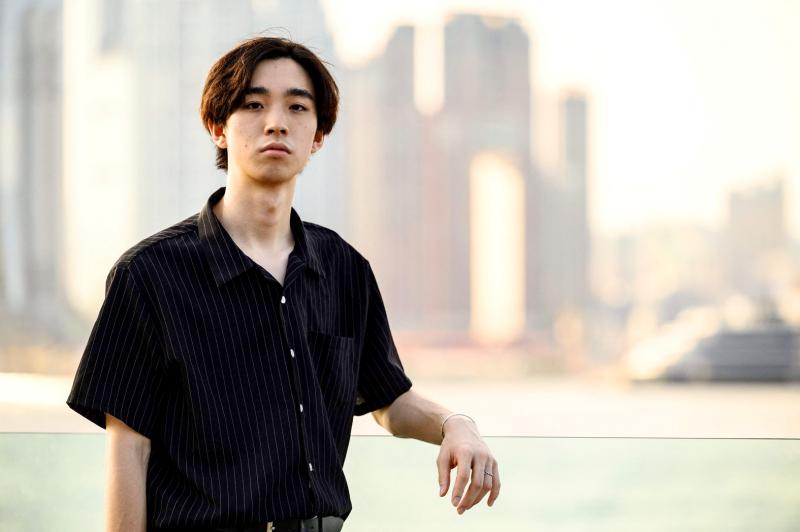
Photo: AFP
Since then he has been arrested five times for hosting booths or making speeches.
“The red lines are being tightened each day,” the 20-year-old said.
He added some venues have quietly urged his group not to turn up after one was questioned and reminded of anti-coronavirus rules by police recently, a tactic commonly used on the Chinese mainland.
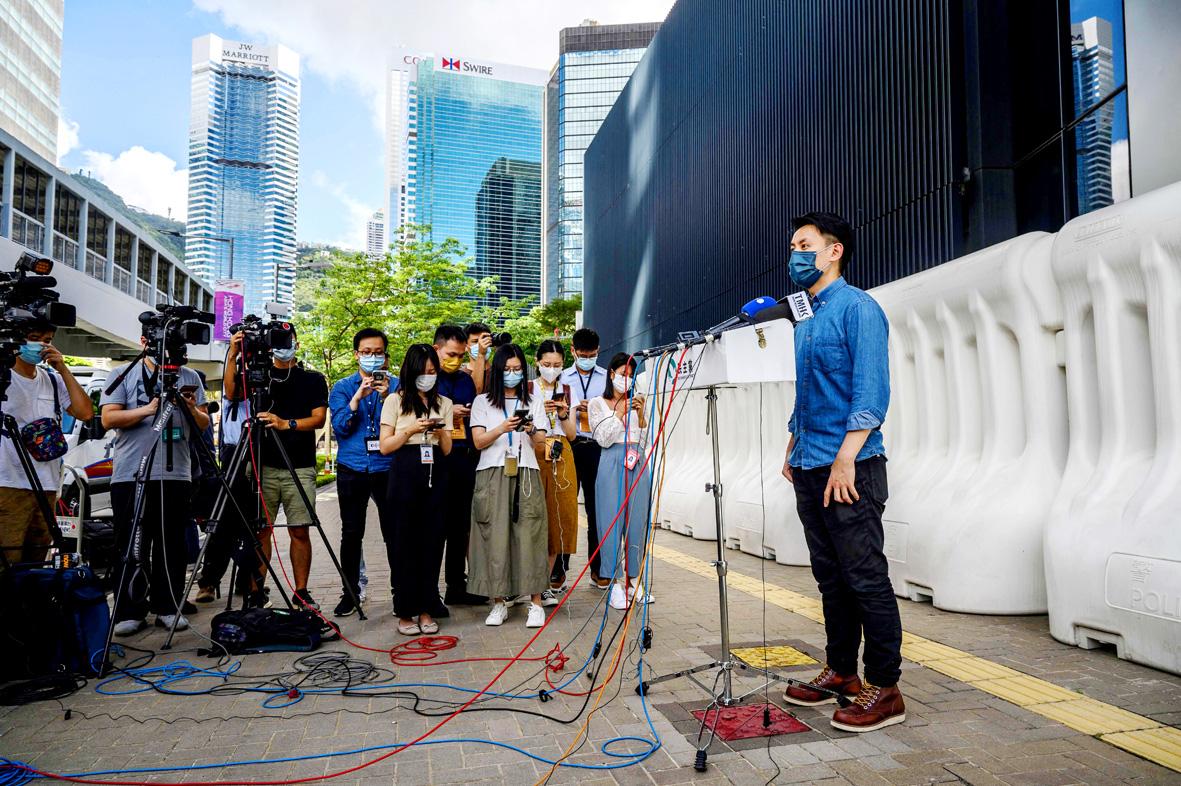
Photo: AFP
“Even the most peaceful and rational voices are not allowed. And there are so many groups disbanding themselves,” he lamented. Civil society, he said, is “ebbing and withering.”
‘PATRIOTS RULE HONG KONG’
China has used a double-blow knockout on dissent in Hong Kong after the city was convulsed by huge and often violent democracy protests two years ago.
The first was the national security law with more than 120 arrests so far, almost entirely for political views.
The other is an ongoing campaign dubbed “Patriots Rule Hong Kong,” where all public office holders and local politicians must be vetted for their loyalty.
Most of the city’s prominent democracy leaders are either in jail, facing prosecution or have fled overseas. And a wave of resignations has swept through the city as community leaders try to avoid receiving a knock on the door from police.
More than 250 district councilors have now quit ahead of the new political loyalty tests.
District councils were the only elections in Hong Kong where all seats were directly chosen by voters and in 2019 pro-democracy figures won in a landslide, hammering pro-Beijing parties.
Some resignations began soon after the new loyalty rules were announced.
But they snowballed in recent weeks when government sources gave interviews to local media suggesting those who were disqualified might have to pay back all operating expenses.
Lo Kin-hei (羅健熙), chairman of Hong Kong’s largest and oldest opposition group the Democratic Party, was one of those who stepped down. “The crackdown came at a speed and frequency that went far beyond our imagination, leaving us trying to catch our breath and collect our thoughts one year on,” he said.
Hong Kong was a place that used to tolerate dissent and political plurality, a stark contrast to one-party China.
But Lo said not a single government official had reached out to him since he took over as head of the Democratic Party late last year.
“We are at the lowest point for the past 30 years,” he added.
‘KEEP THE FLAME ALIVE’
It is not just politicians resigning. Moderate organizations and unions representing doctors, lawyers, civil servants have also disbanded over the last year.
According to an AFP tally, at least 30 organizations have shut down or gone silent in the last 12 months, including the Progressive Lawyers Group and several organizations representing medics.
The Public Doctors’ Association, one of the largest doctor unions, has mulled calling it quits, former president Arisina Ma said, citing the “loss of space... to speak up.”
“It has become really dangerous,” she said.
“In the past you might be brushed aside if the government did not like your opinions. But now they can come after you.”
Diplomats have also complained that many Hong Kong groups now refuse to meet them, fearful of being accused of “foreign collusion,” one of the new national security crimes.
Hong Kong authorities say the security law has returned stability while political vetting will ensure that “anti-China” forces are neutered.
The city’s legislature has been cleared of opposition and all future lawmakers will be vetted. Less than a quarter of seats will be directly elected.
“The space for making gradual progress has disappeared,” Lo said, adding it was now up to Hong Kongers as individuals to keep civil society going.
“For now, we must keep the flame alive, however small it is,” he added. Student leader Wong said he often felt pessimistic and helpless.
But he still plans to press ahead with his street booths “as a reminder to others that someone hasn’t given up.”

Taiwan’s English education system is being pulled apart by three opposing forces. Bilingual Nation 2030 pulls students toward English and global communication. Artificial Intelligence (AI) readiness pulls them toward digital judgment, verification and AI-mediated work. But Taiwan’s old exam culture pulls them back toward memorization, grammar drills, timed reading and correct answers. If the education system keeps using old exams to define success, it risks producing graduates who are neither genuinely bilingual nor genuinely AI-ready, but trained for tasks machines can already perform. The first force is Bilingual Nation 2030. Launched in 2018, the policy aimed to “help Taiwan’s workforce connect
It seems every few days one bumps into one of those “real man” comments in which Taiwan is urged to “face reality” or similar, and “make a deal,” with the speaker implying that soon it will be too late. “Deal” advocates always present themselves as having a superior grip on reality, and the manly ability to make the “hard choice.” Their testosterone-laden language often echoes that of Taiwan sellout advocates. Note that such commentary always specifies a process (“make a deal, work with, make progress”), never the end state of what occupation by a violent authoritarian colonialist state will entail. In
June 1 to June 7 "If all Taiwanese were as afraid of dying as you, then what would happen?” Physician Shih Chiang-nan (施江南) reportedly said this to his wife Chen Chiao-tung (陳焦桐) after she urged him to stop intervening on behalf of Taiwanese soldiers stranded overseas after serving in the Japanese Army during World War II. Shih had clashed with high-ranking officials over the issue, engaged in several heated arguments with Taiwan governor-general Chen Yi (陳儀) and allegedly shouted at general Ko Yuan-fen (柯遠芬), chief of staff of the Taiwan Garrison Command, over

“Taiwan’s Opposition Leader Comes to US With a Message Straight Out of Beijing” read a May 31 headline in the Wall Street Journal. Top US administration officials and members of Congress almost certainly read the WSJ, and if there was a bullet point takeaway that people in Washington should absorb ahead of Chinese Nationalist Party (KMT) Chair Cheng Li-wun’s (鄭麗文) arrival in DC on June 9, that headline is it. The last few columns have discussed this very topic, and the timing is not coincidental. While those top officials likely do not read the Taipei Times, judging by the number


 RSS
RSS