


Chen Chu-long (陳鉅龍) was so terrified before his first day in prison, his hair was falling out. Although the professional dog trainer had said yes to working there, his mind was full of violent scenes from Hong Kong superstar Chow Yun-fat’s (周潤發) 1987 classic, Prison on Fire (監獄風雲).
“The inmates’ expressions were fierce and aggressive,” Chen says. “I was afraid to look them in the eyes. But when they were asked to share their experiences with dogs that first day, they couldn’t stop talking.”
That was 15 years ago, and Hsinchu Prison’s dog training program for inmates, the first of its kind in Asia, is still going strong. For the first 12 years, the recidivism rate for inmates who graduated from the program was zero percent — far lower than the national average of 20 percent to 40 percent. Today, it remains in the single digits. The prison has adopted out 76 dogs in the meantime.
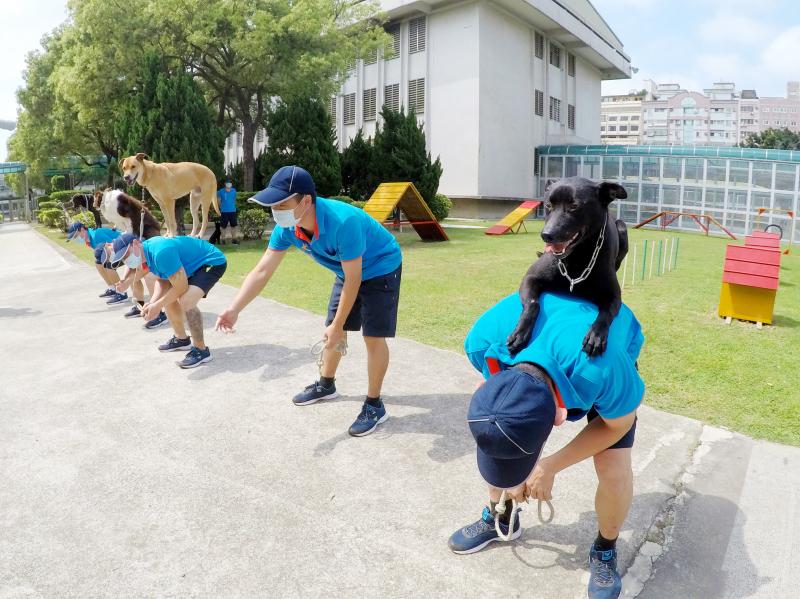
Photo courtesy of P-Pet
It was recently featured in pop heartthrob-turned-YouTuber Ken Chu’s (朱孝天) animal welfare channel P-Pet, where the dogs are seen performing difficult tricks such as jumping on their trainers’ backs, walking backwards on their hind legs and submerging their faces in water to retrieve a ball.
It’s a chance for people and dogs who have both been abandoned by society to meet and change each other, Chen says.
“It is a stark reminder that every living being, no matter how imperfect or misunderstood, deserves a second chance,” Chu says.

Photo courtesy of Hsinchu Prison
ASIA’S FIRST
Chen has been training dogs for over two decades. He started out working at a government shelter in Hsinchu, but soon quit to run his own dog training school because he couldn’t bear to be involved in helping in euthanizing unadopted dogs anymore.
In 2006, Chen received a call from Kuo Su-chin (郭素琴), a local better known as Mrs Chang (張太太) who has devoted her life to caring for stray animals. She said then-Hsinchu Prison warden Huang Jui-jung (黃瑞榮), also a dog lover, was setting up a canine-training program and asked if he would like to help.
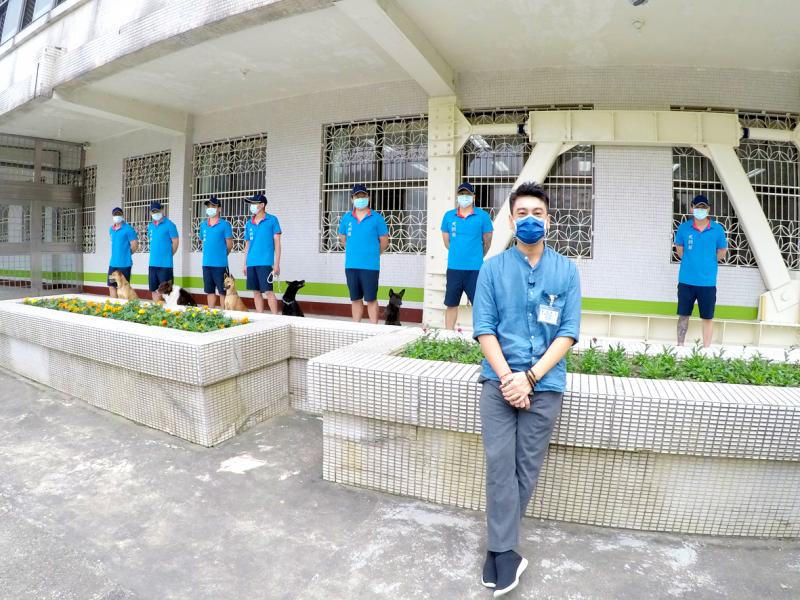
Photo courtesy of P-Pet
“I said yes immediately,” Chen says.
They started with six dogs, three from the shelter and three strays. Most of them were Labrador retrievers after the 2004 Japanese film Quill, featuring a Labrador seeing-eye dog, sparked a craze in Taiwan, leading to a mass abandonment over the next few years.
The prison selected six inmates who each chose a dog they were drawn to. Chen recalls that one named his dog “An-an” (安安), which he soon realized was short for amphetamine (安非他命). Chen says that the dog was allowed to keep the name.
“To many of these addicts, drugs were an extremely important part of their lives,” he says. “I hoped that it would make it easier for him to integrate the dog into his life too.”
The dogs and humans spent the first week getting used to each other, and the inmates did basic tasks such as feeding, cleaning up poop and watching for parasites.
“The inmates have complicated feelings coming in,” Chen says. “They might wonder why they ended up in such a place and start to let their imagination run amok. The dogs too, they’re terrified. One didn’t eat for five days.”
CHANGED LIVES
Basic obedience training lasts for three or four months, then they move on to more advanced exercises, before they let the dogs off leash. It builds trust and confidence, and provides a sense of accomplishment for the inmates.
“It’s the most primal connection between humans and animals,” Chen says. “When they pet the dogs and look into their eyes, you can sense a connection and feeling that only a trainer and their dog can share. Soon, the inmate’s expressions start softening. The change is very obvious.”
Both Chen and Chu share several stories about how inmates have changed.
A-Hsuan (阿?), who is in prison on drug charges, says in Chu’s video that he was impulsive and very quick to anger before he met his dog Robin. “I would even yell at my family if they didn’t bring what I wanted during visitations,” he says.
“But being with Robin, I really learned the value of calmness, persistence, and patience. In dog training, you can’t even start forming a relationship with the dog unless you can see it from the dog’s perspective. This has really taught me about the importance of empathy and understanding what it feels like to be in the other person’s shoes.”
Several inmates have adopted the dogs they trained after getting out of jail. Chen’s favorite story is a former inmate surnamed Lo (羅), who took in his trainee Kuchi. Lo had the dog perform the ribbon cutting ceremony when he opened his business, and he often hires and helps people who graduated from the dog training program.
A-chung (阿中), who also appears in Chu’s video, says he was a rash and short-tempered person, but he calmed down through training A-yong (阿勇).
“If learning to be patient can change A-yong’s life for the better, then that already makes me very happy,” he says.

Taiwan’s English education system is being pulled apart by three opposing forces. Bilingual Nation 2030 pulls students toward English and global communication. Artificial Intelligence (AI) readiness pulls them toward digital judgment, verification and AI-mediated work. But Taiwan’s old exam culture pulls them back toward memorization, grammar drills, timed reading and correct answers. If the education system keeps using old exams to define success, it risks producing graduates who are neither genuinely bilingual nor genuinely AI-ready, but trained for tasks machines can already perform. The first force is Bilingual Nation 2030. Launched in 2018, the policy aimed to “help Taiwan’s workforce connect

It seems every few days one bumps into one of those “real man” comments in which Taiwan is urged to “face reality” or similar, and “make a deal,” with the speaker implying that soon it will be too late. “Deal” advocates always present themselves as having a superior grip on reality, and the manly ability to make the “hard choice.” Their testosterone-laden language often echoes that of Taiwan sellout advocates. Note that such commentary always specifies a process (“make a deal, work with, make progress”), never the end state of what occupation by a violent authoritarian colonialist state will entail. In

There are shadowy cabals plotting to sell out Taiwan to be annexed by China, by invasion if necessary. Fortunately, they are buffoons. In 2019, former Bamboo Union gangster and founder of the China Unification Promotion Party (CUPP), Chang An-le (張安樂, colorfully known as “White Wolf”), led a protest at the Legislative Yuan against comments made by then-premier Su Tseng-chang (蘇貞昌) that in the event of an attack by China, he would never surrender, but would protect the nation by fighting to the end, even if he only had a broom. Chang had party members bring a wooden casket that they

June 1 to June 7 "If all Taiwanese were as afraid of dying as you, then what would happen?” Physician Shih Chiang-nan (施江南) reportedly said this to his wife Chen Chiao-tung (陳焦桐) after she urged him to stop intervening on behalf of Taiwanese soldiers stranded overseas after serving in the Japanese Army during World War II. Shih had clashed with high-ranking officials over the issue, engaged in several heated arguments with Taiwan governor-general Chen Yi (陳儀) and allegedly shouted at general Ko Yuan-fen (柯遠芬), chief of staff of the Taiwan Garrison Command, over


 RSS
RSS