


Cute cartoon animals have been at the heart of Hong Kong clothing brand Chickeeduck since 1990, displayed on everything from t-shirts and tote bags to baby rompers and pillows. But owner Herbert Chow is now struggling to get his designs made in China, where his avian characters have been seized by authorities for “advocating violence.”
Chow, 57, was preparing for the Lunar New Year shopping season earlier this year when he was informed that a shipment of some 10,000 Chickeeduck items had been seized in mainland China.
“My manufacturer said the customs department found the products were advocating violence in social movements,” Chow said after recently deciding to go public.
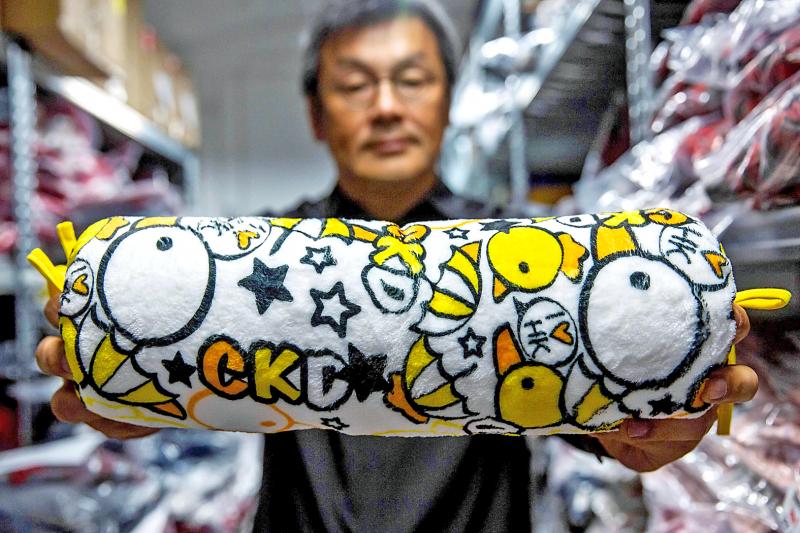
Photo: AFP
At first glance, the contraband cartoons might seem innocuous. They included cushions with yellow birds holding umbrellas alongside “I love HK” speech bubbles, and canvas bags featuring five ducklings swimming on one side and a flag-bearing chicken on the other.
But for those who know Hong Kong’s recent tumultuous politics, the designs are a clear nod to the city’s democracy movement, which is now being swept away by China’s crackdown on dissent.
Chow makes no secret of his messaging. The tote bag, for example, was a reference to the popular protest slogan “Five demands, not one less.”
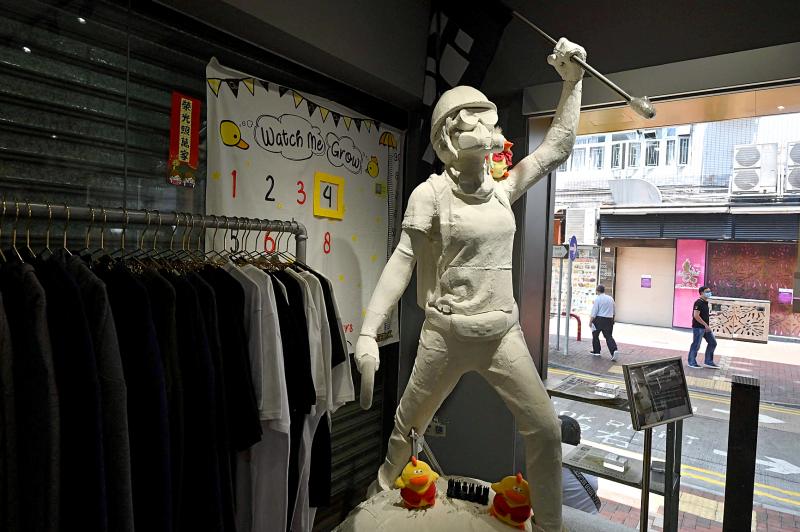
Photo: AFP
But he says he is baffled that such designs would be deemed illegal.
“I don’t see what’s wrong with the message,” he said. “I don’t know what business the Chinese authorities have in trying to stop something like this from going to Hong Kong.”
GROCERY CHAIN RAID
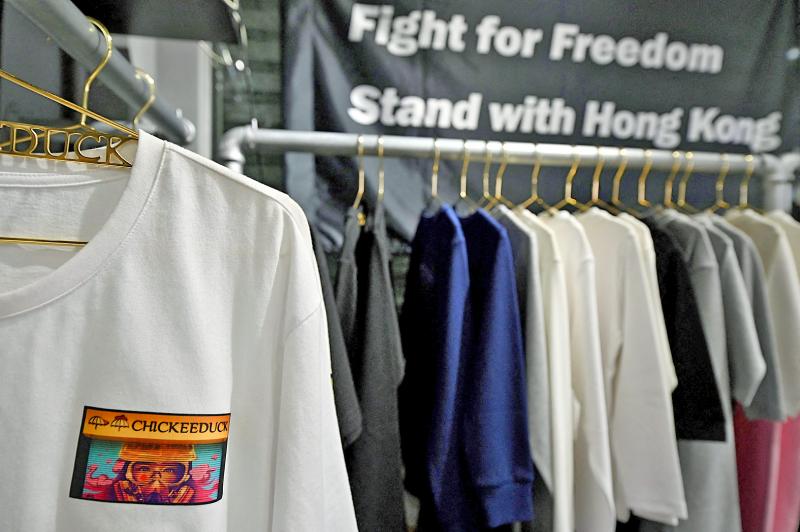
Photo: AFP
Chow’s predicament illustrates how much the landscape has changed in semi-autonomous Hong Kong since 2019’s huge and often violent pro-democracy protests.
Certain speech and views can instantly land people — and businesses — in hot water.
As Chow was speaking with AFP, Hong Kong’s Customs Department held a press conference to announce the seizure of nearly 9,000 items from Abouthai, a grocery chain.
Authorities said the items — mostly imported from Thailand — failed to carry proper warning labels in Chinese.
Abouthai was founded by Mike Lam (林景楠), a pro-democracy businessman who is one of dozens charged under a new national security law that Beijing imposed on Hong Kong last year.
The raid prompted long queues at Abouthai stores by Hong Kongers wanting to show support. The Customs Department said the raid on Abouthai was not political and it rejected “any false accusation maliciously alleging that its law enforcement action against the trader is ‘repression.’”
POLICE VETTING
Chow was born into a family that migrated to Hong Kong from the mainland’s Fujian province. He identifies as “Hong Kong Chinese” and sees himself as a moderate democracy supporter.
He drives a car with the license plate “LV1997” (Love 1997), commemorating the moment Hong Kong was handed to China by Britain. What Hong Kongers want, he argues, is a greater say in how their lives are run. But China’s response has been to go the other way. As well as the national security law, Beijing has spearheaded a campaign — dubbed “staunch patriots running Hong Kong” — to root out dissent across society.
Chow was not initially that involved in politics. But that changed when huge protests erupted in 2019.
After expressing some sympathy for the movement’s goals he found himself accused of being a “traitor” by a powerful ultranationalist user on Weibo, the Chinese version of Twitter.
From there it snowballed. “That was the first time I felt like, what is this country?” he recalled.
Rather than back down — like so many other businesses — he doubled down. Last year he made headlines for refusing to remove a protester statue from one of his stores and the mall responded by not renewing his contract.
He says he is now scrambling to find manufacturers in Southeast Asia willing to make his designs after his Chinese mainland partner warned all new orders must now be vetted by authorities.
“If I give him another design, he’ll say, wait a minute, I’m going to send this to the Public Security Department,” he said.
Chow is adamant his designs are not illegal and says he has no plans to remove them from his remaining four stores.
“We want the Hong Kong people not to get used to ridiculous things,” he said.
For many people, Bilingual Nation 2030 begins and ends in the classroom. Since the policy was launched in 2018, the debate has centered on students, teachers and the pressure placed on schools. Yet the policy was never solely about English education. The government’s official plan also calls for bilingualization in Taiwan’s government services, laws and regulations, and living environment. The goal is to make Taiwan more inclusive and accessible to international enterprises and talent and better prepared for global economic and trade conditions. After eight years, that grand vision is due for a pulse check. RULES THAT CAN BE READ For Harper Chen (陳虹宇), an adviser
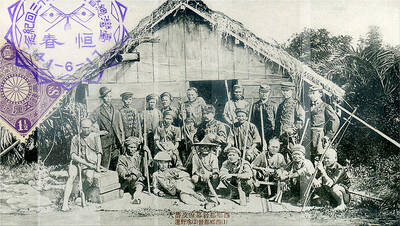
Traditionally, indigenous people in Taiwan’s mountains practice swidden cultivation, or “slash and burn” agriculture, a practice common in human history. According to a 2016 research article in the International Journal of Environmental Sustainability, among the Atayal people, this began with a search for suitable forested slopeland. The trees are burnt for fertilizer and the land cleared of stones. The stones and wood are then piled up to make fences, while both dead and standing trees are retained on the plot. The fences are used to grow climbing crops like squash and beans. The plot itself supports farming for three years.
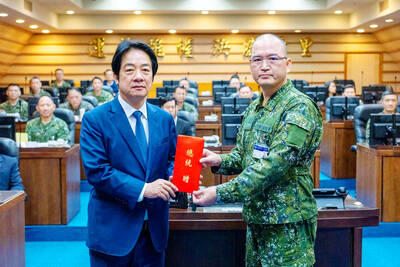
President William Lai (賴清德) on Nov. 25 last year announced in a Washington Post op-ed that “my government will introduce a historic US$40 billion supplementary defense budget, an investment that underscores our commitment to defending Taiwan’s democracy.” Lai promised “significant new arms acquisitions from the United States” and to “invest in cutting-edge technologies and expand Taiwan’s defense industrial base,” to “bolster deterrence by inserting greater costs and uncertainties into Beijing’s decision-making on the use of force.” Announcing it in the Washington Post was a strategic gamble, both geopolitically and domestically, with Taiwan’s international credibility at stake. But Lai’s message was exactly
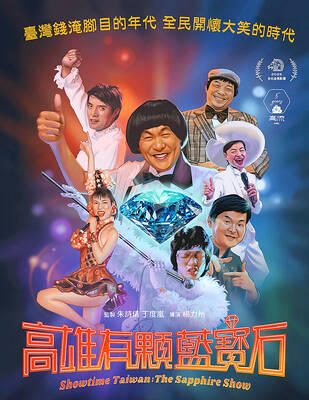
May 4 to May 10 It was once said that if you hadn’t performed at the Sapphire Grand Cabaret (藍寶石大歌廳), you couldn’t truly be considered a star. Taking the stage at the legendary Kaohsiung club was more than just a concert. Performers were expected to entertain in every sense, wearing outlandish or revealing costumes and staying quick on their feet as sharp-tongued, over-the-top hosts asked questions and delivered jokes that would be seen as vulgar, even offensive, by today’s standards. Opening in May 1967 during a period of strict political and social control, Sapphire offered a rare outlet for audiences in


 RSS
RSS