


This article doesn’t focus on a destination so much as a key motif of rural Taiwan: The often humble, but sometimes grand, sanheyuan (三合院).
When I say I adore sanheyuan, I speak from experience. My wife and I lived in this kind of traditional house for just over two years. To be specific, we rented slightly less than half of one.
Sanheyuan (“three structures around a yard”) get their name because they comprise connected single-story structures on three sides of a courtyard. Typically, each wing is divided into three to five rooms.
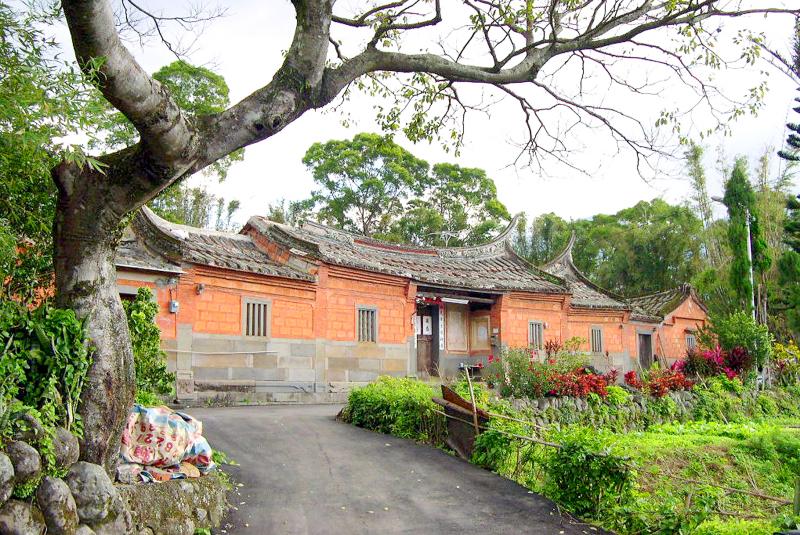
Photo: Steven Crook
In Tainan’s Shanshang District (山上), we occupied the west wing of a sanheyuan, and a room in the south-facing main building — which, as is typical for this kind of house, was slightly higher than the east and west wings.
The other wing belonged to our landlord’s older brother, and was uninhabited. The landlord and his brother kept the keys for the main building’s central chamber, which housed the family’s ancestor shrine.
The lower third of each wall was brick. The upper section consisted of wooden beams and bamboo poles, the spaces between which were filled with wattle (a woven lattice of bamboo slats) and daub (mud mixed with rice husks and pig dung). The courtyard had been concreted over.
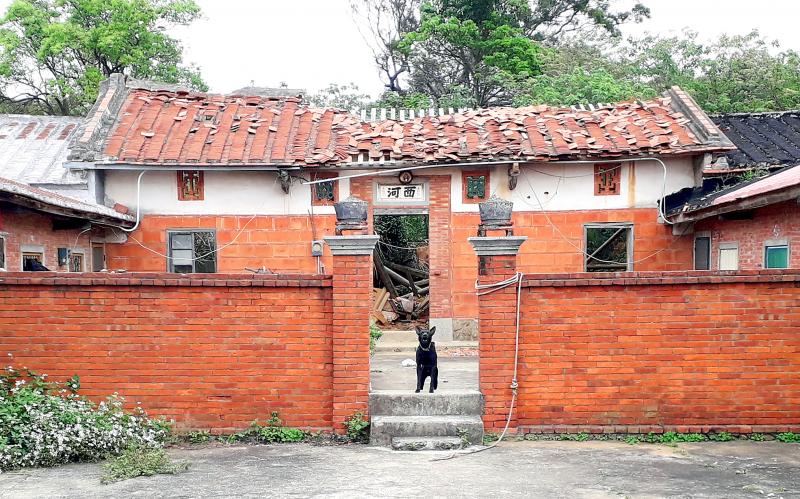
Photo: Steven Crook
A visitor told me that, judging by the condition of the building and the type of tile on the roof, it likely dated from between 1950 and 1960. I don’t remember ever asking the landlord when it was built.
My wife grew up in an older three-sided compound about 3km away. That building, constructed in 1928 when the family was quite prosperous, was demolished several years ago. I’m glad I snapped some photos of it while it stood.
The room given over to the ancestor altar included several panel paintings. By the 21st century, some of them — including one which depicted Mount Fuji in Japan — were seriously faded. I’ve no idea if any of these works of art survived the demolition.
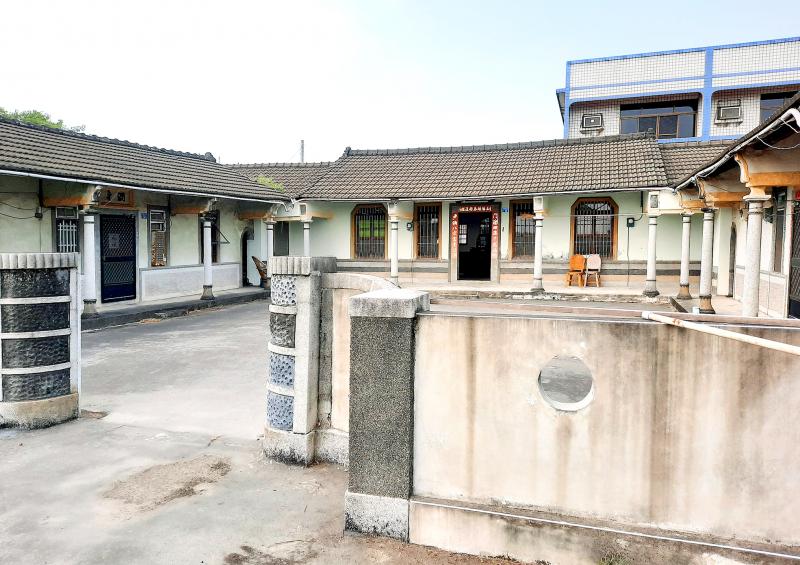
Photo: Steven Crook
I’ve often chanced upon charming three-sided houses when biking through the countryside. But recently I was on foot, and in a built-up area, when I spotted a sanheyuan that stopped me in my tracks.
On Wenhua Street (文化街) in Kaohsiung’s Linyuan District (林園), there’s a west-facing, still-inhabited house with two rather unusual features.
The first is the waist-high coral stone wall between the courtyard and the street. The second is the manner in which the residential wings of this sanheyuan were extended. Rather than try to match the appearance of the original structure — which I’d guess dates from before 1930 — a single flat-roofed concrete room was tacked onto the end of each wing.
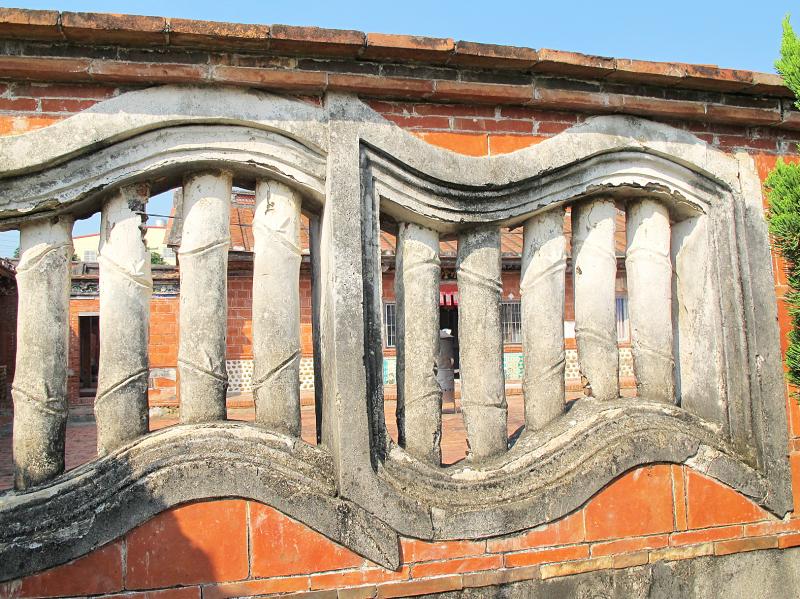
Photo: Steven Crook
These additions are stylish in their own right, and show the influence of architectural conventions imported during the 1895-1945 period of Japanese colonial rule. The owners were keen to show they could keep up with the times, perhaps.
GUPOLIAO CHUANG OLD HOUSE
Compared to many other buildings its age, Gupoliao Chuang Old House (姑婆寮莊家古厝) has come through the past century with barely a scratch. On both of my visits, some of the rooms were locked up, but visitors were allowed to explore most of the compound and take photos.
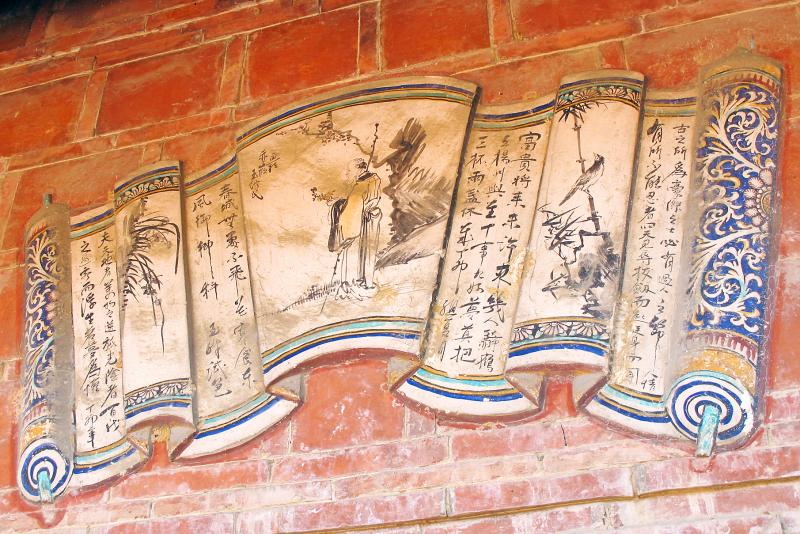
Photo: Steven Crook
Gupoliao is a tiny village just south of the immense Buddhist complex at Fo Guang Shan (佛光山) in Kaohsiung’s Dashu District (大樹). The two Chuang (莊) brothers who commissioned the construction of this gorgeous residential compound prospered through agriculture. The profits they made by raising pigs and growing pineapples and sweet potatoes allowed them to hire craftsmen and import materials from China’s Fujian Province between 1908 and 1921.
The layout is usually described as “a seven halls, three porters’ lodges, four-sided courtyard building” (七包三式的四合院). The southeastern side is merely a wall, however, not a set of rooms.
The reds and browns of the bricks and tiles are supplemented by off-whites and faded blues on the lintels. Among the decorations are mock-scrolls painted by Chen Yu-feng (陳玉峰, 1900-1964), one of the 20th century’s leading temple artists.
Possession of the house has passed through six generations, and inheritance customs stipulate that each son should receive a share of his father’s property. The third generation reportedly included 13 males, so it’s very possible that legal ownership of this landmark is now divided between more than 100 descendants. Fragmented ownership is often a huge obstacle to people who hope to buy and restore an old house in Taiwan.
PHOTOGENIC RUINS
If it’s photogenic ruins you want, take the train to Ciding (崎頂) in the northwestern corner of Miaoli County.
Most visitors to Ciding head for the viewing platform from which you can gaze out over the Taiwan Strait, or the disused railway tunnels that still bear the scars of a World War II US Air Force raid.
In the northern part of the little settlement known as Beihu (北戶), a stone’s throw from the railway station, there’s a handful of long-unoccupied sanheyuan, and a few which are kept up. I found the decrepit beauty of one compound (which bears two address plaques, Beihu 23 and 24) especially hypnotizing. If it hadn’t been for the fierce dog patrolling the inner courtyard, I might well have spent an hour there, picking my way through the debris.
Several years ago, a random motorcycle ride through the hilly countryside above Tamsui (淡水) brought me to two splendid abodes, both of which belong to families surnamed Lee (李).
The one that welcomes visitors is now known as Stonewall Cafe (石牆仔內), at 3 Dapitou, Jhongliao Borough (忠寮里大埤頭). Said to have been built in 1871, its current role means there has been some modification.
In the two centuries before Taiwan became a colony of Japan, the island was beset by banditry and uprisings. Like some other pre-colonial houses, Stonewall Cafe has beveled holes in its outer walls, designed so those inside could watch for and if necessary shoot at intruders, without exposing themselves to danger.
I’m not sure I could find the other Lee building again, or what state it’s now in. It’s just outside Jhuweizih (竹圍子), where the largest building is a psychiatric clinic.
Stumbling across it by sheer chance, it struck me as battered yet utterly beautiful. Whenever I look at the photos I took that day, I remind myself: If you see something that’s old and special, stop and record it in your mind and on your camera’s memory card. You might not get another chance.
Steven Crook has been writing about travel, culture and business in Taiwan since 1996. He is the author of Taiwan: The Bradt Travel Guide and co-author of A Culinary History of Taipei: Beyond Pork and Ponlai.
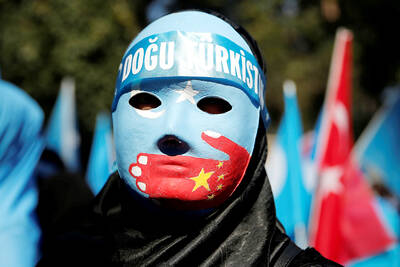
It seems every few days one bumps into one of those “real man” comments in which Taiwan is urged to “face reality” or similar, and “make a deal,” with the speaker implying that soon it will be too late. “Deal” advocates always present themselves as having a superior grip on reality, and the manly ability to make the “hard choice.” Their testosterone-laden language often echoes that of Taiwan sellout advocates. Note that such commentary always specifies a process (“make a deal, work with, make progress”), never the end state of what occupation by a violent authoritarian colonialist state will entail. In
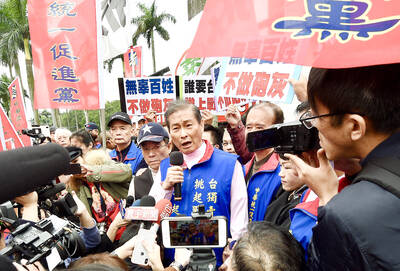
There are shadowy cabals plotting to sell out Taiwan to be annexed by China, by invasion if necessary. Fortunately, they are buffoons. In 2019, former Bamboo Union gangster and founder of the China Unification Promotion Party (CUPP), Chang An-le (張安樂, colorfully known as “White Wolf”), led a protest at the Legislative Yuan against comments made by then-premier Su Tseng-chang (蘇貞昌) that in the event of an attack by China, he would never surrender, but would protect the nation by fighting to the end, even if he only had a broom. Chang had party members bring a wooden casket that they
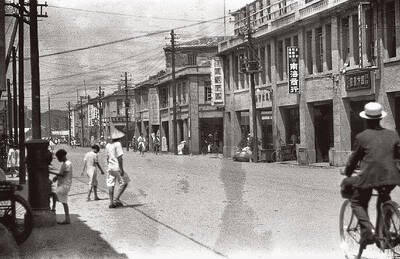
June 1 to June 7 "If all Taiwanese were as afraid of dying as you, then what would happen?” Physician Shih Chiang-nan (施江南) reportedly said this to his wife Chen Chiao-tung (陳焦桐) after she urged him to stop intervening on behalf of Taiwanese soldiers stranded overseas after serving in the Japanese Army during World War II. Shih had clashed with high-ranking officials over the issue, engaged in several heated arguments with Taiwan governor-general Chen Yi (陳儀) and allegedly shouted at general Ko Yuan-fen (柯遠芬), chief of staff of the Taiwan Garrison Command, over

Taiwan’s English education system is being pulled apart by three opposing forces. Bilingual Nation 2030 pulls students toward English and global communication. Artificial Intelligence (AI) readiness pulls them toward digital judgment, verification and AI-mediated work. But Taiwan’s old exam culture pulls them back toward memorization, grammar drills, timed reading and correct answers. If the education system keeps using old exams to define success, it risks producing graduates who are neither genuinely bilingual nor genuinely AI-ready, but trained for tasks machines can already perform. The first force is Bilingual Nation 2030. Launched in 2018, the policy aimed to “help Taiwan’s workforce connect


 RSS
RSS