


Forced to retreat southward by unrelenting winds, I made my way into Lukang (鹿港), which is never a bad thing. I had to abandon any thought of cycling up the coast of Changhua County into Taichung, but at least I could pedal around one of Taiwan’s most historic and characterful towns.
However many times I go back to Lukang, I always seem to discover something I’d not noticed on previous trips. This recent unplanned visit was no exception. Freewheeling through side streets near the rightfully famous Longshan Temple (龍山寺), I found myself facing an unfamiliar place of worship no wider than a shop.
Its name, Lukang Xingan Temple (鹿港興安宮), didn’t ring any bells with me, but its weathered exterior was instantly appealing. I’d barely got my bicycle locked when a middle-aged lady walked up to me and began talking. Four-fifths of what she said was in Mandarin, the rest in English.
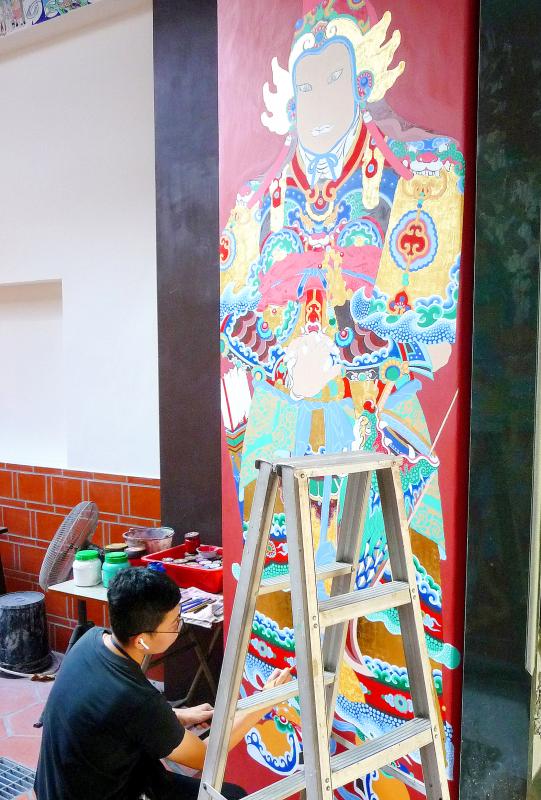
Photo: Steven Crook
She mixed useful statements about the temple with prying questions (“What’s your line of work?” “How old are you?”). She also handed me a Chinese-language booklet that contained a sketch of the temple as it probably looked in the decades after its founding in 1684.
In the late 17th and early 18th centuries, the temple faced one of the docks through which Lukang merchants imported stone, wood and silk, while exporting rice and sugar. Silt eventually blocked the waterways between the sea and the docks. By the second half of the 19th century, the town’s golden age as a cross-strait trade hub was over.
The temple’s name derives from Xinghua (興化) Prefecture, part of Fujian Province in China. Even though the prefectural government was formally abolished about 300 years earlier, it seems the toponym was still in common use when Han people began to settle in Lukang. Old habits do indeed die hard.
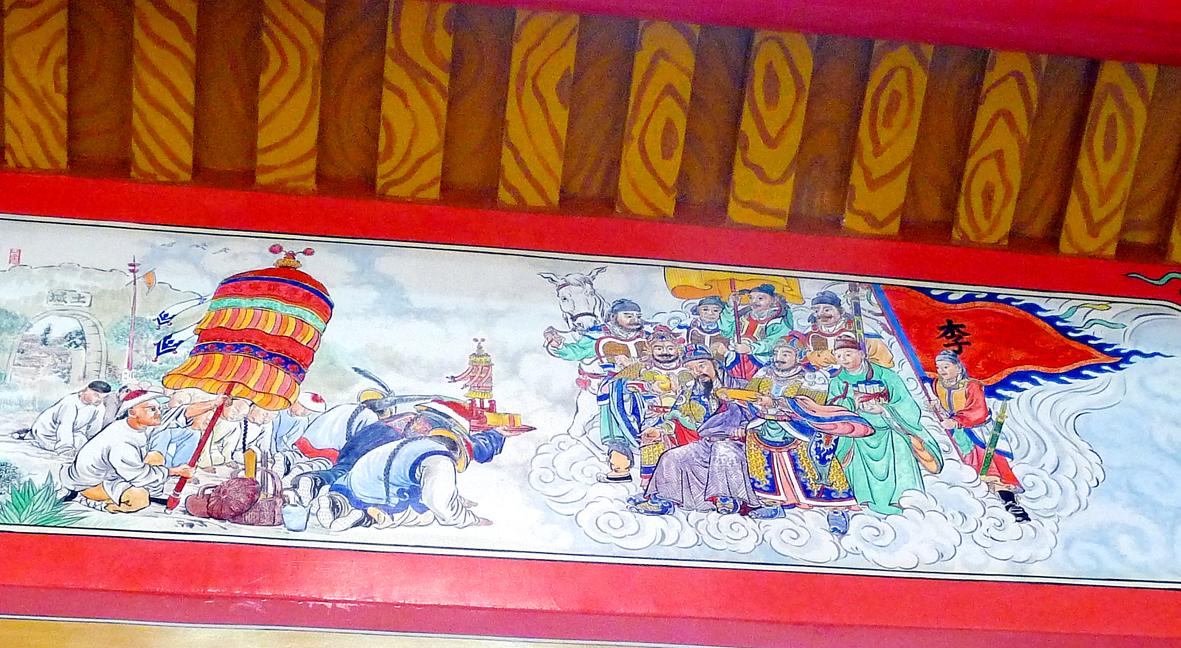
Photo: Steven Crook
The street on which the temple is located — just wide enough for cars to pass — is called Xinghua Lane (興化巷). The temple is at number 64.
Like Lukang’s eternally noisy and crowded Tianhou Temple (天后宮), and the much more sedate Sinzu Temple (新祖宮, also known as Chijian Tianhou Temple, 敕建天后宮), the focus of worship inside Lukang Xingan Temple is Matsu (媽祖), the goddess of the sea who’s now revered as a generalist deity by millions of Taiwanese.
My guide introduced the icons of Matsu, her attendants Shunfenger (順風耳, “ears that hear the wind”) and Qianliyan (千里眼, “eyes that see a thousand leagues”), and the Guanyin bodhisattva.
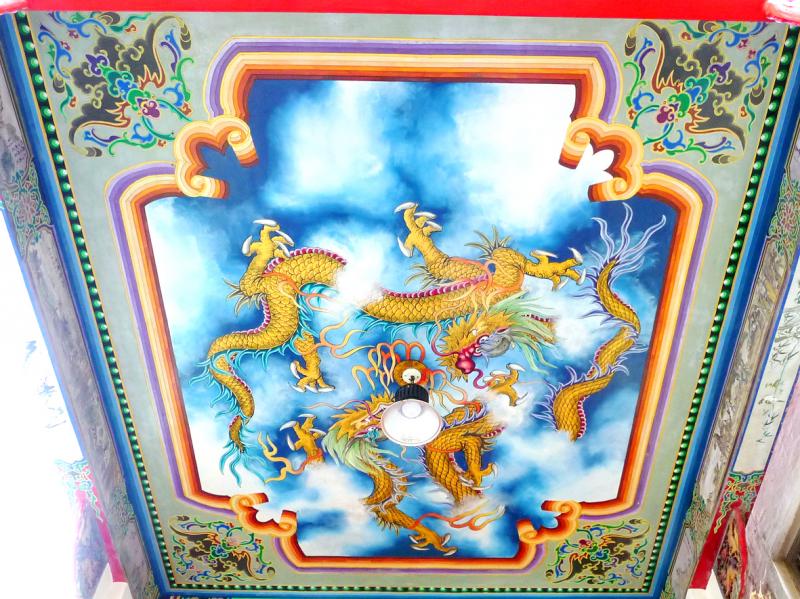
Photo: Steven Crook
Behind the main altar there was a door-sized aperture on the right. I walked through it, expecting to find another part of the temple. To my surprise, I was now in the back of a workshop where a man sat reading the newspaper, surrounded by unvarnished, unpainted wooden statues of gods and goddesses. Looking through the shop’s windows, I could see cars and motorcycles on Jhongshan Road (中山路).
The proprietor didn’t seem to notice me. I left the temple, got on my bicycle, and rode around to the front of the icon workshop, to confirm its name and address. It’s called Wen Bao Buddhist supply shop (文寶佛俱行, which typically sell everything from joss sticks to effigies to beads) and is at 89 Jhongshan Road. The woodcarvings inside are gorgeous, but photography isn’t allowed.
I’d hardly got up to speed before I stopped again. The saying “Every three steps, a small temple. Every five steps, a major temple” is usually associated with Tainan, but it’s just as applicable to the historic center of Lukang.
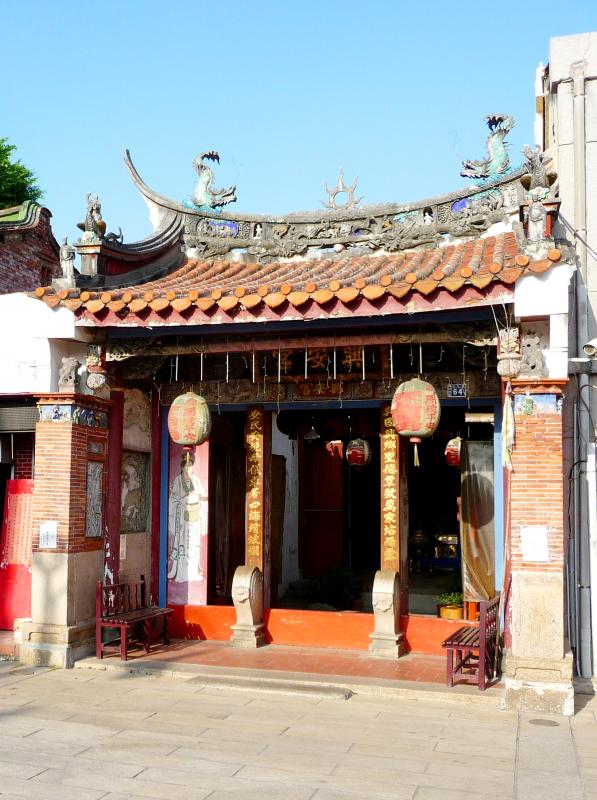
Photo: Steven Crook
I halted at Quanzhou Jhenan Temple (泉州鎮安宮), at 53 Jhongshan Road, because the paint was peeling off the folding wooden doors, and the doors themselves looked ready to fall off their hinges.
Stepping inside, I found a hall of worship smaller than most living rooms. The interior was gloomy and grimy. I couldn’t remember the last time I’d been inside such a dank, impoverished-looking religious building.
The only deity enshrined at Quanzhou Jhenan Temple is Li, Lord of a Thousand Years (李府千歲). He’s believed to be one of the 360 original wangye (王爺) spirits, all of whom — legend has it — were scholars, officials, or musicians employed by Emperor Taizong (reigned 626 to 649) of China’s Tang Dynasty.
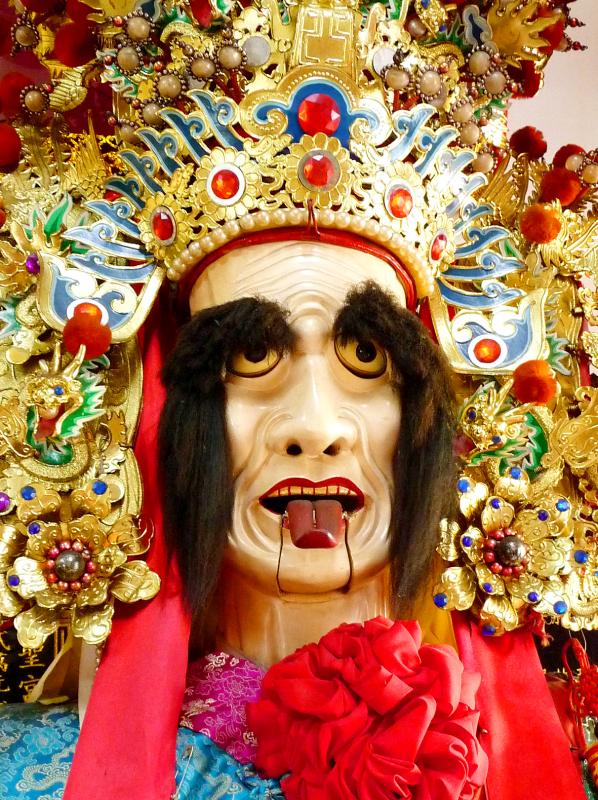
Photo: Steven Crook
Some say the oldest effigy was brought over from Quanzhou in Fujian. Other believe it was found in a nearby creek by Lukang residents who, to be on the safe side, sacrificed incense to the idol. Following the appropriate auguries, a shrine was constructed.
It seems the shrine lost much of its land when Jhongshan Road was widened during the Japanese colonial period. During the Qing era, the thoroughfare was so narrow, with shops’ awnings blocking the sunlight, that it’d been nicknamed “See-No-Sky Street” (不見天街).
Musing whether Lukang has so many temples that its population (currently around 86,000) can’t support all of them, I cycled south. To my astonishment, at 43 Jhongshan Road, I found another Jhenan Temple.
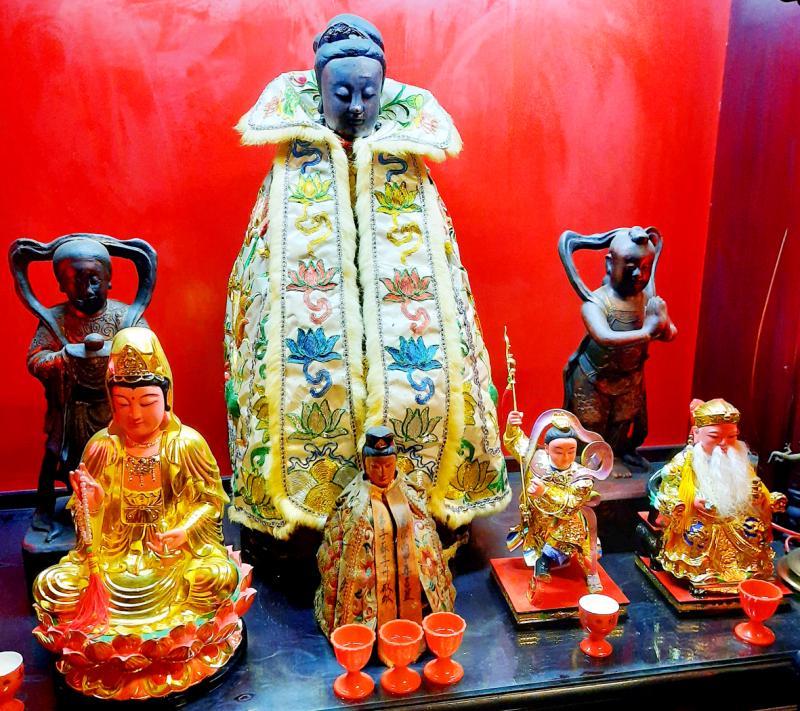
Photo: Steven Crook
Just as narrow as its namesake at number 53, but gleaming with bright colors, it turned out to be uninhabited. By that, I mean it was bereft of statuettes or other icons.
A young artisan was adding finishing touches to the door gods. I wanted to ask him if — as I believe is the custom — the gods’ eyes would be painted in at the very last moment. However, he was humming along to whatever was coming through his earbuds. I worried that, if I tapped him on the shoulder, he’d be startled and ruin his work.
A vendor selling pan-fried pork buns (水煎包) next door cleared up my confusion. Because number 53 was “too small,” the temple would soon be moving to number 43, a plot of land which extends back from the road. The new structure is big enough to include a bathroom, and the ceiling is much higher than in the old location.
Late last month, the temple’s managers announced via Facebook that the formal move will take place on Dec. 26.
After scanning the map on my smartphone, I next decided to take a look at Wusheng Temple (武聖宮) at 41 Xinghua Lane.
Like other shrines with the same name, Wusheng Temple honors the Chinese deity of war and martial arts Guan Gong (關公). The detail that most impressed me was a ceiling painting which shows a pair of dragons clawing their way across a mist-streaked sky. Dragons are always ferocious, of course, but the expressions on this duo made me think that, perhaps, they were also battling headwinds.
Steven Crook has been writing about travel, culture and business in Taiwan since 1996. He is the author of Taiwan: The Bradt Travel Guide and co-author of A Culinary History of Taipei: Beyond Pork and Ponlai.
For many people, Bilingual Nation 2030 begins and ends in the classroom. Since the policy was launched in 2018, the debate has centered on students, teachers and the pressure placed on schools. Yet the policy was never solely about English education. The government’s official plan also calls for bilingualization in Taiwan’s government services, laws and regulations, and living environment. The goal is to make Taiwan more inclusive and accessible to international enterprises and talent and better prepared for global economic and trade conditions. After eight years, that grand vision is due for a pulse check. RULES THAT CAN BE READ For Harper Chen (陳虹宇), an adviser
Traditionally, indigenous people in Taiwan’s mountains practice swidden cultivation, or “slash and burn” agriculture, a practice common in human history. According to a 2016 research article in the International Journal of Environmental Sustainability, among the Atayal people, this began with a search for suitable forested slopeland. The trees are burnt for fertilizer and the land cleared of stones. The stones and wood are then piled up to make fences, while both dead and standing trees are retained on the plot. The fences are used to grow climbing crops like squash and beans. The plot itself supports farming for three years.
President William Lai (賴清德) on Nov. 25 last year announced in a Washington Post op-ed that “my government will introduce a historic US$40 billion supplementary defense budget, an investment that underscores our commitment to defending Taiwan’s democracy.” Lai promised “significant new arms acquisitions from the United States” and to “invest in cutting-edge technologies and expand Taiwan’s defense industrial base,” to “bolster deterrence by inserting greater costs and uncertainties into Beijing’s decision-making on the use of force.” Announcing it in the Washington Post was a strategic gamble, both geopolitically and domestically, with Taiwan’s international credibility at stake. But Lai’s message was exactly

May 4 to May 10 It was once said that if you hadn’t performed at the Sapphire Grand Cabaret (藍寶石大歌廳), you couldn’t truly be considered a star. Taking the stage at the legendary Kaohsiung club was more than just a concert. Performers were expected to entertain in every sense, wearing outlandish or revealing costumes and staying quick on their feet as sharp-tongued, over-the-top hosts asked questions and delivered jokes that would be seen as vulgar, even offensive, by today’s standards. Opening in May 1967 during a period of strict political and social control, Sapphire offered a rare outlet for audiences in


 RSS
RSS