


I’ve seen Nanhua Reservoir (南化水庫) in all weather and from many different angles. Because it’s located between my home and the Central Mountain Range, I’ve driven past it countless times, and thoroughly explored its surroundings by motorcycle and on foot.
It’s one of Taiwan’s prettiest artificial lakes, and an important component of the country’s water-supply system. All but the northernmost part of its watershed, which is in Chiayi County, lies within Tainan. Most of the water entering the reservoir arrives via the Houku Creek (後堀溪) or through an artificial underground channel that diverts water from the Cishan River (旗山溪), a few kilometers further inland in Kaohsiung.
In terms of design capacity, the reservoir is Taiwan’s fifth-largest water-storage facility. The dam is 187.5m high, the fifth-tallest in the country.
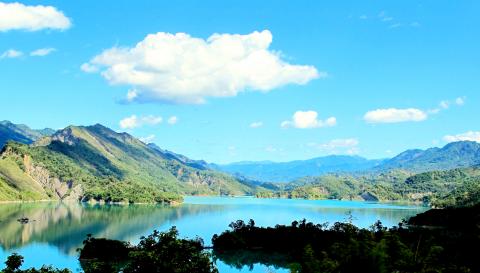
Photo: Steven Crook
Covering 537 hectares, it’s ranked number six by surface area — yet during the dry season, it shrinks quite noticeably.
The need for dams and reservoirs in Taiwan was summed up in a paper published last year and authored by a team of academics from Taiwan, France, and the US.
“The highly seasonal precipitation pattern in Taiwan means that water storage is critical to meeting water demands during the long dry season and in dry years,” they wrote.
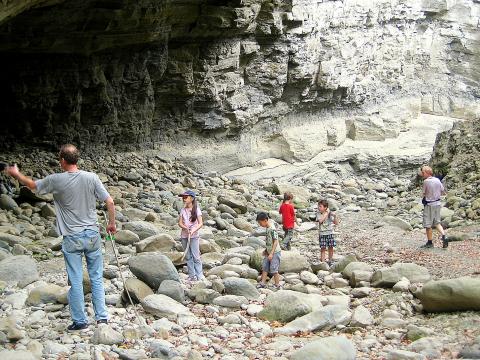
Photo: Steven Crook
The same paper, “Sediment Management in Taiwan’s Reservoirs and Barriers to Implementation,” explained why even newer reservoirs in Taiwan (Nanhua Dam was inaugurated in 1994) may not be useful for very much longer.
“With its extremely high sediment yields, Taiwan supplies the oceans with 384 million tonnes of suspended sediment per year, about 1.9 percent of the world’s total, from its 36,000 km2 (only 0.024 percent of the world’s land area).”
The problem is that a huge amount of sediment never reaches the ocean, and ends up filling Taiwan’s reservoirs.
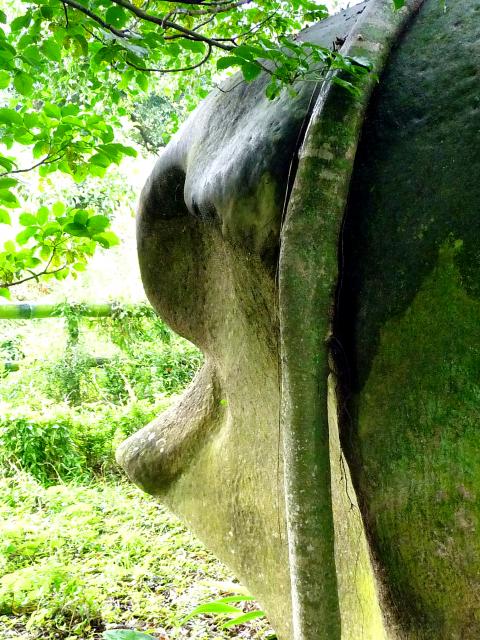
Photo: Steven Crook
Nanhua Reservoir’s waters, which are appealingly blue most of the time, but sometimes become the color of milk tea when heavy rains wash soil down from the encircling mountains. At one point during the summer of 2009, Typhoon Morakot reduced its capacity by more than a tenth.
The best views of the reservoir are to be had from Highway 20, the road also known as the South Cross-Island Highway (南橫公路). Coming from Tainan, you’ll see the body of water on your left as soon as you emerge from a short tunnel beyond the village called Yushan (玉山). The village is nowhere near the national park of that name, nor otherwise connected to Taiwan’s tallest mountain.
Depending on how much time you have, you may want to turn around soon after the 51km marker. If you’ve a full tank of gas, turn off Highway 20 and go north along Local Road 179 (南179). This will take you through the most thinly-populated corner of Tainan.
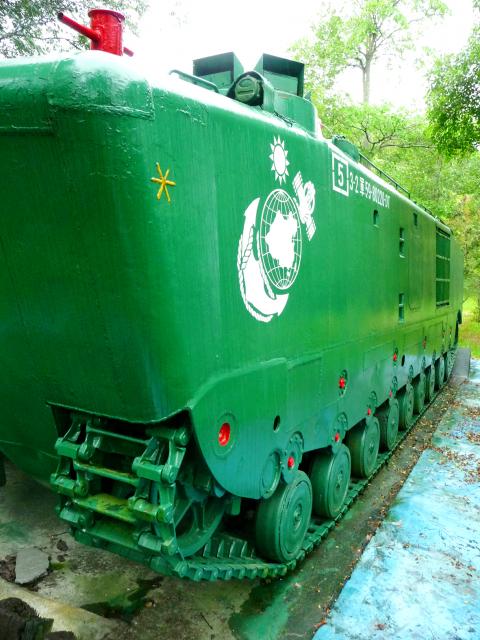
Photo: Steven Crook
After about 12km, if you know where to look, a path leaves the road and heads down to what, in the wet season, is part of the reservoir. A month or two into the dry season, however, it’s an expanse of dried mud. Outdoor-types gather bamboo and branches, rig makeshift bridges across the Houku Creek, and blaze a trail to Dadi Gorge (大地谷). If there’s no bridge, wading is usually possible.
Getting from the road to the gorge seldom takes more than half an hour, and once there you can picnic in a cool, shaded environment. It’s an excellent place to bring children — there’s a small waterfall, rocks to clamber over and no shortage of sticks and stones to gather.
A less adventurous option, and an area that is accessible year-round, lies just beneath the dam. Just inland of Yushan, you’ll see bilingual signs for the reservoir. Where Highway 20 veers sharply to the right, go straight ahead and drive down the hill.
After a short tunnel that goes beneath the dam’s spillway, you’ll come to a park where large pieces of military hardware are displayed. There’s very little information in Chinese about these weapons of war, but you may recognize some of them. There’s a Lockheed F-104 Starfighter (an interceptor that served in Taiwan’s air force between 1961 and 1998) and a Northrop F-5 Tiger II fighter co-manufactured by Taiwan and the US in the 1970s.
An anchor and a gun turret represent the navy; it’s possible to climb inside the latter. The LVT (Landing Vehicle Tracked) once used by Taiwan’s marines is sealed, but it looks to be in excellent condition.
Winding up my most recent visit earlier than planned because of rain, I detoured into the tiny settlement of Maopu (茅埔), a hamlet on the north side of Highway 20 and the nearest community to the dam itself.
I’d spotted a Chinese-only sign pointing the way to “Golden Turtle Stone” (金龜盤石), and quickly guessed — rightly, it turned out — that it’s a rock that’s held to have religious significance. A Chinese-language information panel by a massive banyan tree and a kennel-sized shrine provides some background. The story begins during the Tapani Incident of 1915 (?吧哖事件), when Taiwanese in this part of the south, inspired by a blend of non-mainstream religious beliefs and economic grievances, launched a destructive but futile uprising against the Japanese colonial authorities. A group of rebels passed through Maopu to “recruit fighters and buy horses… while resting beneath the bishop-wood tree [that still stands next to the banyan] they noticed three oddly-shaped boulders, and decided to propitiate [the spirits they believed resided within them].”
Since then, one of the rocks has been known as Golden Turtle Stone. Another is Whitebait Diamond Stone (銀魚鑽石), while the third is called Carp Golden Stone (鯉魚金石). Unfortunately, I couldn’t be sure which one is which. They’re not labeled, and there was no one I could ask. The car-sized boulder around which the banyan has wrapped some of its prop roots may well be Golden Turtle Stone. As with many of the geographical features in Taiwan that are likened to animals, you’ll need to use your imagination when trying to identify it.

Taiwan’s English education system is being pulled apart by three opposing forces. Bilingual Nation 2030 pulls students toward English and global communication. Artificial Intelligence (AI) readiness pulls them toward digital judgment, verification and AI-mediated work. But Taiwan’s old exam culture pulls them back toward memorization, grammar drills, timed reading and correct answers. If the education system keeps using old exams to define success, it risks producing graduates who are neither genuinely bilingual nor genuinely AI-ready, but trained for tasks machines can already perform. The first force is Bilingual Nation 2030. Launched in 2018, the policy aimed to “help Taiwan’s workforce connect
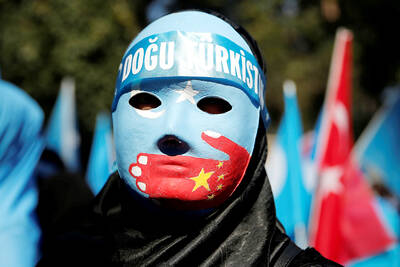
It seems every few days one bumps into one of those “real man” comments in which Taiwan is urged to “face reality” or similar, and “make a deal,” with the speaker implying that soon it will be too late. “Deal” advocates always present themselves as having a superior grip on reality, and the manly ability to make the “hard choice.” Their testosterone-laden language often echoes that of Taiwan sellout advocates. Note that such commentary always specifies a process (“make a deal, work with, make progress”), never the end state of what occupation by a violent authoritarian colonialist state will entail. In
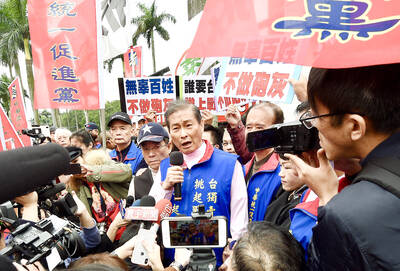
There are shadowy cabals plotting to sell out Taiwan to be annexed by China, by invasion if necessary. Fortunately, they are buffoons. In 2019, former Bamboo Union gangster and founder of the China Unification Promotion Party (CUPP), Chang An-le (張安樂, colorfully known as “White Wolf”), led a protest at the Legislative Yuan against comments made by then-premier Su Tseng-chang (蘇貞昌) that in the event of an attack by China, he would never surrender, but would protect the nation by fighting to the end, even if he only had a broom. Chang had party members bring a wooden casket that they
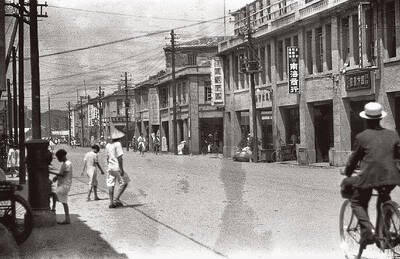
June 1 to June 7 "If all Taiwanese were as afraid of dying as you, then what would happen?” Physician Shih Chiang-nan (施江南) reportedly said this to his wife Chen Chiao-tung (陳焦桐) after she urged him to stop intervening on behalf of Taiwanese soldiers stranded overseas after serving in the Japanese Army during World War II. Shih had clashed with high-ranking officials over the issue, engaged in several heated arguments with Taiwan governor-general Chen Yi (陳儀) and allegedly shouted at general Ko Yuan-fen (柯遠芬), chief of staff of the Taiwan Garrison Command, over


 RSS
RSS