


With the Cannes film festival’s main competition bursting with big-name stars and directors like Quentin Tarantino and Terrence Malick, here are five rising talents to watch out for at this year’s festival:
CAMILA MORRONE
Up to now she may be best known as Leonardo DiCaprio’s impossibly glamorous girlfriend, but the Argentinian model is about to make a name for herself as an actress to be reckoned with.
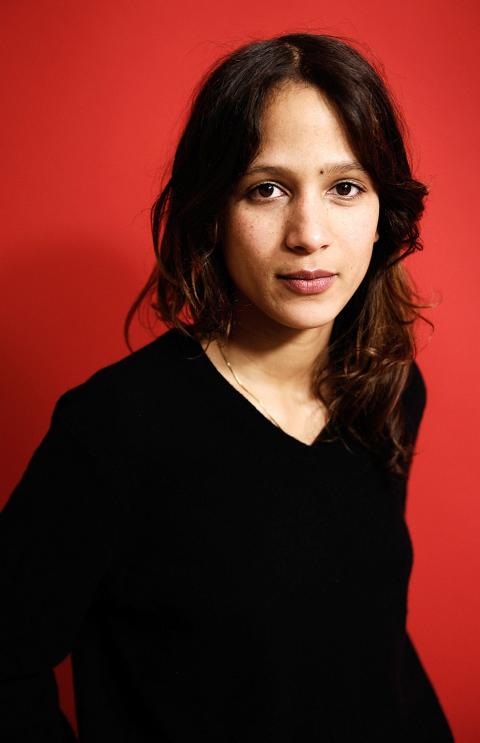
Photo: AFP
Her stand-out performance as a daughter of a opioid-addicted Iraq veteran in Mickey and the Bear brings real depth to the US indie film, which is showing in the festival’s ACID section.
Morrone, 21, has not picked her acting talent — nor her looks — up off the ground. Both her parents were models and her mother Lucia Sola is a television star in Buenos Aires, although the 43-year-old is probably best known as Al Pacino’s erstwhile partner.
The pair are no longer together — the 75-year-old Pacino having taken up with a younger actress last year. Morrone had regarded him as her “stepfather” during their nine years her mother and Pacino were together.
The two will be reunited on the Cannes red carpet with Pacino starring in Quentin Tarantino’s Once Upon a Time in Hollywood.
ROBERT EGGERS
His debut film The Witch is regarded as a modern horror classic, and the famously obsessive young US director seems to have made no compromises for his second, The Lighthouse, which is premiering in the Directors’ Fortnight.
Conditions on the set were so harsh, according to Robert Pattinson, who heads the cast alongside Willem Dafoe, that it was the “closest I’ve come to punching a director,” the actor admitted.
An exhausted Pattinson described how he remonstrated with Eggers after he had to do one take five times on a freezing Nova Scotia beach.
“I feel like you’re just spraying a fire hose in my face,” he told the director.
“And he was like, ‘I was spraying a fire hose in your face.’ It was like some kind of torture,” said Pattinson.
The pair are still firm friends, however, with the star sworn to silence on the plot of the historical black-and-white horror “set in the world of old sea-faring myths”.
WAAD AL-KATEAB
The Syrian documentary maker faced an uphill struggle bringing her film to Cannes.
For Sama records five years of al-Kateab’s own life as an aspiring journalist in her besieged hometown of Aleppo, marrying one of the last doctors in the city and giving birth to her daughter, to whom the film is dedicated.
The documentary is a kind of letter to the little girl, explaining how she was born into the conflict and what happened to her home.
Al-Kateab, who now lives in London, won an Emmy award in 2017 for her films from inside Aleppo for Britain’s Channel 4 News, which are believed to be the most watched of any reports from the war. Her shocking footage of the struggle to save babies and children in the city’s final hospital — in which she ended up living — brought home the horror inflicted on civilians.
JESSICA HAUSNER
The Austrian director who wrote Michael Haneke’s Funny Games is the running for the Palme d’Or with her first film in English, Little Joe.
This science-based chiller with Ben Whishaw, Emily Beecham and Kerry Fox about a genetically engineered plant which affects every living creature it comes into contact with could well be her break-out film.
After making her Cannes debut with Lovely Rita way back in 2001, Hausner, now 46, has slowly built a glowing reputation with a handful of films such as Hotel, Amour Fou and Lourdes, which picked up four prizes at Venice in 2009.
MATI DIOP
The only African in the race for Cannes’ top prize, actress-turned-director Diop comes from Senegalese film royalty.
She is the niece of Djibril Diop Mambety, the pioneering maker of Touki Bouki, a 1973 film premiered at Cannes which went on to inspire Beyonce and Jay-Z.
The pop power couple referenced the movie, in the form of the bull-horn handlebars of its heroes’ motorbike, in the poster for their 2014 tour On The Run II.
French-born Diop, 36, the daughter of musician Wasis Diop, has already make a documentary about her uncle’s ground-breaking story about a couple who try to ride their bike all the way to France.
Her film, Atlantics, is also about a group who decide to leave Senegal for a better life in Europe.

Taiwan’s English education system is being pulled apart by three opposing forces. Bilingual Nation 2030 pulls students toward English and global communication. Artificial Intelligence (AI) readiness pulls them toward digital judgment, verification and AI-mediated work. But Taiwan’s old exam culture pulls them back toward memorization, grammar drills, timed reading and correct answers. If the education system keeps using old exams to define success, it risks producing graduates who are neither genuinely bilingual nor genuinely AI-ready, but trained for tasks machines can already perform. The first force is Bilingual Nation 2030. Launched in 2018, the policy aimed to “help Taiwan’s workforce connect
It seems every few days one bumps into one of those “real man” comments in which Taiwan is urged to “face reality” or similar, and “make a deal,” with the speaker implying that soon it will be too late. “Deal” advocates always present themselves as having a superior grip on reality, and the manly ability to make the “hard choice.” Their testosterone-laden language often echoes that of Taiwan sellout advocates. Note that such commentary always specifies a process (“make a deal, work with, make progress”), never the end state of what occupation by a violent authoritarian colonialist state will entail. In

There are shadowy cabals plotting to sell out Taiwan to be annexed by China, by invasion if necessary. Fortunately, they are buffoons. In 2019, former Bamboo Union gangster and founder of the China Unification Promotion Party (CUPP), Chang An-le (張安樂, colorfully known as “White Wolf”), led a protest at the Legislative Yuan against comments made by then-premier Su Tseng-chang (蘇貞昌) that in the event of an attack by China, he would never surrender, but would protect the nation by fighting to the end, even if he only had a broom. Chang had party members bring a wooden casket that they

June 1 to June 7 "If all Taiwanese were as afraid of dying as you, then what would happen?” Physician Shih Chiang-nan (施江南) reportedly said this to his wife Chen Chiao-tung (陳焦桐) after she urged him to stop intervening on behalf of Taiwanese soldiers stranded overseas after serving in the Japanese Army during World War II. Shih had clashed with high-ranking officials over the issue, engaged in several heated arguments with Taiwan governor-general Chen Yi (陳儀) and allegedly shouted at general Ko Yuan-fen (柯遠芬), chief of staff of the Taiwan Garrison Command, over


 RSS
RSS