


It would have made for a fairy-tale presidency. Local boy wins election to the highest office in the land — and then it’s discovered that the town where he grew up in poverty is sitting on a hugely valuable natural gas field.
It didn’t quite happen like that, of course. Former president Chen Shui-bian (陳水扁) was born in 1950 in what’s now Kuantien District (官田), smack in the middle of Tainan. He isn’t, to put it mildly, the most revered ex-politician in Taiwan. It’s been many years since tourists queued to see his childhood home in the village of Sijhuang (西庄), a few hundred meters north of the Zengwen River (曾文溪). Nor has Kuantien become Taiwan’s Qatar.
In June 2004 — a few months after Chen narrowly won a second term in office — media reports said that the Kuantien gas field contained an estimated 400 million cubic meters of reserves valued at NT$2.5 billion. The following year, however, the numbers were scaled back to 150 million cubic meters worth NT$1 billion. Then, in December 2012, a report on the Liberty Times (the Taipei Times’ sister newspaper) Web site pointed out that the 86 million cubic meters of natural gas which the authorities hoped to extract from the only productive site in the area, Kuantien No. 4 Well (官田4號井), would be enough to meet Taiwan’s gas needs for just three days.
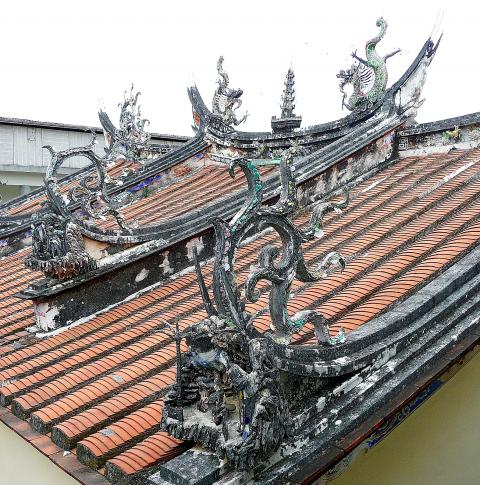
Photo: Steven Crook
Gas-extraction infrastructure is visible to anyone traveling by train between Tainan and Chiayi. Kuantien No. 2 Well (官田2號井) is just inland of Longtian Railway Station (隆田車站), and best approached via Taiwan Highway 1. Arriving by bicycle, I found the intersection of Highway 1 and Highway 165, then took the little farmers’ road opposite. It heads west, straight toward the railroad, and after 100m or so, I saw the gas well on my left.
Unlike the four or five places in southern Taiwan where natural gas seeps out of the ground and burns throughout the year, this isn’t a conventional tourist attraction. A sturdy fence stops outsiders from getting too close to the red, yellow and silver equipment that caps and monitors the well. The entire area within the perimeter has been covered with gravel, like a Zen garden that’s never raked. There are no trees or bushes; whenever grass tries to establish a foothold, the upkeep crew responds with herbicide. The site looks perfectly maintained — for reasons of safety, no doubt, but also in case a technological advance makes extraction financially worthwhile.
Signs on the fence tell people entry is forbidden, and that smoking isn’t allowed. The latter is charmingly old-fashioned: A red line through the kind of tobacco pipe my grandfather smoked, and which I don’t think I’ve ever seen in Taiwan.
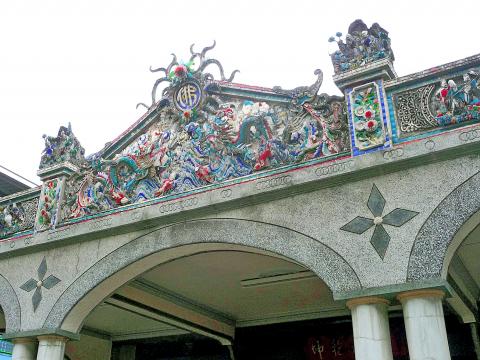
Photo: Steven Crook
Another place of interest is located less than 1km southwest of Kuantien No. 2 Well. The Pheasant-Tailed Jacana Ecological Education Zone (水雉生態教育園區) was created in the late 1990s after environmental groups protested that the high-speed railway would run through wetlands at Hulupi (葫蘆埤), a key breeding location for the Pheasant-tailed jacana.
This wader species isn’t globally endangered, but the population in Taiwan dwindled to a few hundred because many of its habitats were drained and developed. Conservation efforts seem to have reversed the bird’s decline, but pedaling through the countryside here, I saw plenty of evidence of another ecological problem.
Around the edges of the water-chestnut ponds for which Kuantien is famous, I saw clusters of tiny pink eggs. Rice fields left fallow and drained were littered with hundreds of snail shells. Once the golden apple snail (known in Mandarin as fushouluo, 福壽螺) establishes itself, it’s almost impossible to eradicate. Baby snails usually feed on young rice plants, while adult gastropods are notorious for chewing ready-to-harvest taros.
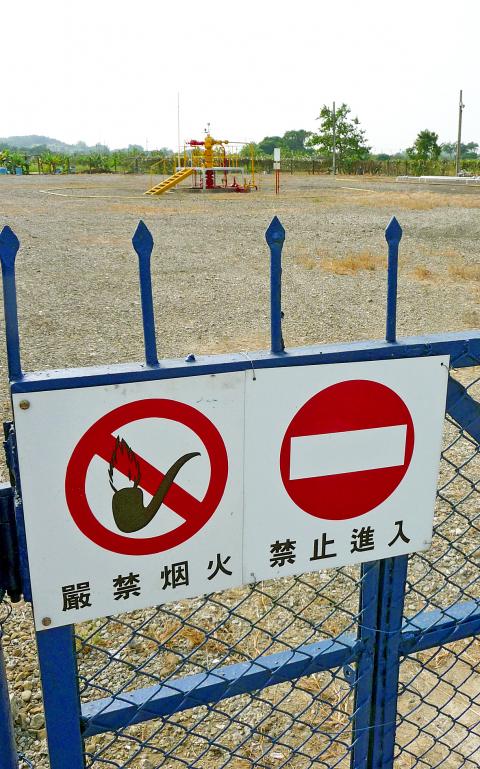
Photo: Steven Crook
These snails aren’t native to Taiwan. More than 30 years ago, they were intentionally introduced from Latin America by entrepreneurs who hoped to develop an export trade. Unfortunately, their meat, while nutritious, is far from delicious. Even those Taiwanese who collect and eat wild snails leave golden apple snails alone.
My next stop was a place in neighboring Liujia District (六甲區) that, thanks to a confluence of water and topography, is believed to have excellent fengshui. Surrounded on three sides by a pond, Chishan Longhuyan Temple (赤山龍湖巖) is said to have been founded by Chen Yung-hua (陳永華), a key figure in the 17th century Ming-Koxinga, also known as Cheng Cheng-kung (鄭成功), period, just prior to the Ching Empire’s annexation of Taiwan.
According to one legend, in 1665 Chen was encamped at this spot with some soldiers. When he awoke, he heard drums and bells, and thought there must be a temple nearby. But there wasn’t — and he interpreted his auditory hallucination as a sign he should dedicate this place to Buddhism.
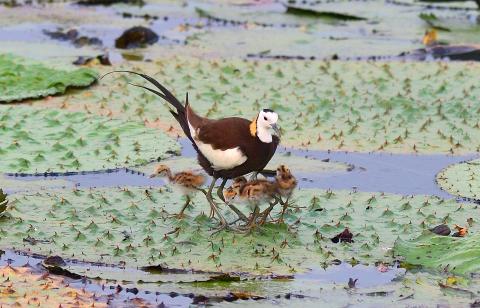
Photo: Yang Chin-cheng, Taipei Times
The shrine has been rebuilt and expanded several times over the centuries, but if you go through the front building you’ll come to one part that obviously hasn’t been renovated for a very long time. In Taiwan, where a great many places of worship have been made over so thoroughly they’ve lost a good part of their charm and individuality — the “no two are different” phenomenon — it’s startling to see a roof which has lost so much of its ceramic applique (剪黏) decoration.
The sculptures retain their shapes, but are largely bereft of the tiny shards of porcelain that give temple roofs their colorful intricacy. The effect is almost monochromatic, a little drab, and yet still appealing. The dragons and qilins made me think of stray dogs which have lost their fur.
There are artisans in Taiwan who specialize in ceramic applique, so perhaps the issue is money. You can be sure, however, that if it had turned out that this part of Taiwan is floating on natural gas, the roof would’ve been repaired by now.
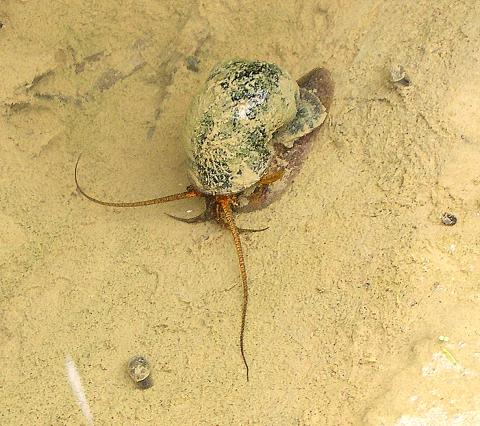
Photo: Steven Crook
Steven Crook has been writing about travel, culture, and business in Taiwan since 1996. Having recently co-authored A Culinary History of Taipei: Beyond Pork and Ponlai, he is now updating Taiwan: The Bradt Travel Guide.
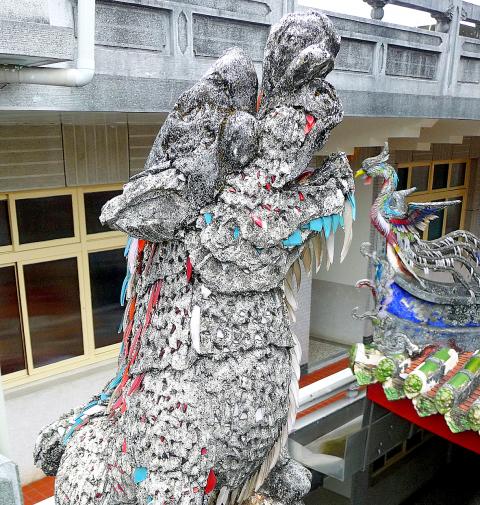
Photo: Steven Crook
Ajay Verma, a consultant gastroenterologist at Kettering general hospital in Northamptonshire, says our gut is a “complex machine.” “It is constantly providing us with the nutrition we need, initially to grow and develop, and then for us to survive, thrive and repair from injury and illness.” How can we keep it functioning well? Put simply: “Make sure what you put into it is balanced, and that you clear out its waste products adequately,” Verma says. “In a general gastroenterology clinic, the most common conditions we see are irritable bowel syndrome (IBS), gastroesophageal reflux disease, inflammatory bowel disease and constipation,” says Nisha
The arithmetic is straightforward and uncomfortable. By the end of 2025, Taiwan had committed itself to a 50-30-20 electricity mix — half natural gas, 30 per cent coal, 20 per cent renewables. The Ministry of Economic Affairs’s (MOEA) own monthly energy reports tell a different story. Natural gas reached 47.8 per cent of generation last year. Coal stood at 35.4 per cent, comfortably above its target ceiling. Renewables came in at 13.1 per cent, well short of the 20 per cent Taipei had pledged a decade earlier. Installed renewable capacity reached roughly half of the 12 gigawatts (GW) the government

Last week US President Donald Trump was asked by a reporter whether he would speak on the phone to the President of Taiwan. “l’ll speak to him. I speak to everybody. We have that situation very well in hand,” Trump said. This marked the second time in a couple of weeks he had said he would talk to the President of Taiwan. In 2016 he famously took a call from then-president Tsai Ing-wen (蔡英文), when he was president-elect. Despite warnings that the apocalypse was nigh because of a phone call, the world quickly forgot about the conversation between two democratically-elected presidents.
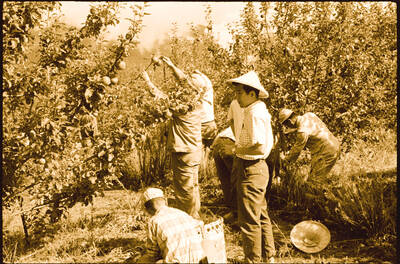
May 25 to May 31 Few believed that apples could be cultivated on a commercial scale in Taiwan’s high mountains. When horticulturalist Cheng Chao-hsiung (程兆熊) first proposed the idea in 1955, both American and Taiwanese colleagues dismissed it as implausible, arguing that temperate fruit could not be reliably grown on a subtropical island, especially on rugged terrain. However, it was this terrain in the Central Mountain Range where many Chinese Civil War veterans were resettled in the late 1950s. With limited job prospects and no family in Taiwan, they were placed on cooperative farms aimed toward self-sufficiency. Some say the conditions


 RSS
RSS