


Diving into a long hole cut in the ice, Viktoria Tsuranova swims a few strokes and flashes a smile at the photographer capturing the moment for her Instagram account.
She is one of a new generation of Russian “Walruses” — hardy swimmers who plunge into frozen rivers and lakes all through the winter. They swear it wards off not just colds but also cellulite, as well as giving them a rush of euphoria.
Ice swimming in Russia has long been associated with older, usually Speedo-clad men. But Tsuranova and other members of Moscow’s “Walruses of the Capital” club are giving it a fashionable new image.
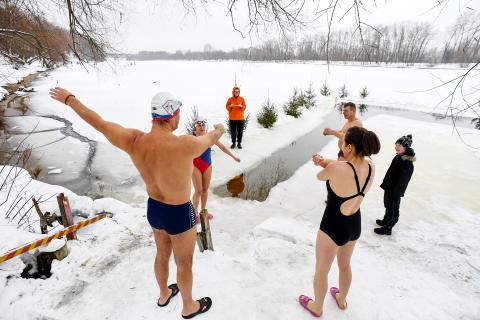
Photo: AFP
“A sporty way of life is right on trend now,” says Nikolai, drinking rosehip tea with honey in a grey onesie. He has just taken a dip in the L-shaped strip of water cut by the bank of the Moskva River, in the relatively balmy air temperature of minus two degrees Celsius.
“There’s a kind of new wave of young people coming up now, following the generation that set the standard for walrus swimming — the older generation.”
Tsuranova, a fitness blogger, later posts a video and photo of her swim on her Instagram, which has 103,000 followers.
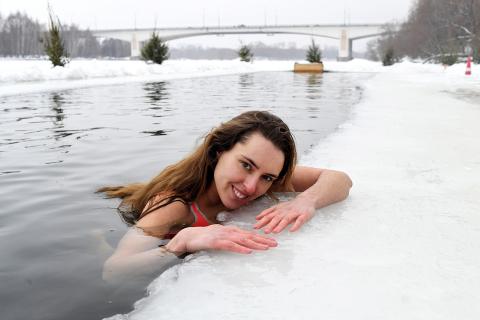
Photo: AFP
Shivering a little in a fur coat after her swim, she says: “I’m just interested in the extreme, in testing myself. I’m scared every time.” She says she hasn’t been ill once over the winter. “It’s a great way to prevent excess fat deposits and cellulite,” Tsuranova adds.
POTENTIAL DANGERS
Others are more equivocal on the health effects of ice swimming, defined as taking a dip in water temperatures of zero to four degrees Celsius.
Russia’s winter swimming federation, based in the Siberian city of Tyumen, lists joint health and good skin among the benefits. But it also warns that those with weak hearts or breathing problems should not attempt it. A separate study by Tyumen scientists in 2015 found that the cold temperature caused stress on the body for people who swam in ice over a period longer than 10 years.
Ice swimming is also practiced in Scandinavia and China, though it is particularly popular in Russia, where cold water is seen as a way to toughen people up. Millions of Orthodox believers in the country plunge into icy pools every Epiphany as part of a religious tradition.
‘MY ELEMENT’
The facilities at the “Walruses of the Capital” club are minimal — a green-painted hut with tiny changing rooms heated by stoves.
Depending on their experience, ice swimmers tend to stay in the water for anything from one to around five minutes. But the club is not just an amateur organization — it also trains swimmers to take part in international competitions held outdoors in winter.
The club’s star swimmer Osman Delibash, 26, trains regularly and recently made a video showing her sitting for an hour in the frozen-over pond in her garden.
This set a record recognized by a Russian association for the longest stint in cold water by a woman.
She has also won a string of medals for swimming distances of up to a kilometer in sub-zero air temperatures.
Delibash, who also teaches soldiers serving in extra-cold environments and performs as a stunt woman, walks around in the snow bare-legged in a bathrobe.
“Water is my element — specifically icy water,” she says.
EUPHORIA
The club’s founder and Delibash’s trainer, Natalya Seraya, gives out certificates to a group of new “walruses” as they crowd inside the steaming hut.
Seraya, who has set Russian records for marathon ice swims, tells them: “Nothing will boost your immunity more strongly than icy water.”
“This is the path to health and long years of active life.”
However, as part of her postgraduate studies, she is also researching, with the help of some of the club’s ice swimmers, where the limits in its benefits lie.
“What’s good for you, what’s dangerous, where is the dividing line?” Seraya says, describing the outlines of her research into the effects of ice swimming.
Swimmers also talk about experiencing psychological benefits from dips.
“There’s some kind of cleansing, as if you reset yourself back to zero,” said first-time swimmer Tatiana Batalova, while blogger Tsuranova says she feels a “high” on emerging.
“When you come out of the water you feel warm and joyful like you’re on wings. You could even call it euphoria,” says Seraya.

Michael slides a sequin glove over the pop star’s tarnished legacy, shrouding Michael Jackson’s complications with a conventional biopic that, if you cover your ears, sounds great. Antoine Fuqua’s movie is sanctioned by Jackson’s estate and its producers include the estate’s executors. So it is, by its nature, a narrow, authorized perspective on Jackson. The film ends before the flood of allegations of sexual abuse of children, or Jackson’s own acknowledgment of sleeping alongside kids. Jackson and his estate have long maintained his innocence. In his only criminal trial, in 2005, Jackson was acquitted. Michael doesn’t even subtly nod to these facts.

Writing of the finds at the ancient iron-working site of Shihsanhang (十 三行) in New Taipei City’s Bali District (八里), archaeologist Tsang Cheng-hwa (臧振華) of the Academia Sinica’s Institute of History and Philology observes: “One bronze bowl gilded with gold, together with copper coins and fragments of Tang and Song ceramics, were also found. These provide evidence for early contact between Taiwan aborigines and Chinese.” The Shihsanhang Web site from the Ministry of Culture says of the finds: “They were evidence that the residents of the area had a close trading relation with Chinese civilians, as the coins can be

The March/April volume of Foreign Affairs, long a purveyor of pro-China pablum, offered up another irksome Beijing-speak on the issues and solutions for the problems vexing the People’s Republic of China (PRC) and the US: “America and China at the Edge of Ruin: A Last Chance to Step Back From the Brink” rang the provocative title, by David M. Lampton and Wang Jisi (王緝思). If one ever wants to describe what went wrong with US-PRC relations, the career of Wang Jisi is a good place to start. Wang has extensive experience in the US and the West. He was a visiting

The January 2028 presidential election is already stirring to life. In seven or eight months, the primary season will kick into high gear following this November’s local elections. By this point next year, we will likely know the Democratic Progressive Party (DPP) candidate and whether the Taiwan People’s Party (TPP) will be fielding a candidate. Also around this time, the Chinese Nationalist Party (KMT) will either have already completed their primary, or it will be heading into the final stretch. By next summer, the presidential race will be in high gear. The big question is who will be the KMT’s


 RSS
RSS