


After experiencing homelessness in 2011, Sarah Eby found herself constantly collecting things so she would never again feel she had nothing to call her own.
“When I moved into my apartment, it just felt empty,” the mother-of-one from Arvada, Colorado said. “I got everything I could to try and make it feel like I had a home.”
But as Eby moved house over the years, the clutter built up. Now, inspired by the Japanese home organizing guru Marie Kondo, the 27-year-old says she has banished the chaos for good. And she’s hardly the only one.

Photo: AFP
Kondo is small in stature, but her tidying philosophy has reached stratospheric heights.
Her book, The Life Changing Magic of Tidying Up, has earned a cult following since its publication in the US in 2014, with millions adopting her suggestions for a neater, happier existence.
But it is the 34-year-old’s new Netflix show, Tidying up with Marie Kondo — released on New Year’s Day, when everyone is keen to reinvent themselves and motivated by their resolutions — that has everyone talking.
“I love mess,” Kondo proclaims in the show, which sees her visit American homes — flanked by her interpreter — to implement her trademarked “KonMari” method.
The idea is simple: gather your things one Kondo-defined category at a time and go through them one by one, keeping only those that “spark joy,” and giving them a place in your home.
As for the rest, a KonMari convert thanks his or her used items and tags them for donation or the garbage can.
At the end, most converts find they have far fewer possessions, and a happier outlook.
“I think it plays an integral role with my relationship to things,” said Eby, who watched one episode of the show before diving into the book.
“I was never messy or unclean or untidy — I just had too many things. And so the part that I connected with most would be the letting go of the things that don’t bring me joy.”
OVERNIGHT ICON
Almost overnight, Kondo has emerged as a cultural icon — she is the subject of countless viral tweets and memes, and a flurry of think pieces unpacking the show in surprising, somewhat disconcerting depth.
Her method however is not without controversy: advice to donate old books has infuriated bibliophiles on social media.
But for Den Kovacs, a video games journalist and KonMari disciple, Kondo — with her gentle, judgment-free encouragement — is a welcome antidote to harsh reality TV, not to mention American chaos.
“People really do feel ... chaotic, they feel overwhelmed,” said the 23-year-old from Livonia, Michigan. “So when they see someone who comes in, and she’s like, ‘I can fix this! We got this!’ ... people are like ‘Yes, I need this in my life.’”
Social media users have already reported a “Kondo effect” at local thrift stores, with more goods pouring in for resale — although a national spokesperson for Goodwill said it is “too soon to tell.”
And as viral trends go, KonMari-mania is one that could actually be good for people: according to a 2016 study, too much clutter can be bad news for wellbeing.
“The more clutter you have ... the less your sense of home, the less your sense of life satisfaction,” said DePaul University psychologist Joseph Ferrari, a co-author of the study.
“That’s contrary to what people might think. They think that you have to have more, and people with abundance are happier people. No.”
‘IT FEELS REALLY GOOD’
Kondo’s fans are earnestly reporting the benefits of going clutter-free.
“It feels really good,” says Kovacs, who explored other tidying approaches, but found KonMari to be the most effective.
“I really decluttered my mind. It felt like I had less stress, less to focus on ... I could focus on myself.”
Meanwhile, for Olguyne Fernandez-Fraga, a 27-year-old nutritionist from Miami, Kondo has boosted her social life.
“Before it would be like ‘Oh, can we invite so and so over?’ and it was like ‘No, look at the house,’” Fernandez-Fraga said.
“Whereas now, it’s like yeah, they could come in the next 10 minutes if they want to.”
And in the digital age, it turns out even e-mail inboxes and social media friends can be “KonMaried.”
“I just went down the (Facebook) list and asked myself, ‘Does this person spark joy?’” Kovacs explained.
“As soon as you start to ask that about someone, you suddenly realize the people that add value to you,” he said.
“You certainly appreciate them a lot more than you did before.”

It’s only half the size of its more famous counterpart in Taipei, but the Botanical Garden of the National Museum of Nature Science (NMNS, 國立自然科學博物館植物園) is surely one of urban Taiwan’s most inviting green spaces. Covering 4.5 hectares immediately northeast of the government-run museum in Taichung’s North District (北區), the garden features more than 700 plant species, many of which are labeled in Chinese but not in English. Since its establishment in 1999, the site’s managers have done their best to replicate a number of native ecosystems, dividing the site into eight areas. The name of the Coral Atoll Zone might

On Monday morning, in quick succession, the Chinese Communist Party (CCP) and the Chinese Nationalist Party (KMT) released statements announcing “that the Central Committee of the Communist Party of China and General Secretary Xi Jinping (習近平) have invited KMT Chairwoman Cheng Li-wun (鄭麗文) to lead a delegation on a visit to the mainland” as the KMT’s press release worded it. The KMT’s press release added “Chairwoman Cheng expressed her gratitude for the invitation and has gladly accepted it.” Beijing’s official Xinhua news release described Song Tao (宋濤), head of the Taiwan Work Office of the CCP Central Committee, as
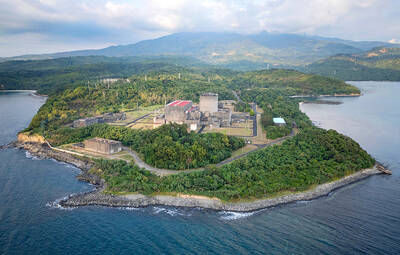
Nuclear power is getting a second look in Southeast Asia as countries prepare to meet surging energy demand as they vie for artificial intelligence-focused data centers. Several Southeast Asian nations are reviving mothballed nuclear plans and setting ambitious targets and nearly half of the region could, if they pursue those goals, have nuclear energy in the 2030s. Even countries without current plans have signaled their interest. Southeast Asia has never produced a single watt of nuclear energy, despite long-held atomic ambitions. But that may soon change as pressure mounts to reduce emissions that contribute to climate change, while meeting growing power needs. The
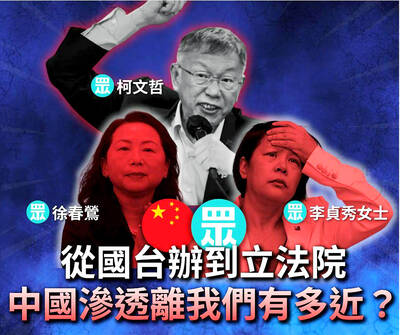
Last week saw Ko Wen-je (柯文哲), former Taipei mayor and founder of the Taiwan People’s Party (TPP), receive a 17-year sentence for crimes involving political corruption. This was only the opening round: the case is likely to drag on for several more years in appeals. Both the TPP and the Chinese Nationalist Party (KMT) are claiming that the prosecutors are engaging in a political witch hunt, green terror, fascism and so forth. It is easy to see this as a kind of compensation. After all, otherwise they would have to admit that the rather impressive collection of evidence against Ko actually


 RSS
RSS