


Taiwan’s Hakka minority is associated with the hillier parts of the northwest and certain inland districts in the south. Being a pancake-flat coastal township, Jiadong Township (佳冬) in Pingtung County is therefore an outlier.
It’s also a backwater. Few of those driving or riding down to Kenting National Park (墾丁國家公園) use Highway 17, the road that passes through the oldest and most interesting part of Jiadong. The township’s population has been shrinking for some time. As of late last year, the number of residents was about 19,000, 6 percent fewer than in mid-2014.
Another demographic change has been more gradual. Once resoundingly Hakka, nowadays nearly half of Jiadong’s inhabitants are non-Hakka. Some of the speakers of Hoklo (more commonly known as Taiwanese) who’ve relocated to Jiadong in recent years have done so to run fish farms. Between the railway line and coast, a distance of about 1.8km, aquaculture dominates the landscape.
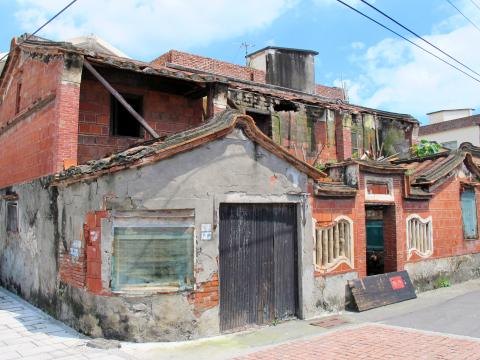
Photo: Steven Crook
Jiadong has more than its fair share of classical buildings, the grandest of which stands at the intersection of Goujhu Road (溝渚路) and Cinan Road (啟南路). The Hsiao Family Residence (蕭家古厝) is a 51-room complex that was built in stages from the 1860s to the beginning of the 20th century.
The Jiadong Hsiao clan are descended from Hsiao Ta-mei (蕭達梅) a Hakka man who migrated to Taiwan from what was then called Mei County (梅縣) in China’s Guangdong Province, but which is now part of Meizhou City (梅州市). Hsiao Ta-mei lived and prospered in Tainan. One of his grandsons, Hsiao Kuang-ming (蕭光明, 1841-1911), relocated to Jiadong to expand the family’s rice-milling and cloth-dyeing businesses.
When the Imperial Japanese Army landed in Taiwan to enforce the island’s cession to Tokyo by the Qing Empire, Hsiao Kuang-ming was appointed deputy commander of an anti-Japanese Hakka volunteer force. They marched toward Takao (modern-day Kaohsiung), but were unable to cross a river. Returning to Jiadong, they dug in and waited.
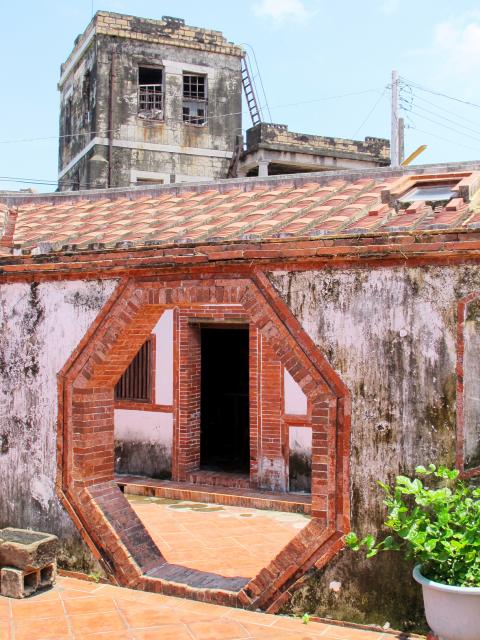
Photo: Steven Crook
Japanese forces arrived on Oct. 11, 1895, and the shooting began. Hsiao’s second son was killed and his third son wounded before Taiwanese resistance collapsed. Fleeing with two of his grandchildren, Hsiao Kuang-ming made his way to Guangdong.
Hsiao stayed in China until 1899, when he negotiated a return to Taiwan. The Japanese colonial government appointed him to a minor local-government position, and he supervised further expansion of the residence. Craftsmen were brought in from Fujian Province, and much of the wood used was imported from other parts of China.
The residence is typical of Chinese architecture, but the south-facing facade — one of the few features you can properly appreciate if you don’t pay for admission (NT$50 for adults, NT$30 for children) — is an anomaly. During the reign of Japanese Emperor Taisho (1912-1926), after the original entrance was wrecked by a typhoon, the clan’s leaders decided to show they were keeping up with the times by having it rebuilt in the ornate baroque-influenced manner then popular. If you’ve visited Dasi Old Street (大溪老街) in Taoyuan, you’ll recognize the style.
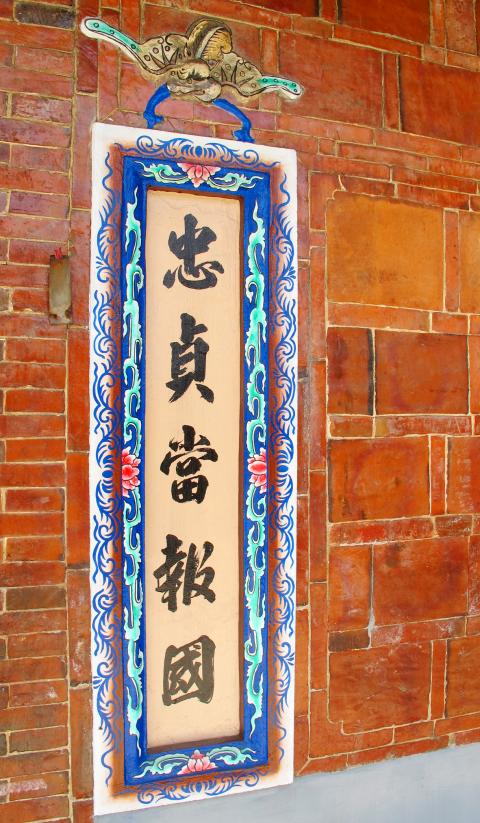
Photo: Steven Crook
Opening hours are 9am to midday and 2pm to 5pm, Tuesday to Sunday, but because the clan members who staff the entrance and show visitors around sometimes take time off, it’s a good idea to get a Chinese-speaker to call ahead (tel: 0932-200-024) if you plan to visit on a weekday.
Do join a guided tour if possible. There’s no additional charge, and you’ll learn a lot about the history of the building and the thorough yet sensitive restoration it underwent at the turn of the century.
The authorities provided NT$86 million in subsidies, and helped arrange temporary housing so people living in the residence could move out while the roofs were fixed, floor tiles were replaced and insect screens added. Currently, about two dozen people inhabit the back of the complex.
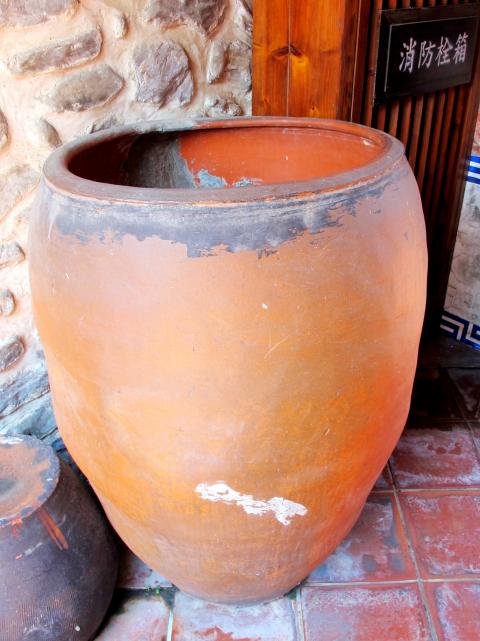
Photo: Steven Crook
The new tiles match the old ones in terms of color, but are of a different material that doesn’t become slimy. The screens don’t detract from the traditional appearance of portals. At the same time, the drains around the complex were redone. Because the original drains were quite deep, tourists had fallen in them, and the residents struggled to keep them clear of leaves and other debris.
Exploring with a clan member, I learned that the hexagonal and rectangular entrances that link different parts of the complex are deliberately unaligned. It was believed that having one doorway facing another was like setting one person’s mouth in opposition to the mouth of another, and would lead to relatives arguing. And I had no idea that the hefty ceramic pot standing in a hallway served as a one-person air-raid shelter during World War II.
On the other side of Goujhu Road, the three-floor Hsiao Family Western House (蕭家洋樓) is in awful condition and not open to the public. Completed in 1930, it’s said to have been the first private home in Taiwan constructed using cinder blocks. Following World War II, a physician used it as his clinic, but after he moved overseas it fell into disrepair.
Not quite so neglected is the Lisyue Di (理學第) on Lane 185, Goujhu Road (溝渚路185巷). This is where members of the Luo (羅) clan worship an ancestor who arrived in Taiwan six generations ago, and add the names of children and grandchildren to a printed family tree that stretches across a wall on the left as you enter the front building. If you look around the compound, you’ll get a good idea of what happens when ownership becomes fragmented by inheritance. Some segments are kept up; others have been crudely renovated, or left to collapse.
The Zhang A-ting House (張阿丁宅), on the corner of Hsibian Road (西邊路) and Donggen Road (冬根路), is likely the oldest two-floor structure in the town. In 2011, when the building was close to 100 years old, part of the roof and one wall collapsed. Afraid that this unique abode would be lost forever, locals and conservationists began lobbying for restoration funds.
In 2012, when I first visited Jiadong, the house was still in a very sorry state. By the end of 2014, however, the rescue was complete, and tourists could go inside. Any sense of real antiquity has been lost, however. That’s probably a price that had to be paid — and elsewhere in Jiadong, there are enough teetering piles and crumbling dwellings to satisfy the most ardent seeker of times gone by.

Taiwan’s English education system is being pulled apart by three opposing forces. Bilingual Nation 2030 pulls students toward English and global communication. Artificial Intelligence (AI) readiness pulls them toward digital judgment, verification and AI-mediated work. But Taiwan’s old exam culture pulls them back toward memorization, grammar drills, timed reading and correct answers. If the education system keeps using old exams to define success, it risks producing graduates who are neither genuinely bilingual nor genuinely AI-ready, but trained for tasks machines can already perform. The first force is Bilingual Nation 2030. Launched in 2018, the policy aimed to “help Taiwan’s workforce connect
It seems every few days one bumps into one of those “real man” comments in which Taiwan is urged to “face reality” or similar, and “make a deal,” with the speaker implying that soon it will be too late. “Deal” advocates always present themselves as having a superior grip on reality, and the manly ability to make the “hard choice.” Their testosterone-laden language often echoes that of Taiwan sellout advocates. Note that such commentary always specifies a process (“make a deal, work with, make progress”), never the end state of what occupation by a violent authoritarian colonialist state will entail. In
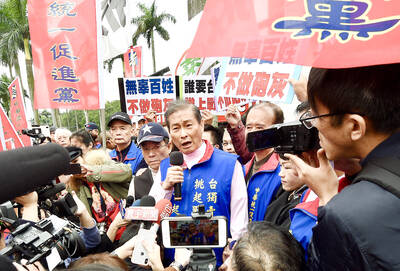
There are shadowy cabals plotting to sell out Taiwan to be annexed by China, by invasion if necessary. Fortunately, they are buffoons. In 2019, former Bamboo Union gangster and founder of the China Unification Promotion Party (CUPP), Chang An-le (張安樂, colorfully known as “White Wolf”), led a protest at the Legislative Yuan against comments made by then-premier Su Tseng-chang (蘇貞昌) that in the event of an attack by China, he would never surrender, but would protect the nation by fighting to the end, even if he only had a broom. Chang had party members bring a wooden casket that they
June 1 to June 7 "If all Taiwanese were as afraid of dying as you, then what would happen?” Physician Shih Chiang-nan (施江南) reportedly said this to his wife Chen Chiao-tung (陳焦桐) after she urged him to stop intervening on behalf of Taiwanese soldiers stranded overseas after serving in the Japanese Army during World War II. Shih had clashed with high-ranking officials over the issue, engaged in several heated arguments with Taiwan governor-general Chen Yi (陳儀) and allegedly shouted at general Ko Yuan-fen (柯遠芬), chief of staff of the Taiwan Garrison Command, over


 RSS
RSS