


I’m prepared to bust out my rudimentary Thai as I walk toward the cashier — but it turns out, I didn’t need it. “Shi wu,” the lady says in Yunnanese Mandarin instead of sip ha, Thai for the number 15. I know I’m getting close.
As the songthaew, a common type of bus-truck, sputters its way up the rugged mountain roads, I see more and more road signs with both Thai and Chinese. I’m dropped off at a dusty intersection where the Akha, Lisu and other hill tribes, wearing their distinctive headdresses and colorful clothing, are hawking their wares in a large open-air market.
A man with a baby on his back walks up to me and starts speaking in Chinese.
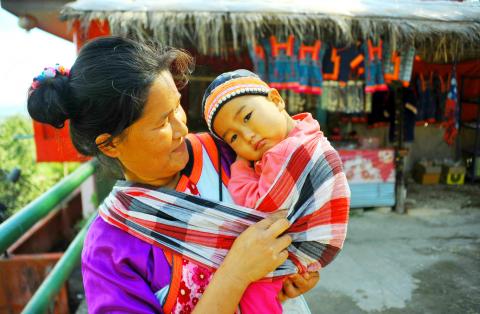
Photo: Han Cheung
“If you need any help, just come to my store and ask,” he offers. I thank him, turn around and spot a distinctive white Chinese-style gate with the Chinese Nationalist Party (KMT) logo on it, marking the mausoleum of General Tuan Hsi-wen (段希文) — the man responsible for the overwhelming Chinese presence here in Mae Salong.
In its early days, Mae Salong, also known as Santikhiri, was a treacherous jungle beyond Thai control, inhabited by a handful of hill tribes. While most KMT troops fled to Taiwan or remained in China after losing the Chinese Civil War in 1949, a handful belonging to the 93rd Division refused to surrender and fled across the Myanmar border.
General Tuan, who had retreated to Hong Kong, grew restless and returned to the battlefield to lead these troops. But KMT leader Chiang Kai-shek (蔣介石) ordered them out of Myanmar and they later sought asylum in Mae Salong in 1961, making a living as anti-communist fighters for the Thai army as well as drug producers and traffickers.
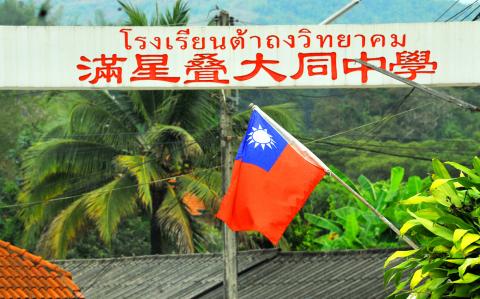
Photo: Han Cheung
Despite there being no roads at the time leading to this area, intrepid Western tourists somehow made their way here, which essentially served as a base for Tuan’s 5th regiment of the 93th division. The first guesthouse opened in 1970, and today there’s at least five or six in the immediate vicinity with several fancier resorts down the road. Many houses look like they belong in Taiwan, with the iconic metal doors surrounded by spring couplets, and most restaurants serve Yunnanese instead of Thai fare, with one even offering Taiwanese braised fatty pork over rice.
While tourists are drawn in by the curious history and cultural anomaly of there being a mini-China in northern Thailand, there are also breathtaking treks through the surrounding tribal villages and high grade oolong tea and arabica coffee, which have largely replaced poppy as the area’s main cash crop.
GENERAL TUAN FiGHTS THE COMMUNISTS
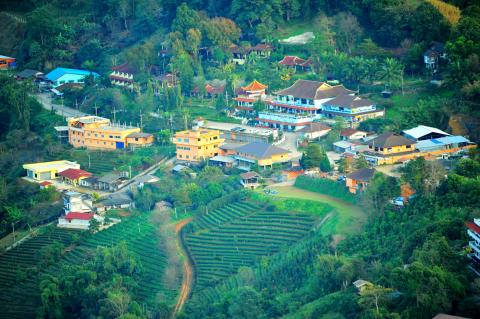
Photo: Han Cheung
Wearing his father’s fatigues and KMT helmet, Chang Tai-hua (張泰華) has stood guard over Tuan’s grave for the past 18 years. Now in his 60s, Chang provides visitors with incense and recounts the story about how Tuan was able to lead his battle-weary troops to this area to find some semblance of stability.
“I am loyal and devoted to General Tuan,” he says. “We all grew up eating the rice he provided. Without him, we wouldn’t be here today.”
After arriving in Thailand, Tuan struck a deal with the Thai government where they would be allowed to stay in return for helping fight Thai communists and other invaders. Tuan told a British journalist in 1967 that the illegal opium trade funded his army. Fighting ended in the early 1980s, upon which the soldiers and their families were granted Thai citizenship.
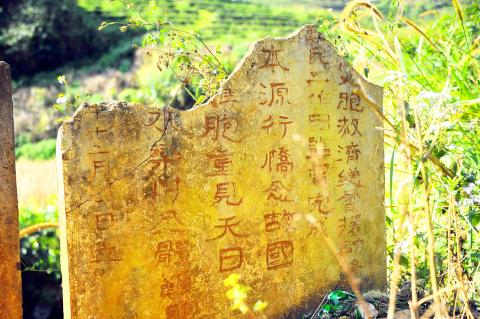
Photo: Han Cheung
Detailed history can be found at the Chinese Martyr’s Memorial Museum, a sprawling complex containing a massive hall with spirit tablets of dead soldiers.
The area has a complex relationship with Taiwan. While thousands of soldiers and their families retreated to Taiwan in two waves after the civil war, Chiang wanted Tuan and other leaders to keep a contingent here to aid his anti-communist efforts. The diaspora identified more with the Republic of China than Taiwan, and many of these schools still use revised Taiwanese textbooks despite ramped up efforts from the Chinese to win the loyalty of overseas huaren (華人, people of Chinese descent). While some prefer China now, countless students over the past few decades have studied and settled in Taiwan, including three out of the five children of Mrs. Hu (胡), who owns the guesthouse where I’m staying.
This “lost army” was brought to national attention with the release of A Home Too Far (異域), a 1990 movie that depicted the KMT soldiers’ struggles in this village. Support poured into the area, and its legacy is impossible to miss. A short walk in the countryside brings you bridges and other infrastructure built by Taiwanese relief organizations. Even tiny Hua Hsing Elementary School has a large plaque honoring its sponsor, the Taoyuan Association of Interior Design and Decoration, who donated the building in 1996.
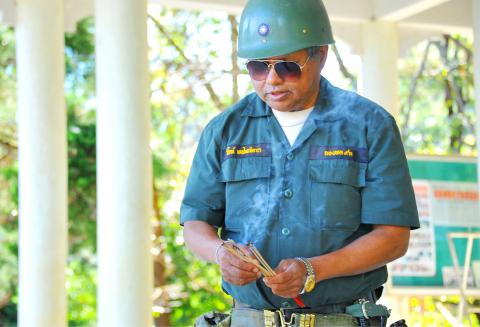
Photo: Han Cheung
The fervor for the town eventually subsided, and by the time the Democratic Progressive Party (DPP) came to power in 2000, the political narrative had changed. Locals say that support still trickles in, and many shy away from discussing politics, claiming that the two sides still enjoy a good relationship. But few seemed happy about KMT chairman Wu Den-yih’s (吳敦義) visit in 2017, a year after the KMT lost power again to the DPP.
“He’s just here to qunuan (取暖),” a resident said, a popular euphemism that means groveling for support. “Did he bring anything to help us?” another asked.
The younger generation doesn’t seem to care that much about politics. Just like in Taiwan, despite the fact that their fathers or grandfathers fought the Chinese communists, they tend to go where the opportunities are.
“No, [the squabbles between the KMT and the Chinese communists are] all in the past, and it has nothing to do with politics anymore,” the 30-something son of a former KMT soldier tells me. “China is stronger, and it offers better incentives. However, the competition there is vicious as well. That’s why I prefer living here.”
EVERYONE LEARNS CHINESE
On my second day in Mae Salong, I find myself playing bass guitar for the 10:30am service at a Chinese-speaking church in nearby Ban Klang village. It was Sunday morning and I had been drawn in by the sounds of worship, only to notice that the band was missing a member.
I’m surprised to find that despite being proficient in Mandarin, neither the guitarist or drummer are ethnic Chinese — they are Akha, who arrived here from China half a century before the KMT and now number about 80,000 in northern Thailand.
“We have Akha, Lisu, Lahu, Chinese living together in this village,” says the guitarist, who goes by his Chinese name Shih-chieh (世傑). He’s rather shy, but he reveals that in addition to the standard Thai education, he learned Chinese in nearby Wen Ming Junior High, founded by organizations from Taiwan and Hong Kong.
After playing a Chinese rendition of We’re Together Again Praising the Lord, I continue my walk through the lush tea and coffee plantations. Most travelers elect to traverse this 13-km loop by rented scooter, but I need the exercise after gorging on delicious Yunnanese Muslim food the previous day.
A few villages are of mixed ethnicity, but the division is clear as the Akha live in their traditional thatched huts, while Chinese live in modest concrete dwellings. The Chinese influence is so strong that I’m able to speak to the Akha children playing along the dirt roads lined with drying coffee beans.
I stop by a coffee shop that doesn’t look like it belongs in these hills. There’s a group of sons and grandsons of KMT soldiers enjoying their Sunday afternoon.
“This place’s coffee is pesticide-free,” one of them says. They invite me to join them, recommending that I head across the street to grab a bowl of Yunnanese noodles to go with the coffee.
We chat about life in Mae Salong, and one of them tells me he studied for two years in Taichung Industrial High School before dropping out due to poor grades. When they’re not talking to me, they revert to Yunnanese, a Mandarin dialect that I can understand most of.
I ask about their relations with the surrounding peoples: “Well, it’s a small place and we know everyone here. Many of them can speak Chinese, but we can all converse in Thai. We’re all from humble backgrounds so we don’t feel that one group is better than the other.”
During dinner, my waiter, Likoh, another Akha who learned Chinese for three years from a Taiwanese missionary, tells me that more and more Akha are taking advantage of the area’s Chinese-language resources for economic opportunities, especially with the influx of Chinese tourists and China’s growing power. It’s not so much about Taiwan anymore, though the legacy lingers.
DEN OF THE DRUG LORD
I’m so fascinated with this place that I ended up staying for three full days. Every morning I chat with Mrs. Hu over tea for an hour before heading out. Her children want her to join them in Taiwan, but she refuses — Mae Salong has been her home for over 50 years since she escaped Communist China as a young woman.
For my final foray, I head 26km north on a scooter (wearing a helmet emblazoned with the ROC flag) to Ban Hin Taek, whose poetic Chinese name, manxingdie (滿星疊, or a field of stars), belies its past as the home base for notorious drug lord Khun Sa. The locals revere him because he built the first school, roads and hospital in the area, and a creepy wax figure of him sits in the meeting room of his old compound.
Being half-Chinese, Khun Sa promoted Chinese education in this village, and today the aforementioned Datong Junior High boasts a shiny new building funded by Hong Kong relief groups. I run into a few Hong Kong YMCA volunteers and resident Taiwanese teachers, one of whom has been here since 1988. Inevitably the conversation turns to politics, and while it’s evident that the school fully supports the Republic of China, the teachers talk of the competitive relationship between the area’s schools and the governments in Taipei and Beijing.
It starts to rain, and I hurry back to Mae Salong. Along the way I pass the 101 Tea Plantation — a Taiwanese-run enterprise that, despite local insistence, is not named after the skyscraper. I’m sure I only scratched the surface of Mae Salong in three days, and it seems to warrant another trip to delve deeper.
“Come back during Lunar New Year,” a man on the songthaew out of town says. “We keep many traditions that have disappeared in China and Taiwan. And the hill tribes join in on the fun too. It’s a wonderful time.”
Ajay Verma, a consultant gastroenterologist at Kettering general hospital in Northamptonshire, says our gut is a “complex machine.” “It is constantly providing us with the nutrition we need, initially to grow and develop, and then for us to survive, thrive and repair from injury and illness.” How can we keep it functioning well? Put simply: “Make sure what you put into it is balanced, and that you clear out its waste products adequately,” Verma says. “In a general gastroenterology clinic, the most common conditions we see are irritable bowel syndrome (IBS), gastroesophageal reflux disease, inflammatory bowel disease and constipation,” says Nisha
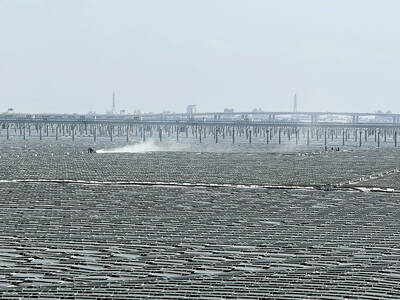
The arithmetic is straightforward and uncomfortable. By the end of 2025, Taiwan had committed itself to a 50-30-20 electricity mix — half natural gas, 30 per cent coal, 20 per cent renewables. The Ministry of Economic Affairs’s (MOEA) own monthly energy reports tell a different story. Natural gas reached 47.8 per cent of generation last year. Coal stood at 35.4 per cent, comfortably above its target ceiling. Renewables came in at 13.1 per cent, well short of the 20 per cent Taipei had pledged a decade earlier. Installed renewable capacity reached roughly half of the 12 gigawatts (GW) the government

Last week US President Donald Trump was asked by a reporter whether he would speak on the phone to the President of Taiwan. “l’ll speak to him. I speak to everybody. We have that situation very well in hand,” Trump said. This marked the second time in a couple of weeks he had said he would talk to the President of Taiwan. In 2016 he famously took a call from then-president Tsai Ing-wen (蔡英文), when he was president-elect. Despite warnings that the apocalypse was nigh because of a phone call, the world quickly forgot about the conversation between two democratically-elected presidents.
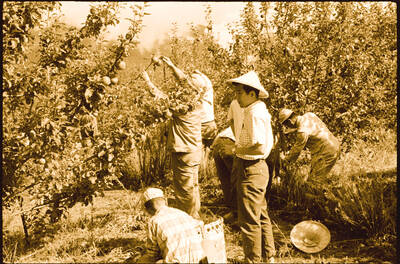
May 25 to May 31 Few believed that apples could be cultivated on a commercial scale in Taiwan’s high mountains. When horticulturalist Cheng Chao-hsiung (程兆熊) first proposed the idea in 1955, both American and Taiwanese colleagues dismissed it as implausible, arguing that temperate fruit could not be reliably grown on a subtropical island, especially on rugged terrain. However, it was this terrain in the Central Mountain Range where many Chinese Civil War veterans were resettled in the late 1950s. With limited job prospects and no family in Taiwan, they were placed on cooperative farms aimed toward self-sufficiency. Some say the conditions


 RSS
RSS