


The name may put you off, but it’s one of the most picturesque villages I’ve come across in Taiwan. Wugoushuei (五溝水, “fifth ditch”) in the eastern half of Pingtung County has more than three dozen strikingly attractive traditional buildings, a main street that is winding and narrow and some unique local customs.
The community was established by Hakka families who had migrated from southern China to Taiwan during the reign of Emperor Kangxi (1654–1722). Wugoushuei owes its existence, as well as its name, to the way these pioneers redirected water flowing down from the nearby Central Mountain Range.
They dug a network of irrigation channels without the aid of machinery, using picks and shovels to break up the ground, and oxen to drag cartloads of soil from one place to another. By the late 18th century, they were able to exploit the region’s tremendous agricultural potential. Back then, rice was the main crop. Now, much of the land is used to grow bananas, betel nut and coconuts.
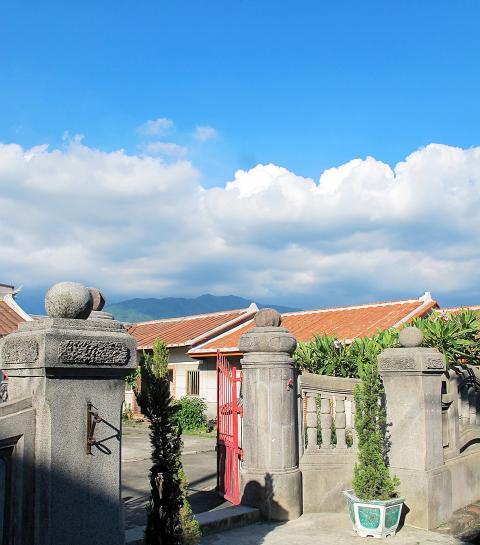
Photo: Steven Crook
The current population of Wugoushuei is around 1,200. Within 2km, there’s a tiny village called Sangoushuei (三溝水, “third ditch”), and a more substantial community named Sigoushuei (泗溝水, “fourth ditch”). In Chinese, “four” is usually written si (四), but in 1920 the authorities decreed that this toponym should be modified to si (泗). According to one account, this was done to distinguish the village from two others in Taiwan with exactly the same name — but where these places might be is something I’ve not been able to discover.
Several of Wugoushuei’s oldest and most beautiful homes were damaged by flooding in the wake of Typhoon Morakot in 2009, but thanks to money from the central government and careful restoration work, they now look superb.
Many of these structures are located on Sisheng Road (西盛路), and one of the most-photographed is at number 28. Built during the reign of Japanese Emperor Taisho (1912–1926), it combines Chinese, Japanese and Western architectural elements. It was the first proper school in the village; previously, sons of the rich studied with tutors, or were sent away to attend traditional academies.
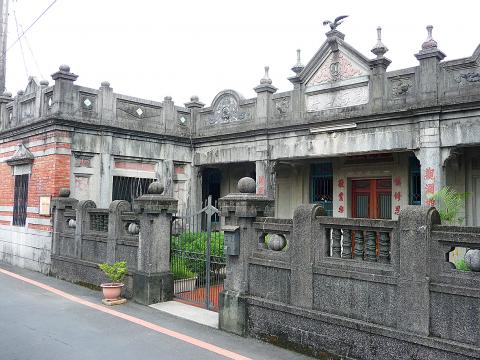
Photo: Steven Crook
Wugoushuei’s most important family is the Liu (劉) clan. This branch of the Liu claim descent from Liu Yuancheng (劉元城), a Song dynasty scholar-official whose unwillingness to compromise his principles led the emperor to order his castration.
READING HISTORY IN BUILDINGS
The Liu Ancestral Shrine (劉氏宗祠) is both the best-known relic and the largest compound in the village. The Lius have been worshiping their ancestors here since at least 1864, but the buildings which stand here were constructed between 1887 and 1921.
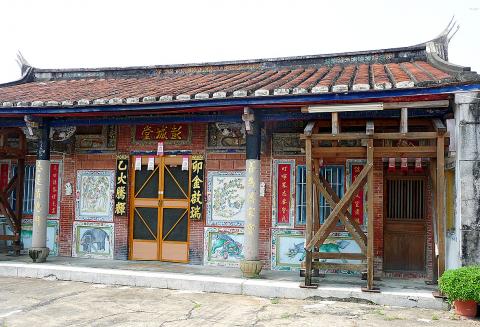
Photo: Steven Crook
Also enshrined here is a minor deity called Lord Xiqin (西秦王爺), who has long been the guardian of Wugoushuei’s children. Among local families, there’s a tradition of bringing infants who cry constantly, are unduly nervous or who aren’t thriving as they should to Lord Xiqin, so that he can adopt and protect them as they grow up.
The shrine is at 70 Sisheng Road, about 100m east of Wugou Elementary School (五溝國小). The buildings aren’t open to the public, but on my three visits no one has stopped me from exploring the courtyard and taking photos.
The elegant but somewhat small single-storey redbrick house at 53 Sisheng Road is known as Jinshihdi (進士第), because its construction was commissioned by a member of the Liu clan who had passed the highest level of China’s imperial civil service examinations. He thus become a jinshi (進士), often translated as “presented scholar.” This was a notable and extremely prestigious achievement; between 1823 and 1894, a mere 29 Taiwanese attained this status.
The Hakka settlers’ seizure of land and water resources inevitably led to conflict with the area’s indigenous people, and some of this history is preserved at Zhongyong Shrine (忠勇祠) on the southern edge of the village at 3 Sisheng Road.
It’s considered a shrine of the Hakka yimin (義民) folk religion, but rather than commemorate those who died protecting the community during the great uprisings of the 19th century, it was established to honor three settlers originally from China’s Guangdong Province who in 1833 were killed by indigenous people.
After that ambush, Wugoushuei’s Hakka pioneers realized that an early-warning system was needed. Some suggested that gongs be distributed to several households, but at that time, all available metal was needed for tools to work the land.
An innovative solution was eventually found. Bamboo baskets containing gunpowder were hung from trees near the frontline. When settlers came under attack, they’d ignite the nearest basket. Hearing an explosion, those nearby would rush to assist.
This practice evolved into a local custom called “detonation culture” (殲炮城文化). For generations, around the time of the Lantern Festival — the 15th day of the first month in the Chinese lunar calendar — a basket has been detonated to blast away misfortune. This tradition, known in Hakka as jiam pau sang, was registered in 2015 with the Ministry of Culture as a form of intangible cultural heritage.
LOCAL DELICACIES
Wugoushuei lies within Wanluan Township (萬巒鄉), which is famous for pig’s trotter. Local recipes result in meat which is sticky, yet deliciously succulent. Because of its heaviness, rather than eat it with white rice, you may want to order some stir-fried vegetables.
If you’re driving or riding from central Wanluan toward Wugoushuei, you’ll pass right through Minhe Road (民和路), which has the main concentration of eateries specializing in pig’s trotter. If you can’t find it, ask a local for directions to Pig’s Trotter Street (豬腳街).
Steven Crook has been writing about travel, culture, and business in Taiwan since 1996. Having recently co-authored A Culinary History of Taipei: Beyond Pork and Ponlai, he is now updating Taiwan: The Bradt Travel Guide.

Taiwan’s English education system is being pulled apart by three opposing forces. Bilingual Nation 2030 pulls students toward English and global communication. Artificial Intelligence (AI) readiness pulls them toward digital judgment, verification and AI-mediated work. But Taiwan’s old exam culture pulls them back toward memorization, grammar drills, timed reading and correct answers. If the education system keeps using old exams to define success, it risks producing graduates who are neither genuinely bilingual nor genuinely AI-ready, but trained for tasks machines can already perform. The first force is Bilingual Nation 2030. Launched in 2018, the policy aimed to “help Taiwan’s workforce connect

It seems every few days one bumps into one of those “real man” comments in which Taiwan is urged to “face reality” or similar, and “make a deal,” with the speaker implying that soon it will be too late. “Deal” advocates always present themselves as having a superior grip on reality, and the manly ability to make the “hard choice.” Their testosterone-laden language often echoes that of Taiwan sellout advocates. Note that such commentary always specifies a process (“make a deal, work with, make progress”), never the end state of what occupation by a violent authoritarian colonialist state will entail. In
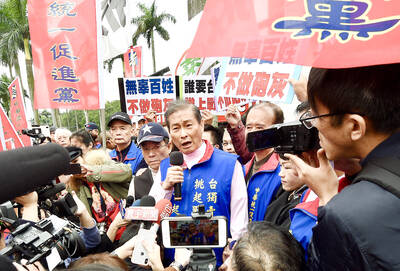
There are shadowy cabals plotting to sell out Taiwan to be annexed by China, by invasion if necessary. Fortunately, they are buffoons. In 2019, former Bamboo Union gangster and founder of the China Unification Promotion Party (CUPP), Chang An-le (張安樂, colorfully known as “White Wolf”), led a protest at the Legislative Yuan against comments made by then-premier Su Tseng-chang (蘇貞昌) that in the event of an attack by China, he would never surrender, but would protect the nation by fighting to the end, even if he only had a broom. Chang had party members bring a wooden casket that they
June 1 to June 7 "If all Taiwanese were as afraid of dying as you, then what would happen?” Physician Shih Chiang-nan (施江南) reportedly said this to his wife Chen Chiao-tung (陳焦桐) after she urged him to stop intervening on behalf of Taiwanese soldiers stranded overseas after serving in the Japanese Army during World War II. Shih had clashed with high-ranking officials over the issue, engaged in several heated arguments with Taiwan governor-general Chen Yi (陳儀) and allegedly shouted at general Ko Yuan-fen (柯遠芬), chief of staff of the Taiwan Garrison Command, over


 RSS
RSS