


During a traditional puppet contest in Yilan, the host accidentally refers to judge Chen Hsi-huang (陳錫煌) as his father, the legendary puppet master Lee Tien-lu (李天祿). She then corrects herself and reintroduces Chen — but not as himself, but as Lee’s son. This scene underscores Chen’s life, which is the focus of the film Father (紅盒子): even at 80 years old, he still can’t step out of his father’s shadow.
Lee was a larger-than-life personality whose early years were depicted in the 1993 biopic The Puppetmaster (戲夢人生) by Hou Hsiao-hsien (侯孝賢), who served as executive producer for Father. Lee died in 1998, and 20 years later, it’s Chen’s turn to have his story told — although like Chen’s life, the film is still very much about Lee.
The two pretty much led parallel lives — their family background is even spliced and overlapped in one scene.
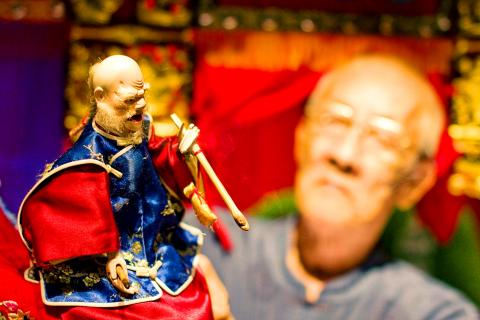
Photo courtesy of atmovies.com
Lee’s father, surnamed Hsu, had married into his mother’s family, resulting in the first-born son carrying the mother’s surname. Chen tells an identical story, and due to the differences in surnames and traditional belief, the two were never close, with his younger brother (surnamed Lee) taking over the father’s puppet troupe and Chen branching out on his own at the age of 79.
The film’s Chinese title translates as “red box,” which houses Marshal Tian Du (田都元帥), the god of performing arts who Chen prays to before performing. The box and the deity it contains was the only thing Chen took when he left the family troupe, and in a sense it has become a replacement for his father, hence the Chinese and English film titles refer to the same idea despite being literally distinct.
Lee witnessed the decline of the traditional puppet industry in the 1970s until foreign interest sparked a late-career renaissance, which allowed him to travel the globe and even moonlight as a movie star.
Chen’s fate is much bleaker. The entire film carries a melancholy tone of helplessness as the viewer gets the feeling that society has moved on, with most puppet masters and musicians in their twilight years. Although Chen has trained two disciples and doesn’t hesitate to showcase and teach his art, stating many times that he is willing to pass on everything he knows, the troupe struggles to find performance opportunities. Even when it does, attendance is sparse and the troupe is plagued by permit issues and noise complaints.
Director Yang Li-chou (楊力州), who spent 10 years making the film, asks aloud twice: Am I shooting the story of a man’s legacy, or am I documenting the demise of a tradition? Is this just a performance of despair?
The film opens with a stunningly emotional sequence that begins with an old photo of father and son, transitioning to a fixed-camera frame of a pensive Chen talking about his father. He doesn’t have much to say, quickly falling silent and staring straight at the camera. The next scene is a poignant close up of Chen’s wrinkled hand dancing without a puppet against a black background, and finally the camera zooms out to reveal an empty theater.
These closeups of Chen, totally immersed in his art, appear several more times in the film and are always a joy to watch. When the camera zooms out, Chen’s passion towards his craft is apparent as he closes his eyes while moving fluidly and looks at his puppet lovingly before finishing. The soundtrack is masterfully employed to elicit emotion, striking a delicate balance between live sounds, melancholy cello and erhu-based background music and complete silence.
Perhaps the most heartbreaking part of the film is Chen’s persistence in preserving his dying art; despite his rocky relationship with his father and lack of interest in his art, puppetry is all that he has ever known, and ever had.
In addition to including parts of the filming process into the movie (such as when Yang asks Chen for permission to film his hand without the puppet), an interesting device the director employs is having Chen’s disciples watch footage from the film during the interviews before asking them questions. It’s not a straight-up traditional documentary, with other experimental devices used — the best saved for last in a tear-jerking final sequence that shall not be revealed.
Despite Yang’s profile as a prolific and award-winning documentary filmmaker, he says it was hard to get sponsorship for the film. He quips in a Business Weekly (商業週刊) interview that the film contains three elements that are considered “box office poison:” old people, puppetry and documentary filmmaking. Some people urged him to remove some close up shots of the puppetry, but Yang refused.
And the film has enjoyed success so far, winning best feature at the 11th Chinese Documentary Festival in Hong Kong this past weekend as well as leading all Taiwanese films in box office sales since it hit the theaters last Friday.
Yang once said that he experiences a person’s lifetime in each story he shoots, which can be hard on his soul as most people’s lives are not easy. Luckily, his approach results in deeply moving pieces like Father for the audience to enjoy and cry over.

Taiwan’s English education system is being pulled apart by three opposing forces. Bilingual Nation 2030 pulls students toward English and global communication. Artificial Intelligence (AI) readiness pulls them toward digital judgment, verification and AI-mediated work. But Taiwan’s old exam culture pulls them back toward memorization, grammar drills, timed reading and correct answers. If the education system keeps using old exams to define success, it risks producing graduates who are neither genuinely bilingual nor genuinely AI-ready, but trained for tasks machines can already perform. The first force is Bilingual Nation 2030. Launched in 2018, the policy aimed to “help Taiwan’s workforce connect

It seems every few days one bumps into one of those “real man” comments in which Taiwan is urged to “face reality” or similar, and “make a deal,” with the speaker implying that soon it will be too late. “Deal” advocates always present themselves as having a superior grip on reality, and the manly ability to make the “hard choice.” Their testosterone-laden language often echoes that of Taiwan sellout advocates. Note that such commentary always specifies a process (“make a deal, work with, make progress”), never the end state of what occupation by a violent authoritarian colonialist state will entail. In

There are shadowy cabals plotting to sell out Taiwan to be annexed by China, by invasion if necessary. Fortunately, they are buffoons. In 2019, former Bamboo Union gangster and founder of the China Unification Promotion Party (CUPP), Chang An-le (張安樂, colorfully known as “White Wolf”), led a protest at the Legislative Yuan against comments made by then-premier Su Tseng-chang (蘇貞昌) that in the event of an attack by China, he would never surrender, but would protect the nation by fighting to the end, even if he only had a broom. Chang had party members bring a wooden casket that they
June 1 to June 7 "If all Taiwanese were as afraid of dying as you, then what would happen?” Physician Shih Chiang-nan (施江南) reportedly said this to his wife Chen Chiao-tung (陳焦桐) after she urged him to stop intervening on behalf of Taiwanese soldiers stranded overseas after serving in the Japanese Army during World War II. Shih had clashed with high-ranking officials over the issue, engaged in several heated arguments with Taiwan governor-general Chen Yi (陳儀) and allegedly shouted at general Ko Yuan-fen (柯遠芬), chief of staff of the Taiwan Garrison Command, over


 RSS
RSS