


Oct. 22 to Oct. 28
For many years, the battle was called “The Great Victory at Guningtou” (古寧頭大捷). At that time, the Chinese Communist Party had already established the People’s Republic of China in Beijing and were hell bent on wiping out the Chinese Nationalist Party (KMT) troops remaining in China’s southern areas.
On Oct. 17, 1949, the People’s Liberation Army (PLA) captured Xiamen. Kinmen, just a few kilometers off shore, was next, and ultimately, Taiwan.
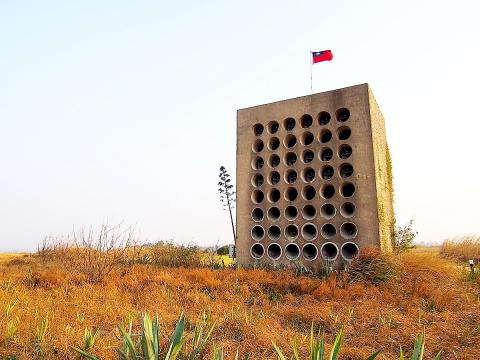
Photo courtesy of Wikimedia Commons
On the evening of Oct. 24, about 20,000 PLA soldiers left the shores of Xiamen in wooden boats, with about 9,000 landing on Kinmen. After three days of intense fighting, all soldiers who landed were captured or killed, resulting in a rare victory for the KMT. It is seen as a significant event in cross-strait relations, in which the KMT not only safeguarded Kinmen, but also stopped the PLA from advancing on to Taiwan.
When KMT leader Chiang Kai-shek (蔣介石) heard the news, he shed tears of relief, stating, “Taiwan is safe … This is the turning point of our revolution.” Taiwan Provincial Governor Chen Cheng (陳誠) visited Kinmen the day after the victory and made the following speech: “This great victory … is the beginning of our military success in the southeast and has given our people a boost in morale after so much losing … Upon hearing the news, the people of Taiwan all celebrated joyfully, as this event bodes a bright future for our country.”
The KMT had barely won any battles since the PLA crossed the Yangtze River in January 1949. How were they able to rally in the most crucial moment?
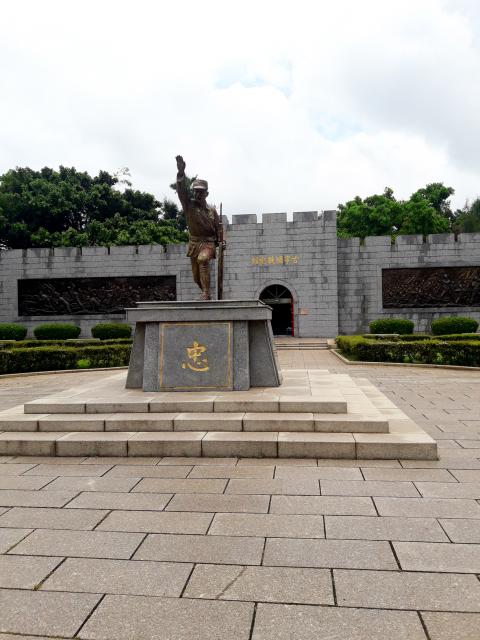
Photo courtesy of Wikimedia Commons
COMMANDER’S WORDS
The late General Hu Lien (胡璉), who participated in the Battle of Guningtou, published a book in the 1970s detailing the victory.
He is quoted to have said in a Legislative Yuan meeting in 1974, “In 25 years, the Communists have wanted to attack Kinmen and Taiwan, but they don’t have the ability to, nor do they dare. Some people think the Communists are hesitant because of international pressure, but I think that’s a secondary reason. They’re afraid of the anti-Communist fortress we have established in Kinmen, Penghu and Taiwan … I’m confident to say that the day the Communist bandits attack, it will be the beginning of the end for them.”
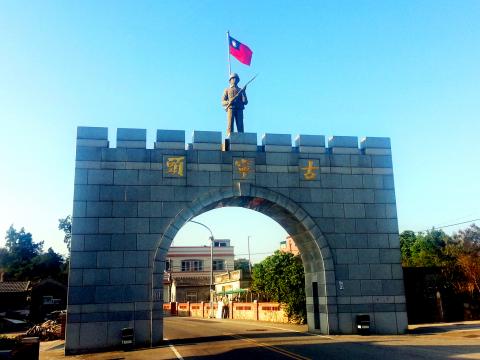
Photo courtesy of Wikimedia Commons
This speech falls in line with the traditional stance that the KMT espoused in its early days, when it still believed that it could retake China one day.
Hu and his 12th Brigade arrived on Kinmen at dusk on Oct. 25, only to find out that the PLA invasion was already under way. The KMT troops had rushed the PLA troops while they disembarked their ships, capturing many enemies, cutting off their escape routes and burning the boats so they couldn’t escape. Things stagnated later that day, but Hu’s arrival greatly bolstered the KMT forces as they continued the onslaught throughout the 26th.
By the morning of the 27th, the KMT had cleared out the PLA troops in Guningtou Village, and the remaining soldiers along the shore surrendered. Chen Cheng arrived in Kinmen later that day, upon which several hundred more PLA troops appeared out of the bushes and to surrender.
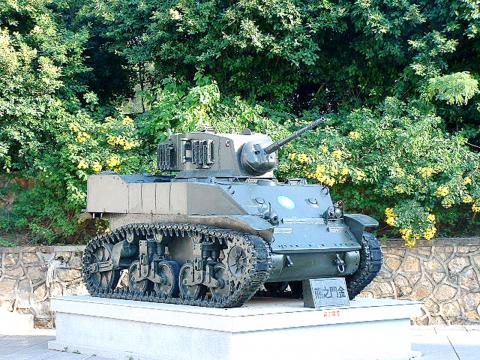
Photo courtesy of Wikimedia Commons
“The mistakes of the enemy gave us a chance to quickly assemble an army for a chance to win,” Hu begins his analysis of the battle.
He writes that if the PLA troops cleared out the KMT troops on the southern coast of China first, then the KMT would not have been able to send any reinforcements to Kinmen. If they attacked any earlier or any later, it would have been a surefire Communist victory.
But Hu writes that the Communists were too impatient. Instead of a more tactical invasion with troops landing at multiple points on the island, they decided to send in 9,000 troops without a commanding officer overseeing the entire operation.
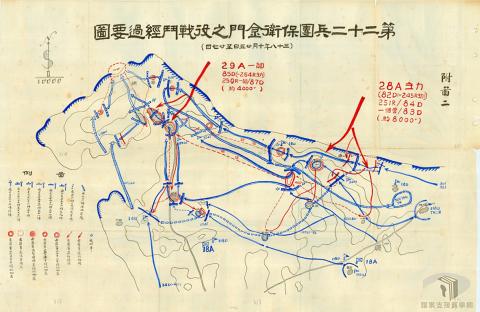
Photo courtesy of Archival Resources for Teaching, National Archives Administration
Meanwhile, Hu lauds the KMT for keeping their troops supplied and in high morale amidst all the losing, and prepared for the invasion by deploying a large force to Kinmen while other battles were going on. He also praises the two commanders who held on to Kinmen before his arrival, noting that if they wavered, the PLA would still be able to win despite their miscalculations.
Finally, he credits the ROC Navy and Air Force for taking out PLA cannons and disrupting their ability to send reinforcements to Kinmen.
Outspoken former PLA general Liu Yazhou (劉亞洲) agrees with Hu on many points, writing in a paper on the topic, “If we attacked three days earlier, we would have been able to rout the KMT forces before Hu could arrive. If we attacked three days later, we would have known about Hu’s arrival and had a chance to reevaluate our strategy.”
According to the PLA’s official report released on Oct. 29, 1949, the main reasons for their crushing defeat was “rashness of the plan and underestimation of the enemy.”
MODERN TAKES FROM BOTH SIDES
A government report published on the 60th anniversary of the battle revisits the decisive factors: Chiang’s foresight in April 1949 to fortify the previously undefended Kinmen; Chen Cheng’s timely resolution to send in the 12th Brigade; KMT troops holding out in Xiamen long enough to fortify Kinmen, the high morale and fighting spirit of the troops and correct tactical decisions of the commanders; and finally the strong KMT (US supplied) artillery and tanks as well as the previously mentioned help from the Air Force and Navy.
The report finds the Communists “wildly overconfident” after winning almost every fight that year. They did not plan carefully how reinforcements would arrive from Xiamen, greatly underestimating the number of KMT troops in Kinmen. The PLA had originally planned to invade Kinmen two weeks earlier, but the operation kept being delayed due to difficulty gathering boats.
Finally, since the area around Guningtou was indeed the best point to disembark, the KMT was already waiting there and was able to deal a heavy blow to the enemy just as they arrived.
A new book on the battle by Chinese scholars does mention the tactical errors by the PLA, but it also points to several “coincidences” that contributed to the KMT victory. The authors write that the PLA troops were actually about to complete a convert landing operation when a KMT scout accidentally set off a landmine, which quickly led to the KMT troops discovering the invasion.
Also, three malfunctioning tanks left by the shore “suddenly started working again” as the PLA troops arrived, boosting the KMT’s firepower on the beach.
But the authors acknowledge that even with these coincidences, the KMT still took this battle much more seriously than the Communists. They compared the battle to Qing Dynasty Admiral Shih Lang (施琅) taking Taiwan in 1662, noting that not only were conditions acting in his favor, but he was also well-prepared.
“Without sufficient preparation, no number of ‘coincidences’ would be of use,” they conclude.
Taiwan in Time, a column about Taiwan’s history that is published every Sunday, spotlights important or interesting events around the nation that have anniversaries this week.

Ajay Verma, a consultant gastroenterologist at Kettering general hospital in Northamptonshire, says our gut is a “complex machine.” “It is constantly providing us with the nutrition we need, initially to grow and develop, and then for us to survive, thrive and repair from injury and illness.” How can we keep it functioning well? Put simply: “Make sure what you put into it is balanced, and that you clear out its waste products adequately,” Verma says. “In a general gastroenterology clinic, the most common conditions we see are irritable bowel syndrome (IBS), gastroesophageal reflux disease, inflammatory bowel disease and constipation,” says Nisha
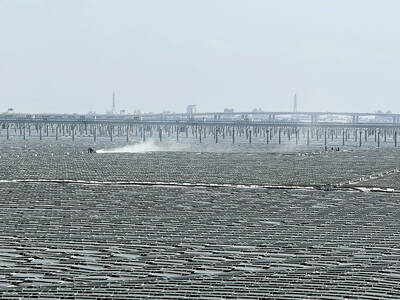
The arithmetic is straightforward and uncomfortable. By the end of 2025, Taiwan had committed itself to a 50-30-20 electricity mix — half natural gas, 30 per cent coal, 20 per cent renewables. The Ministry of Economic Affairs’s (MOEA) own monthly energy reports tell a different story. Natural gas reached 47.8 per cent of generation last year. Coal stood at 35.4 per cent, comfortably above its target ceiling. Renewables came in at 13.1 per cent, well short of the 20 per cent Taipei had pledged a decade earlier. Installed renewable capacity reached roughly half of the 12 gigawatts (GW) the government

Last week US President Donald Trump was asked by a reporter whether he would speak on the phone to the President of Taiwan. “l’ll speak to him. I speak to everybody. We have that situation very well in hand,” Trump said. This marked the second time in a couple of weeks he had said he would talk to the President of Taiwan. In 2016 he famously took a call from then-president Tsai Ing-wen (蔡英文), when he was president-elect. Despite warnings that the apocalypse was nigh because of a phone call, the world quickly forgot about the conversation between two democratically-elected presidents.
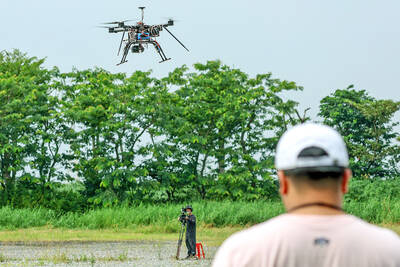
Taiwan’s drone exports are taking off, fuelled by the war in Ukraine, as Taiwanese companies seek a stake in the fast-growing global market for unmanned aerial vehicles (UAV). Low-cost drones used for reconnaissance and strikes are in high demand as governments around the world boost defense spending in the face of intensifying conflicts. A relative new player in the increasingly competitive industry, Taiwan’s pitch is to be an “Asian hub” for the production of UAVs and components free of Chinese materials, or “non-red.” That means its UAVs can be up to three times more expensive than their Chinese competitors, like the world’s biggest


 RSS
RSS