


July 2 to July 8
It was a project that even the gods were against.
When a set of divination blocks that were cast in two temples in the settlement of Houjin (後勁) near Kaohsiung “stood up” on its narrow side six times within a month — an occurrence so rare that even once would be considered a miracle — residents took it as a divine message.
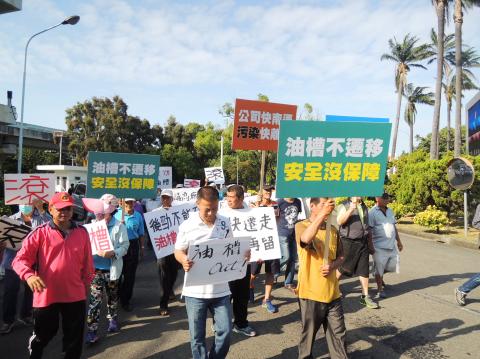
Photo: Tsai Ching-hua, Taipei Times
A dark cloud had hung over the settlement since the state-run CPC Corp, Taiwan (CPC, 中油) in June 1987 announced its plans to build the Fifth Naphtha Cracker Plant in the area.
At the time, Chen Tsai (陳財), keeper of Shengyun Temple (聖雲宮) stood before Baoshengdadi (保生大帝, also known as the God of Medicine) and asked if he supported Houjin’s resistance to the plant’s construction. He then threw the blocks and received his divine answers.
Lee Yu-kun (李玉坤), who had just returned to his hometown to set up a signage design shop but ended up dedicating his life to the cause, says in the book Against the Fifth Naphtha Cracker Plant (堅持:後勁反五輕的未竟之路) that it was immensely moving to know that even the gods supported their cause.
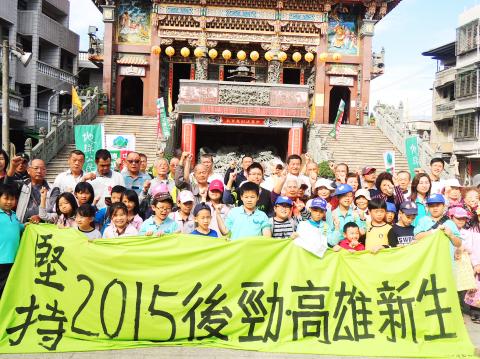
Photo: Ko Yu-hao, Taipei TImes
Religion did not just provide spiritual support for the protesters. The area temple property association also donated NT$2 million to fund the protest in August 1987.
GROWING ANGER
The unrest “officially” began on July 2, when a group of young activists distributed flyers at the local market warning residents of harmful emissions and criticizing local leaders for “selling out Houjin.”
The next day, more than 200 showed up to a public hearing held by two city councilors, who were unable to provide satisfactory answers. The crowd marched straight to the gate of CPC’s Kaohsiung refinery to express their discontent.
On July 24, Minister of Economic Affairs Lee Ta-hai (李達海) visited the refinery, but he refused to meet the protesters and slipped out a side door. Enraged, they immediately took action and planted a flag at the gate, set up tents and began what would be known as the “West Gate Blockade” (西門圍堵).
There was reason for concern, as nearby areas had become heavily industrialized by CPC, leading to the once pristine Houjin River becoming heavily polluted long before the announcing of the naphtha cracker.
There were also other factors. One of the resistance leaders, Tsai Chao-peng (蔡朝鵬), says in Against the Fifth Naphtha Cracker Plant that most people had no idea what a naphtha cracker plant was, but the resistance was also fueled by discontent against “KMT hegemony” and unfair treatment toward residents by the CPC plant after it acquired their land. The company built hospitals and schools for its employees and their families, but Houjin residents were not granted access to the facilites.
Liu Yung-ling’s (劉永鈴) tailor shop, which he renamed “Anti-Fifth Naphtha Cracker Plant Tailor Shop” (反五輕西服工作室), became an important base for protesters. Under the principles “Do not back down, do not compromise and do not ask for compensation,” the protests focused solely on halting environmental pollution.
THE THREE YEAR BLOCKADE
Violence erupted 17 days into the blockade. Several drunk CPC workers attempted to drive a vehicle into the camp, but got stuck at the base of the flag. The workers fled after a brief confrontation, but angry residents flipped the car over and were about to set it on fire when Lee arrived on scene and stopped their actions. The media, irresponsible as ever, portrayed the protesters as baomin (暴民, “a mob”).
On Aug. 5, an association was formed with three demands: the plant shall not be build in Houjin, CPC must ameliorate the existing pollution before building anything new, and that the CPC should completely move out of the area. At this time, nobody expected that the “blockade” would last for more than three years.
One of the stranger events of the protest was the “peeing incident” on Oct. 10, 1987. That day, the residents rode in 10 tour buses to the Legislative Yuan in response to several legislators criticizing the protests, claiming that they were incited by a few unruly troublemakers and should be punished.
Two elderly residents started searching for a bathroom immediately after they got off the bus. The police in the legislature were already on guard and arrested the two when they accidentally entered the building. This escalated into a massive brawl, and is known as the first time blood was shed in the name of environmental protection in Taiwan.
The situation only worsened in the ensuing months, including a massive clash between residents and riot police in December. Internal disputes plagued the resistance efforts after this, with only intermittent action throughout 1989.
The blockade was still in place by March 1990, when Liu and a fellow protester scaled the flare tower at the CPC plant, chained themselves to the structure and waved a banner. But by this time, CPC had made many measures to appease the people, allowing them to use their facilities, relocating a harmful flare tower and providing clean water.
Two months later, Houjin residents held a public referendum — the first ever in Taiwan — with 60.8 percent “absolutely against” the plant. But the government completely ignored the results. On Sept. 13, Premier Hau Pei-tsun (郝柏村) led thousands of riot police to spend a night in Houjin. By this time, the resistance was on its last legs. After offering NT$1.5 billion in total compensation and promising to move out after 25 years as well as other incentives, CPC began construction.
EPILOGUE
While the protesters were not able to stop the plant’s construction, Lee never stopped fighting. He was there throughout the plant’s many controversies, and made his final stand on Nov. 30, 2015, when he led several hundred residents to the plant’s main gate to reiterate their demands that CPC also remove its oil storage tanks after the 25 year deadline was met.
Lee died of a stroke four days later, and was sorely missed when Houjin residents gathered that New Year’s Eve to celebrate the plant’s closure.
Taiwan in Time, a column about Taiwan’s history that is published every Sunday, spotlights important or interesting events around the nation that have anniversaries this week.

Taiwan’s English education system is being pulled apart by three opposing forces. Bilingual Nation 2030 pulls students toward English and global communication. Artificial Intelligence (AI) readiness pulls them toward digital judgment, verification and AI-mediated work. But Taiwan’s old exam culture pulls them back toward memorization, grammar drills, timed reading and correct answers. If the education system keeps using old exams to define success, it risks producing graduates who are neither genuinely bilingual nor genuinely AI-ready, but trained for tasks machines can already perform. The first force is Bilingual Nation 2030. Launched in 2018, the policy aimed to “help Taiwan’s workforce connect
It seems every few days one bumps into one of those “real man” comments in which Taiwan is urged to “face reality” or similar, and “make a deal,” with the speaker implying that soon it will be too late. “Deal” advocates always present themselves as having a superior grip on reality, and the manly ability to make the “hard choice.” Their testosterone-laden language often echoes that of Taiwan sellout advocates. Note that such commentary always specifies a process (“make a deal, work with, make progress”), never the end state of what occupation by a violent authoritarian colonialist state will entail. In
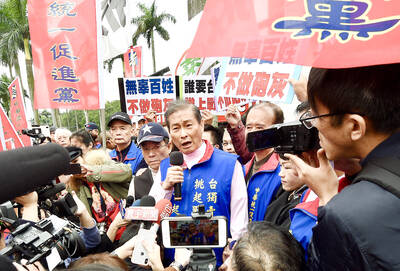
There are shadowy cabals plotting to sell out Taiwan to be annexed by China, by invasion if necessary. Fortunately, they are buffoons. In 2019, former Bamboo Union gangster and founder of the China Unification Promotion Party (CUPP), Chang An-le (張安樂, colorfully known as “White Wolf”), led a protest at the Legislative Yuan against comments made by then-premier Su Tseng-chang (蘇貞昌) that in the event of an attack by China, he would never surrender, but would protect the nation by fighting to the end, even if he only had a broom. Chang had party members bring a wooden casket that they
June 1 to June 7 "If all Taiwanese were as afraid of dying as you, then what would happen?” Physician Shih Chiang-nan (施江南) reportedly said this to his wife Chen Chiao-tung (陳焦桐) after she urged him to stop intervening on behalf of Taiwanese soldiers stranded overseas after serving in the Japanese Army during World War II. Shih had clashed with high-ranking officials over the issue, engaged in several heated arguments with Taiwan governor-general Chen Yi (陳儀) and allegedly shouted at general Ko Yuan-fen (柯遠芬), chief of staff of the Taiwan Garrison Command, over


 RSS
RSS