


The Taiwan International Festival of Arts (TIFA) opens this weekend at the National Theater in Taipei with a harrowing tale of addiction, loss, anguish, darkness and joy: the dance-theater production Betroffenheit.
On the surface such a show would not appear to be the logical choice to start off the celebrations of the festival’s 10th year. However, Betroffenheit has wowed audiences across Canada, the US, Europe and Australia since its premiere in July 2015, and received the Olivier award for Best New Dance Production in April last year for performances at Sadler’s Wells Theatre the previous year.
Betroffenheit is a collaboration between two of Canada’s most celebrated artists and companies, both Vancouver based: contemporary choreographer Crystal Pite of Kidd Pivot and Jonathon Young, playwright, actor and cofounder of the Electric Company Theatre.
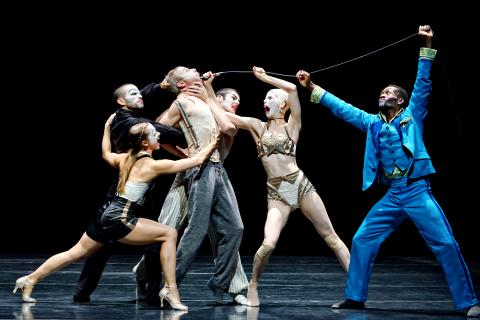
Photo courtesy of Michel Slobodian
Its origin comes from a parent’s worst nightmare: the death of a child.
The teenaged daughter of Young and fellow Electric Company cofounder Kim Collier died on July 23, 2009, along with two of her cousins, in a cabin fire on a lakeside property owned by the family. Young, who had been in another building with Collier when the blaze broke out, tried to rescue the youngsters, but could not.
Young has said the loss of his only child, nephew and niece left him feeling emotionally and physically lost, feeling he had lost his purpose and without the words to describe his despair.
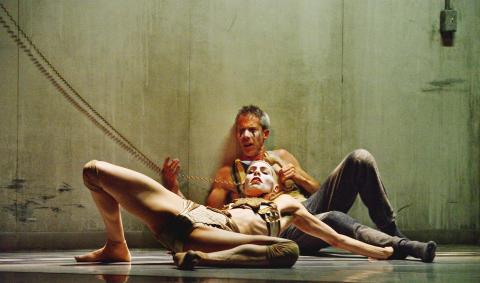
Photo courtesy of Michel Slobodian
As he gradually recovered, he sought to make sense of both the loss and its psychological repercussions, to explore the internal process of coming to grips with such an emotional trauma.
When he decided he wanted to create a theater production that would explore the world of recovery, he wanted to make it more than just about his and his family’s personal loss, to make it universal. So he reached out to Pite and asked her to collaborate.
Young has said that he came across “Betroffenheit,” a German word meaning “consternation,” in a book he read, and he and Pite decided to use it as the title of their work. However, for them, “Betroffenheit” means more than just consternation; it is about being completely discombobulated by events.
Young wrote the text of the show, which is about a man struggling to conquer his drug addiction, which he said he found was a common problem for people suffering from post-traumatic stress disorder.
Pite choreographed and directed the production, using five of her dancers for the supporting roles.
The story of Betroffenheit is about hitting rock bottom and struggling to find a way to survive, to find a way out of hell.
Young plays the lead, while dancers Bryan Arias, David Raymond, Cindy Salgado, Jermaine Spivey and Tiffany Tregarthen portray the voices that he hears, his inner demons and elements of his subconscious that lead him to question his existence even as they proffer up memories in an effort to keep him alive.
In the end, the show is about survival and redemption truimphing over destruction.
Betroffenheit, which will be performed in English with Chinese subtitles, lasts about two hours with an intermission. There is an advisory that it contains coarse language, adult themes, strobe lighting and haze effects.
There will also be a post-show talk in the theater lobby after Sunday’s matinee.
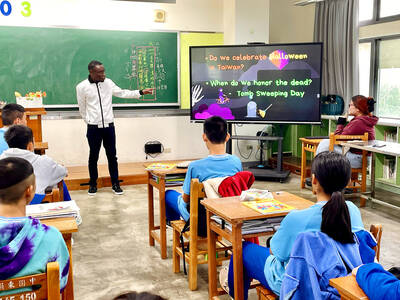
For many people, Bilingual Nation 2030 begins and ends in the classroom. Since the policy was launched in 2018, the debate has centered on students, teachers and the pressure placed on schools. Yet the policy was never solely about English education. The government’s official plan also calls for bilingualization in Taiwan’s government services, laws and regulations, and living environment. The goal is to make Taiwan more inclusive and accessible to international enterprises and talent and better prepared for global economic and trade conditions. After eight years, that grand vision is due for a pulse check. RULES THAT CAN BE READ For Harper Chen (陳虹宇), an adviser
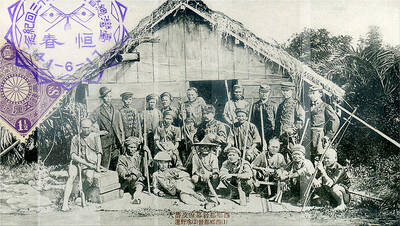
Traditionally, indigenous people in Taiwan’s mountains practice swidden cultivation, or “slash and burn” agriculture, a practice common in human history. According to a 2016 research article in the International Journal of Environmental Sustainability, among the Atayal people, this began with a search for suitable forested slopeland. The trees are burnt for fertilizer and the land cleared of stones. The stones and wood are then piled up to make fences, while both dead and standing trees are retained on the plot. The fences are used to grow climbing crops like squash and beans. The plot itself supports farming for three years.

President William Lai (賴清德) on Nov. 25 last year announced in a Washington Post op-ed that “my government will introduce a historic US$40 billion supplementary defense budget, an investment that underscores our commitment to defending Taiwan’s democracy.” Lai promised “significant new arms acquisitions from the United States” and to “invest in cutting-edge technologies and expand Taiwan’s defense industrial base,” to “bolster deterrence by inserting greater costs and uncertainties into Beijing’s decision-making on the use of force.” Announcing it in the Washington Post was a strategic gamble, both geopolitically and domestically, with Taiwan’s international credibility at stake. But Lai’s message was exactly

May 4 to May 10 It was once said that if you hadn’t performed at the Sapphire Grand Cabaret (藍寶石大歌廳), you couldn’t truly be considered a star. Taking the stage at the legendary Kaohsiung club was more than just a concert. Performers were expected to entertain in every sense, wearing outlandish or revealing costumes and staying quick on their feet as sharp-tongued, over-the-top hosts asked questions and delivered jokes that would be seen as vulgar, even offensive, by today’s standards. Opening in May 1967 during a period of strict political and social control, Sapphire offered a rare outlet for audiences in


 RSS
RSS