


Screaming Chinese-poetry inspired lyrics like a demon bursting from the depths of hell, the black-clad singer raises a white chalice above his bamboo hat as fog enveloped the stage.
Powered by cacophonous guitars and drums, the black metal band Zuriaake dips into the tenebrous depths of ancient Chinese culture to produce a unique blend of east and west.
Though the breed of occult darkness their music celebrates is unwelcome by authorities, the group is enjoying a new surge of popularity among mainland listeners seeking music that reflects their growing national pride.
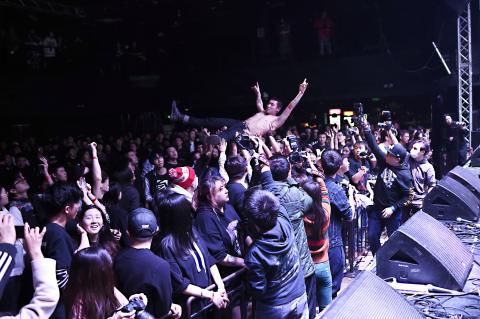
Photo: AFP
“Out in the land of bones, the hellfire lingers with shimmering luminance,” the singer known as “Bloodfire” howls at a crowd of hundreds in Beijing, silhouetted against a projected backdrop of an eerie black-and-white forest.
His shrieking lyrics are written in a dense style of ancient poetry that even those able to make out the words of his throat-raking rasp would need a dictionary to decipher.
Zuriaake, formed in 1998, is one of China’s longest-running metal bands. Its name is an invented Chinglish portmanteau meaning “lake of buried corpses.”
Songs such as Desolated Mountain and Whispering Woods get audiences headbanging to subtle verses packed with dark nature imagery.
The band wears head-to-toe black, with their faces entirely shrouded under their triangular hats. Bloodfire also wears a woven reed raincoat.
The costumes are meant to evoke the image of an old fisherman in a Chinese landscape painting, alone in his skiff and dwarfed by the nature around him. Lanterns and branches adorn their mic stands. The band has inadvertently ridden a rising wave of interest in nationalist pop culture as the ruling Communists trumpet messages of Chinese exceptionalism, said a black metal music label founder in the audience who gave the pseudonym VT.
He called the process “our society marketing itself to itself. Young people don’t necessarily believe in everything the government says, but now that China is becoming a bigger global power, they still want to find things that fit with their Chinese identity” to be fans of, he said.
“Zuriaake fills that need,” he said, speaking on condition of anonymity to avoid any political backlash against his label.
‘CHINESE-STYLE HORROR’
Black metal is an extreme subgenre of heavy metal that rose to notoriety in the 1990s after anti-Christian Norwegian bands that spearheaded the style burned churches and in one case murdered a band member.
It typically employs nature imagery and promotes Satanism and misanthropy in protest of mainstream culture. Artists often perform in white-faced, hollow-eyed corpse make-up.
But protesting Christianity made no sense in modern China, where Communist atheism has replaced Buddhism and Taoism as the dominant dogma.
Nor did corpse paint, given that the Chinese imagine zombies as stiff, hopping cadavers more humorous than terrifying.
“If you’ve understood the essence of a Western genre and are still just imitating the form, you’ll slowly become mediocre. We’re playing pure Western metal, but we’re unique,” Bloodfire said, refusing to give his real name.
In China, horror is “more subtle and veiled, about the unknown” rather than gore, he added.
“I want to express Chinese-style horror, and ancient Chinese-style withdrawal from society, nobility and virtue,” he said.
To do that, the band turned to the chaotic Spring and Autumn and Warring States periods from around 771 to 221 BC for inspiration — the last time they felt Chinese literature held an emotional intensity and despair that paired well with the black metal aesthetic.
“From that time on, Chinese poetry became more and more formalized, and became increasingly sunny — it lacked darkness,” Bloodfire said. The band’s music, he said, tries to convey the feelings of bygone Chinese literati who sought to “live in seclusion and not involve themselves in worldly affairs, despite having a clear picture of the world and its problems.”
‘IT SPEAKS TO ME’
For nearly two decades, Zuriaake’s band members have remained anonymous to their fans, using stage names and never speaking in character.
Instead, they bow and make traditional hand gestures of respect towards the audience at the end of their sets. “We want people to feel each person on stage is nothing but a symbol,” said Bloodfire.
As the birthplace of Confucius, the group’s home province of Shandong has always been “more conservative and slower to be influenced by the West than other places,” explained guitarist Sly.
While traditional culture industries boom there, there is very little by way of rock and roll.
“You can easily buy zithers, ink brushes, and chess sets, but not electric guitars,” Sly laughed, adding that it was perhaps why they felt most comfortable expressing themselves in ancient verse.
Zhang Xia, 32, flew from the southernmost province of Guangzhou just to catch Zuriaake live in Beijing.
“All of our music culture is imitating Western music, but they’re different,” she said. “I’ve always liked mystery and the occult, but because of the traditional Chinese elements, Zuriaake speaks more to me.”

Taiwan’s English education system is being pulled apart by three opposing forces. Bilingual Nation 2030 pulls students toward English and global communication. Artificial Intelligence (AI) readiness pulls them toward digital judgment, verification and AI-mediated work. But Taiwan’s old exam culture pulls them back toward memorization, grammar drills, timed reading and correct answers. If the education system keeps using old exams to define success, it risks producing graduates who are neither genuinely bilingual nor genuinely AI-ready, but trained for tasks machines can already perform. The first force is Bilingual Nation 2030. Launched in 2018, the policy aimed to “help Taiwan’s workforce connect
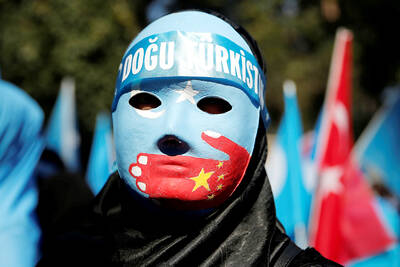
It seems every few days one bumps into one of those “real man” comments in which Taiwan is urged to “face reality” or similar, and “make a deal,” with the speaker implying that soon it will be too late. “Deal” advocates always present themselves as having a superior grip on reality, and the manly ability to make the “hard choice.” Their testosterone-laden language often echoes that of Taiwan sellout advocates. Note that such commentary always specifies a process (“make a deal, work with, make progress”), never the end state of what occupation by a violent authoritarian colonialist state will entail. In
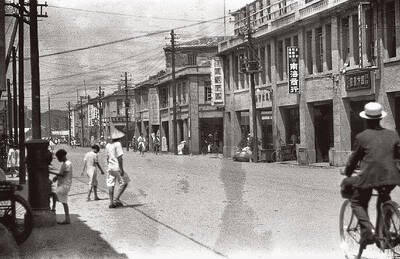
June 1 to June 7 "If all Taiwanese were as afraid of dying as you, then what would happen?” Physician Shih Chiang-nan (施江南) reportedly said this to his wife Chen Chiao-tung (陳焦桐) after she urged him to stop intervening on behalf of Taiwanese soldiers stranded overseas after serving in the Japanese Army during World War II. Shih had clashed with high-ranking officials over the issue, engaged in several heated arguments with Taiwan governor-general Chen Yi (陳儀) and allegedly shouted at general Ko Yuan-fen (柯遠芬), chief of staff of the Taiwan Garrison Command, over

“Taiwan’s Opposition Leader Comes to US With a Message Straight Out of Beijing” read a May 31 headline in the Wall Street Journal. Top US administration officials and members of Congress almost certainly read the WSJ, and if there was a bullet point takeaway that people in Washington should absorb ahead of Chinese Nationalist Party (KMT) Chair Cheng Li-wun’s (鄭麗文) arrival in DC on June 9, that headline is it. The last few columns have discussed this very topic, and the timing is not coincidental. While those top officials likely do not read the Taipei Times, judging by the number


 RSS
RSS