


An exhibit in Manhattan is aiming to introduce visitors to the tumultuous period around the end of martial law in Taiwan 30 years ago as witnessed through the eyes of the camera lens.
“History’s Shadows and Light” (歷史的暗影,與光) features the work of three Taiwanese photojournalists and a team of videographers who captured scenes from political and social movements in the nation between 1986 and 1995.
“Before the end of martial law in 1987, political photography was impossible,” said Sharleen Yu (余思穎), one of the curators of the exhibit, sponsored by the Taipei Cultural Center in New York.
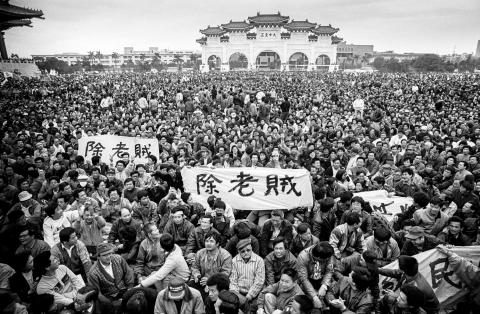
Photo courtesy of Hsu Po-hsin
In conjunction with dangwai (黨外, “outside the party”) magazines, political photography of the 1980s centered on mass rallies and rarely seen events, striking a critical pose against the government, according to literature about the exhibit.
This came amid the backdrop of 38 years of martial law, lifted by former president Chiang Ching-kuo (蔣經國) on July 15, 1987. During that period, Taiwanese were denied such basic freedoms as the right to assemble, speak freely and organize political parties.
It was seen as a first important step toward democratization — a process that journalists were on hand to capture.
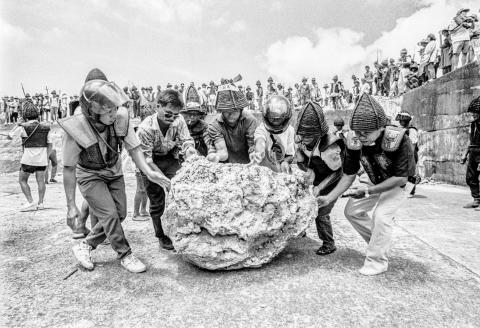
Photo courtesy of Huang Tzu-ming
“Around the time martial law was lifted, society had already amassed a great amount of energy in hopes of forging change,” Yu said. “The people wanted the truth. That period also just so happened to coincide with the rise of the media.”
“History’s Shadows and Light” originated from a larger-scale exhibit called “Faint Light, Dark Shadows” (微光闇影), held earlier this year at the Taipei Fine Arts Museum in Taipei and also curated by Yu.
Housed in the first and second-floor gallery space of the Taipei Economic and Cultural Office (TECO) in New York, “History’s Shadows and Light” showcases the work of photojournalists Liu Chen-hsiang (劉振祥), Huang Tzu-ming (黃子明) and Hsu Po-hsin (許伯鑫).
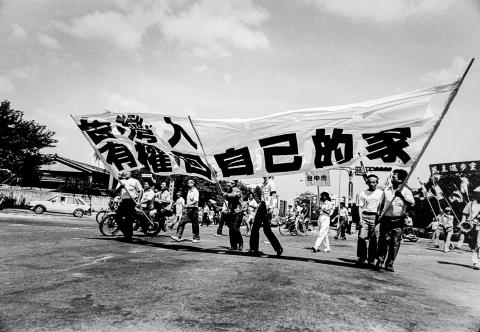
Photo courtesy of Liu Chen-hsiang
TURNING POINTS
Greeting visitors on the first floor as they enter are also videos from the Green Team (綠色小組), a photographers’ group founded in October 1986. Using home video cameras, the Green Team recorded a number of social movements that took shape in Taiwan during that time.
The group distributed their footage through informal channels in an effort to circumvent official news being reported by Taiwan’s big three television networks.
Among the filmed events shown at the New York exhibit are the Taoyuan Airport Incident of 1986 and the desecration of graves of Aboriginal people in Nantou less than a year later.
The Taoyuan Airport Incident unfolded on Nov. 30, 1986, when the newly formed Democratic Progressive Party (DPP) sent people to meet Hsu Hsin-liang (許信良). Exiled for opposing the Chinese Nationalist Party (KMT) government, Hsu had attempted to enter Taiwan by plane via Japan, but was blocked.
The other video shows a dozen organizations, led by the Taiwan Aboriginal Rights Association (台灣原住民權利促進會), carrying a coffin to the Executive Yuan on April 3, 1987. The groups were protesting the Nantou County Government’s digging up of Aboriginal graves — and leaving the disinterred remains exposed — to develop the Dongpu hot spring area in Sinyi Township (信義).
The exhibit’s second floor features the work of Liu, Huang and Hsu. In a setting reminiscent of a photography darkroom, light boxes illuminating negatives are affixed to the walls, displaying a series of shots leading up to the one chosen for development. The selection is marked with a red square around it.
KEEPIN’ IT REEL
Yu said the design of the exhibition space was meant to replicate the process of how photographs were selected for publication at news organizations before the advent of digital photography.
“At that time, they had to go inside a darkroom,” she said. “Journalists, after finishing shooting, would then immediately need to rely on their experience to decide which negatives to use. They had to choose directly, they didn’t first make an original print.”
Exhibit-goers with iPhones can experience what it was like to make those kinds of decisions in a darkened space by turning on an option that inverts colors and allows the negatives to be viewed as a photograph.
To keep the displays clean, curators minimized the amount of text accompanying the photos, instead displaying QR codes that can be scanned with a smartphone to reveal captions.
The exhibit explores topics that developed after the lifting of martial law, including movements involving farmers and workers, as well as human rights and environmental protection.
A selection of prints is arranged on exhibition tables designed by Luxury Logico (豪華朗機工), which made the cauldron used in the lighting ceremony of the Taipei Summer Universiade in the summer. The group is also responsible for the installation’s layout.
Among the photographs is one from Liu, exhibit co-curator and former photographer with the Independent Newspaper Group (自立報系), taken on Aug. 26, 1988.
It captures a scene following the memorial service of Chen Cui-yu (陳翠玉), a blacklisted democracy activist. The photograph shows a funeral procession making its way to the Presidential Office to protest the KMT’s policy of blacklisting dissidents.
Another shot from Huang, now the head of the China Times’ center of photography, shows members of the Tao Aboriginal community on Orchid Island (蘭嶼) pushing huge rocks into the sea on June 1, 1995, to stop a nuclear waste ship from entering the harbor. The protest was in response to a delay in moving a nuclear waste storage facility.
And one from Hsu, a former photojournalist for the Independent Evening Post (自立晚報), shows an oath-taking rally held by the DPP on March 18, 1990, at Chiang Kai-shek Memorial Hall. The group was rallying to “eliminate the old guards and save the country.”
While political photography was an outgrowth of the lifting of martial law in 1987, Yu said the period was also a turning point in the style of photography used to bear witness to what was happening across the nation.
Some photojournalists used coarse-grain, out-of-focus images to convey to viewers a feeling of what it was like to actually be at the scene of a conflict, Yu said. This contrasted with the notion of documentary-like photos that were supposed to be extremely clear and distinct.
“That style, at the time, ushered in another type of aesthetic in photography,” Yu said.
The curators hope that bringing “History’s Shadows and Light” to New York — a city that Yu said attaches great importance to human rights and freedom — can introduce more people to this pivotal part of Taiwan’s history while also highlighting developments at the time in political photography.
“I want people to think about art first,” said Ellen Ko (柯慧貞), executive cultural officer of the Taipei Cultural Center in New York. “And, of course, it’s good to know that as a young democracy we have come this far.”
The exhibit is on until Oct. 12 at the Taipei Economic and Cultural Office (TECO) in New York, 1 East 42nd St.
Taiwan’s English education system is being pulled apart by three opposing forces. Bilingual Nation 2030 pulls students toward English and global communication. Artificial Intelligence (AI) readiness pulls them toward digital judgment, verification and AI-mediated work. But Taiwan’s old exam culture pulls them back toward memorization, grammar drills, timed reading and correct answers. If the education system keeps using old exams to define success, it risks producing graduates who are neither genuinely bilingual nor genuinely AI-ready, but trained for tasks machines can already perform. The first force is Bilingual Nation 2030. Launched in 2018, the policy aimed to “help Taiwan’s workforce connect
It seems every few days one bumps into one of those “real man” comments in which Taiwan is urged to “face reality” or similar, and “make a deal,” with the speaker implying that soon it will be too late. “Deal” advocates always present themselves as having a superior grip on reality, and the manly ability to make the “hard choice.” Their testosterone-laden language often echoes that of Taiwan sellout advocates. Note that such commentary always specifies a process (“make a deal, work with, make progress”), never the end state of what occupation by a violent authoritarian colonialist state will entail. In
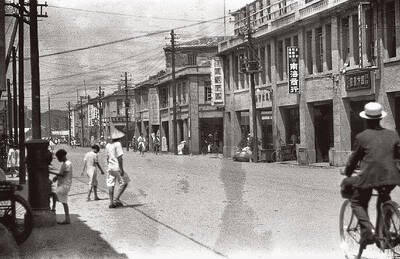
June 1 to June 7 "If all Taiwanese were as afraid of dying as you, then what would happen?” Physician Shih Chiang-nan (施江南) reportedly said this to his wife Chen Chiao-tung (陳焦桐) after she urged him to stop intervening on behalf of Taiwanese soldiers stranded overseas after serving in the Japanese Army during World War II. Shih had clashed with high-ranking officials over the issue, engaged in several heated arguments with Taiwan governor-general Chen Yi (陳儀) and allegedly shouted at general Ko Yuan-fen (柯遠芬), chief of staff of the Taiwan Garrison Command, over

“Taiwan’s Opposition Leader Comes to US With a Message Straight Out of Beijing” read a May 31 headline in the Wall Street Journal. Top US administration officials and members of Congress almost certainly read the WSJ, and if there was a bullet point takeaway that people in Washington should absorb ahead of Chinese Nationalist Party (KMT) Chair Cheng Li-wun’s (鄭麗文) arrival in DC on June 9, that headline is it. The last few columns have discussed this very topic, and the timing is not coincidental. While those top officials likely do not read the Taipei Times, judging by the number


 RSS
RSS