


As Wong Kin-kao stands on the deck of the traditional Chinese wooden junk he is building in Shenwan, a cluster of fish ponds and factories in the Pearl River Delta of southern China, he shouts to be heard over the shriek of metalwork from steel ships that are being worked on nearby.
“It’s like a piece of art,” said Wong, a bronzed 54-year-old with stony hands and a quick grin, describing what he loves about the scimitar-shaped boats with the batwing sails that he so rarely gets to build.
A native of the delta region, Wong in 1982 swam for two hours from nearby Zhuhai to what was then the Portuguese colony of Macau to escape China’s strict communist government. Once there he set up an early incarnation of Yi Hap Shipyard, a builder of wooden junks, which symbolize the delta and the maritime culture that drove China’s early growth.
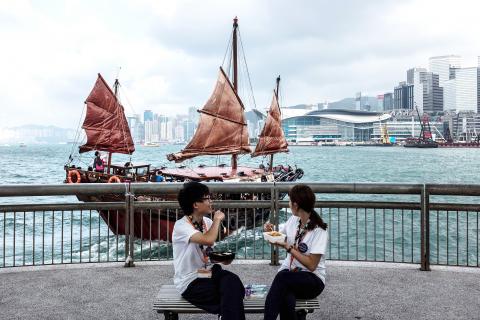
Photo: AFP
“Not many people are hand-making wooden junks anymore,” Wong said. “I wish more people would.”
Within the next few months, the junk, the Dai Cheung Po — also known as the Aqua Luna II — will unfurl its blood-red sails above its high stern and low bow and join its smaller sister, the Cheung Po Tsai, or the Aqua Luna I, already in Victoria Harbor in Hong Kong, to offer parties and dinners.
It is one of a few of these traditional ships with sails being made by one of the last remaining junk builders in China.
“The building tradition is more or less moribund,” said Stephen Davies, a former director of the Hong Kong Maritime Museum.
Yet the style remains traditional, “insofar as they are still doing what Grandpa did, and before him,” he said.
RELIC OF THE PAST
The new junk is made of Southeast Asian ironwood and teak and costs about US$1.3 million to build. It was commissioned by a restaurant group in Hong Kong, which lies about 80 km east of Shenwan on the edge of the delta where the river’s silty water turns ocean blue.
Also in Hong Kong is the Dukling, a classic, red-sailed junk that dates from 1955. It sank once and was recently refurbished. Since June, its owners have offered tours of Hong Kong’s waters, reflecting how junks today are used mostly for tourism and private parties.
They are three of only a handful of junks that remain in the delta, replaced long ago by stouter wooden fishing vessels without sails, speedboats and huge container ships.
The 19th-century pirate Cheung Po Tsai, or Cheung Po “the Kid,” who crisscrossed the delta pillaging and later joined the Qing dynasty imperial navy, sailed a ship that looked similar to his namesakes, though its sails may have been a yellow woven bamboo, not red. The red color is largely a flourish, Davies said.
The life of the delta is partly interlaced because of junks, which were once numerous with their fanlike silhouettes, trading down into Southeast Asia and up the coast of China.
The junk — the word’s origins are murky, with Chinese, Malay and Portuguese cited as influences — may have assumed its iconic, curved hull and sails about 1,000 years ago, during the Song dynasty, though written records are scarce.
Captivated by the junk’s beauty, David Yeo, the founder and owner of Aqua Restaurant Group, commissioned a Hong Kong master boat builder, Au Wai, to conceptualize and direct the construction of the Aqua Lunas and to work with Wong in Shenwan. The first was launched in 2006, and unlike junks of the past, both are motor-powered, and their sails are decorative.
“He has made more commercial junk boats than anyone else in Hong Kong. He is a master of a true art form,” Yeo said in an email. “An art form that is sadly dying out in Hong Kong today.”
Au’s life reflects the sweep of delta geography. He is unsure where he was born but knows his father was from Guangdong province in China, through which the Pearl River runs.
Known as Ah Sin — the honorific and name translate as Dear Magician, for his talent — Au, 85, grew up poor in Hong Kong.
In his boatyard on Hong Kong Island, in the eastern district of Shau Kei Wan, he points to photographs of wooden ships of all kinds that he has built since being apprenticed to an uncle at the age of 13: simple “walla-walla” motorboats and corporate junks that carry some design elements of the traditional junk but without sails.
LABOR OF LOVE
Beyond the wood shavings, the harbor glitters in the sun. Fishing boats draw up outside to deliver their catch to the next-door Shau Kei Wan wholesale fish market.
“I was very naughty as a boy, and no one could control me,” Au said. Barely a teenager, he sold fish on the streets.
“I did what I wanted. So my family said, ‘You should look for a special skill,’” he said. “An uncle was the owner of a shipyard and also a member of the ship association.”
His son, Au Sai Kit, works with him, but because his son has no children, the family tradition will probably end there.
Hardly anyone in Hong Kong is willing to do manual labor, the elder Au said, so he has to look to places like Shenwan, where he and his son travel regularly to confer with Wong and his team of workers.
Building a luxury junk is a labor of love, Au said.
“We take the wood piece by piece, fit them together in a curve, measure each piece and cut it,” he said. Copper nails are used to hammer the hull together. No other metal or artificial materials are used.
It takes about a year to build a traditional junk, Wong said.
Once junks were made from camphor wood and pine from next-door Fujian province, said Davies, the former museum director.
“They were simple to build. That was the genius of the hull design,” he said.
But they had flaws.
“The hull is only joined together by nails, so you can’t have one high sail. You need low-stress rigging,” he said. “They had to keep adding sails to make the junk sail in a straight line.”
The idea of a Chinese junk has been romanticized, Davies said.
“Junks were brutally hard work. The grunt work — it took 14 members of crew to work the sails. It was pure sweat,” he said.
But Davies concedes that the traditional Chinese junk remains iconic.
“That sweep down to the bow, the fan in profile, with the masts that create this beautiful arc along the top. The fully battened, standing rigging. There is just a beautiful harmony in looking at it,” he said.

This month the government ordered a one-year block of Xiaohongshu (小紅書) or Rednote, a Chinese social media platform with more than 3 million users in Taiwan. The government pointed to widespread fraud activity on the platform, along with cybersecurity failures. Officials said that they had reached out to the company and asked it to change. However, they received no response. The pro-China parties, the Chinese Nationalist Party (KMT) and Taiwan People’s Party (TPP), immediately swung into action, denouncing the ban as an attack on free speech. This “free speech” claim was then echoed by the People’s Republic of China (PRC),

Most heroes are remembered for the battles they fought. Taiwan’s Black Bat Squadron is remembered for flying into Chinese airspace 838 times between 1953 and 1967, and for the 148 men whose sacrifice bought the intelligence that kept Taiwan secure. Two-thirds of the squadron died carrying out missions most people wouldn’t learn about for another 40 years. The squadron lost 15 aircraft and 148 crew members over those 14 years, making it the deadliest unit in Taiwan’s military history by casualty rate. They flew at night, often at low altitudes, straight into some of the most heavily defended airspace in Asia.
Many people in Taiwan first learned about universal basic income (UBI) — the idea that the government should provide regular, no-strings-attached payments to each citizen — in 2019. While seeking the Democratic nomination for the 2020 US presidential election, Andrew Yang, a politician of Taiwanese descent, said that, if elected, he’d institute a UBI of US$1,000 per month to “get the economic boot off of people’s throats, allowing them to lift their heads up, breathe, and get excited for the future.” His campaign petered out, but the concept of UBI hasn’t gone away. Throughout the industrialized world, there are fears that

The Democratic Progressive Party (DPP) controlled Executive Yuan (often called the Cabinet) finally fired back at the opposition-controlled Legislative Yuan in their ongoing struggle for control. The opposition Chinese Nationalist Party (KMT) and Taiwan People’s Party (TPP) acted surprised and outraged, but they should have seen it coming. Taiwan is now in a full-blown constitutional crisis. There are still peaceful ways out of this conflict, but with the KMT and TPP leadership in the hands of hardliners and the DPP having lost all patience, there is an alarming chance things could spiral out of control, threatening Taiwan’s democracy. This is no


 RSS
RSS