


A Nepali who will become the first transgender model to walk the runway at an Indian fashion show hopes to inspire other victims of gender identity discrimination across conservative South Asia.
Anjali Lama, who was born a man in rural Nepal, was ostracized by members of her own family after telling them twelve years ago that she wanted to live as a woman.
She overcame abuse and prejudice to become the Himalayan country’s first transgender model and is now preparing to strut the catwalk at Lakme Fashion Week in Mumbai, India’s premier fashion show, next month.

Photo: Tandem Communications/AFP
“Growing up in Nepal as a transgender was extremely difficult,” Lama, 32, told AFP in an e-mail interview ahead of the fashion extravaganza, which runs until Sunday.
“In South Asian countries people still aren’t that accepting, they treat it like an illness. The public looks at you differently and treats you in a different manner,” she said.
Lama was born Nabin Waiba to a family of poor farmers in remote Nuwakot in mountainous Nepal.

Photo: Tandem Communications/AFP
But she always knew that she had been born in the wrong body and in 2005 took the decision to dress as a woman for the first time. “I knew I couldn’t feel like another person living in someone else’s body. Hence, I was ready to face the cruel words that people threw at me,” said the model. “Most of the people, including my own brothers, weren’t ready to accept me for who I was. I had to stay strong and believe in myself. My mother and sisters were the only ones who supported me throughout.”
Lama found some acceptance in Kathmandu, where she moved to study, and later became an activist for an LGBT rights group called Blue Diamond Society.
She underwent partial sex reassignment surgery in 2009 and her interest in modeling was piqued the following year when she was pictured on the front cover of a magazine featuring an article about transgender people.
NEW YORK, MILAN, PARIS?
It spurred her to pursue a career in modeling full-time. She enrolled in classes but initially found work hard to come by.
“I was getting rejected because of my identity and that was extremely disheartening,” said Lama, who has established herself as a successful model in her native Nepal over the past couple of years.
In 2014 she featured in a documentary titled Anjali: Living Inside Someone Else’s Skin in which she said she hoped to become completely female one day — an operation that is financially out of reach for most Nepalis.
Her recent success has come as Nepal has increased its recognition of transgender people. In 2015 the country, which allows citizens to choose their sex, started issuing third gender category passports for those who identify themselves as transgender.
“With the changing times people have become more accepting,” explained Lama.
Manisha Dhakal, one of the founders of the Blue Diamond Society, said Nepal’s government needed to do more to provide equal opportunities in education and employment for transgender people.
“To get the acceptance in society we need to be economically empowered,” she told AFP.
In neighboring India, “Hijras” have also long complained of discrimination and marginalization. They are recognized as a third gender but are often shunned from society with some forced into begging or prostitution.
Lama — who said it would be a “dream come true” to follow other transgender models onto major catwalks such as New York, Milan and Paris — hopes her turn at Lakme Fashion Week will make a difference in the battle for acceptance.
She added: “I do hope to be an inspiration for other transgender people. I’d like to tell them to always believe in themselves and to work towards their goals.”
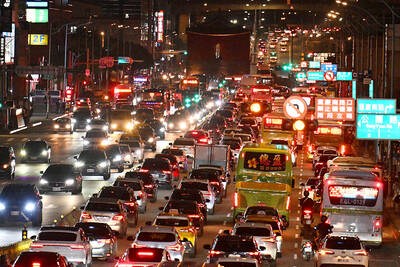
By global standards, the traffic congestion that afflicts Taiwan’s urban areas isn’t horrific. But nor is it something the country can be proud of. According to TomTom, a Dutch developer of location and navigation technologies, last year Taiwan was the sixth most congested country in Asia. Of the 492 towns and cities included in its rankings last year, Taipei was the 74th most congested. Taoyuan ranked 105th, while Hsinchu County (121st), Taichung (142nd), Tainan (173rd), New Taipei City (227th), Kaohsiung (241st) and Keelung (302nd) also featured on the list. Four Japanese cities have slower traffic than Taipei. (Seoul, which has some

In our discussions of tourism in Taiwan we often criticize the government’s addiction to promoting food and shopping, while ignoring Taiwan’s underdeveloped trekking and adventure travel opportunities. This discussion, however, is decidedly land-focused. When was the last time a port entered into it? Last week I encountered journalist and travel writer Cameron Dueck, who had sailed to Taiwan in 2023-24, and was full of tales. Like everyone who visits, he and his partner Fiona Ching loved our island nation and had nothing but wonderful experiences on land. But he had little positive to say about the way Taiwan has organized its

Michael slides a sequin glove over the pop star’s tarnished legacy, shrouding Michael Jackson’s complications with a conventional biopic that, if you cover your ears, sounds great. Antoine Fuqua’s movie is sanctioned by Jackson’s estate and its producers include the estate’s executors. So it is, by its nature, a narrow, authorized perspective on Jackson. The film ends before the flood of allegations of sexual abuse of children, or Jackson’s own acknowledgment of sleeping alongside kids. Jackson and his estate have long maintained his innocence. In his only criminal trial, in 2005, Jackson was acquitted. Michael doesn’t even subtly nod to these facts.
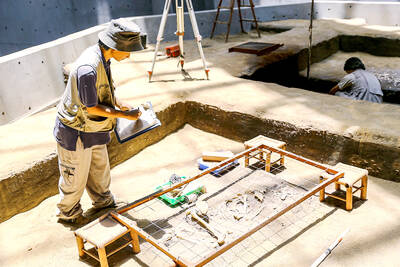
Writing of the finds at the ancient iron-working site of Shihsanhang (十 三行) in New Taipei City’s Bali District (八里), archaeologist Tsang Cheng-hwa (臧振華) of the Academia Sinica’s Institute of History and Philology observes: “One bronze bowl gilded with gold, together with copper coins and fragments of Tang and Song ceramics, were also found. These provide evidence for early contact between Taiwan aborigines and Chinese.” The Shihsanhang Web site from the Ministry of Culture says of the finds: “They were evidence that the residents of the area had a close trading relation with Chinese civilians, as the coins can be


 RSS
RSS