


It’s witty, funny, bold and at times irreverent. It’s Shakespeare as you’ve never seen or heard him before as the LAB Space closes out the year with Bomb-itty of Errors, a hip-hop version of the Bard’s The Comedy of Errors. It’s a show that you won’t want to miss.
Two sets of identical twins, Antipholus and Dromio, are separated at birth and raised in the different cities of Syracuse and Ephesus. The complications begin when the Syracuse Antipholus and Dromio, as joyful vagabonds, come to sedate Ephesus where they are both mistaken for their similarly named counterparts and quickly become enmeshed in their affairs.
Director Brook Hall has put together a strong cast of Steve Coetzee and Airy Liu (劉怡伶), the Syracuse Antipholus and Dromio, and Meg Anderson and Charlie Storrar, the Ephesus Antipholus and Dromio, to carry this delightful farce.
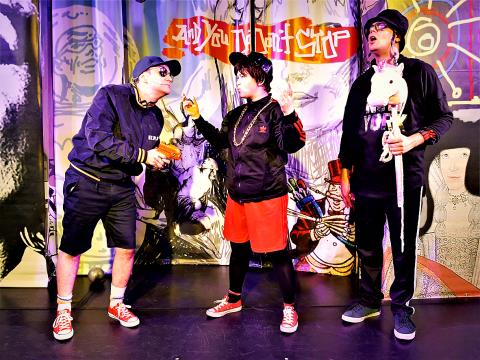
Photo courtesy of Antonella Gismundi
From here on in, one needs a touch of Samuel Taylor Coleridge’s “willing suspension of disbelief.”
In Shakespeare’s day, men played the women’s roles and actors spoke in iambic pentameter. Rap is often iambic tetrameter and the real delight of this play is the versatility shown by the four leads as they take on multiple roles and rap in style.
Everyone will have his/her favorite scenes. For this writer, it is Hasidic Hendelberg (Coetzee) getting lost in his own rap.
Another is when Storrar as Luciana is alarmingly “courted” by Syracuse Antipholus (Coetzee) whom “she” thinks is her sister’s husband.
Kudos go to costume designer Jenna Robinette, set designer Joseph Lark-Riley and show sponsorship from the Department of Culture, Taipei City Government. Not only are multiple costumes needed but ones that can come off and on in a split second as characters exit one door and return through another.
Lark-Riley’s graffiti-laced set provides the multiple entrances and exits as well as a visible balcony for “beat man,” DJ Cross Cutz (Cedric Bouadzi), who regularly interacts with the cast below.

This month the government ordered a one-year block of Xiaohongshu (小紅書) or Rednote, a Chinese social media platform with more than 3 million users in Taiwan. The government pointed to widespread fraud activity on the platform, along with cybersecurity failures. Officials said that they had reached out to the company and asked it to change. However, they received no response. The pro-China parties, the Chinese Nationalist Party (KMT) and Taiwan People’s Party (TPP), immediately swung into action, denouncing the ban as an attack on free speech. This “free speech” claim was then echoed by the People’s Republic of China (PRC),

Exceptions to the rule are sometimes revealing. For a brief few years, there was an emerging ideological split between the Democratic Progressive Party (DPP) and Chinese Nationalist Party (KMT) that appeared to be pushing the DPP in a direction that would be considered more liberal, and the KMT more conservative. In the previous column, “The KMT-DPP’s bureaucrat-led developmental state” (Dec. 11, page 12), we examined how Taiwan’s democratic system developed, and how both the two main parties largely accepted a similar consensus on how Taiwan should be run domestically and did not split along the left-right lines more familiar in
Many people in Taiwan first learned about universal basic income (UBI) — the idea that the government should provide regular, no-strings-attached payments to each citizen — in 2019. While seeking the Democratic nomination for the 2020 US presidential election, Andrew Yang, a politician of Taiwanese descent, said that, if elected, he’d institute a UBI of US$1,000 per month to “get the economic boot off of people’s throats, allowing them to lift their heads up, breathe, and get excited for the future.” His campaign petered out, but the concept of UBI hasn’t gone away. Throughout the industrialized world, there are fears that

The Democratic Progressive Party (DPP) controlled Executive Yuan (often called the Cabinet) finally fired back at the opposition-controlled Legislative Yuan in their ongoing struggle for control. The opposition Chinese Nationalist Party (KMT) and Taiwan People’s Party (TPP) acted surprised and outraged, but they should have seen it coming. Taiwan is now in a full-blown constitutional crisis. There are still peaceful ways out of this conflict, but with the KMT and TPP leadership in the hands of hardliners and the DPP having lost all patience, there is an alarming chance things could spiral out of control, threatening Taiwan’s democracy. This is no


 RSS
RSS