


Cubanos, or Cuban sandwiches, have become somewhat of a thing in Taiwan ever since Jon Favreau served them from a food truck in the 2014 winter movie Chef.
Few places seem to get it right, though, usually going too heavy or sweet with the sauces (it’s said that a true cubano should only contain mustard) or using the wrong type of bread. But really, authenticity should not be something to dwell on as even US restaurants often suggest their own take on the prototypical version that Cuban workers in Florida ate. The point is, that I have yet to sample a cubano in Taiwan that is up to par.
This quest brought my friend and me to Borracho & Wok, a small gastropub tucked into an alley behind Zhongxiao E Rd, which is rumored to have excellent Cuban sandwiches. The restaurant also exercises its creativity, as its offerings include a spicy peanut butter and bacon version (NT$180) and a raw beef and truffle (NT$250) invention.
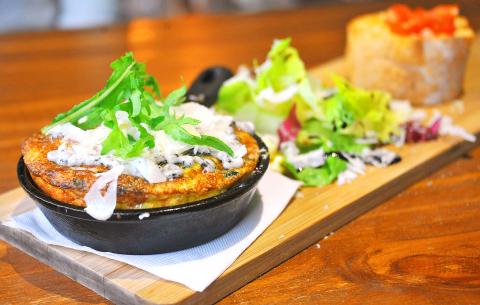
Photo: Han Cheung, Taipei Times
I later find out that it’s actually owned by celebrity chef Chen Wei-kang (陳偉剛), but that’s really irrelevant for people who don’t watch local television shows. As borracho means “drunk” in Spanish, the place has a pretty extensive alcohol menu (Alpenkaiser Weizenbier or red wine for brunch, anyone?), and the wok part refers to the many dishes that are served in cast iron skillets. To get the full experience, we order the raw beef cubano and a spinach frittata with truffle and chorizo (NT$260) in a skillet. You can add NT$90 for a salad, chips and a drink to go with the sandwich.
For appetizers, we chose the deep fried squid ink and risotto balls (NT$230), which were filled with melted cheese, squid bits and lots of garlic. They are perfectly fried with just the right amount of crispiness and the rice is sticky yet firm, creating layers of textures when paired with the runny cheese and squid. The garlic is the main flavor here, with a touch of saltiness. The distribution of squid is a bit uneven, however, as one of the balls only contained one tiny piece.
The frittata was fluffy in the inside, balanced with the bits of chorizo and spinach. It’s topped with the slightly sharp padano cheese, which pleasantly melts into the egg. The dish leans toward the sweet side again as the top is coated with truffle mayonnaise — fortunately the chef shows restraint and keeps it light.
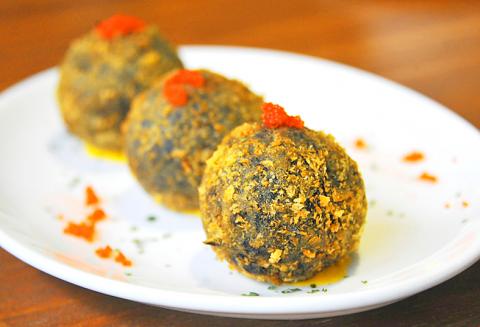
Photo: Han Cheung, Taipei Times
The cubano was expectedly not authentic, but it did not disappoint. As most Taiwanese versions of foreign food go, it featured a sweeter palate with the truffle relish. There’s lots of cheese, which contains both the stringy and liquidy type — personally I would have just preferred stringy as there is already the relish that softens the bread, which was developed by the Japanese executive chef while he was training in South America. It does resemble Cuban bread (which is similar to French bread) despite being slightly crunchier, and pairs well with the rest of the ingredients. Even though the beef did not come exactly raw, it didn’t matter as it was tender and flavorful. And it does contain ham — which is the staple of a cubano and cannot be omitted.
The side salad was refreshing — many local establishments tend to overdo the dressing and toppings, but this one treaded lightly, featuring only with raw mozzarella bits, thin slices of padano and dashes of olive oil and vinaigrette.
Overall, it was not exactly the cubano I was looking for, but I did leave Borracho and Wok satisfied as the food was intricate and not too heavy. Maybe this is good enough, and if I want a real Cuban sandwich I should head to Miami.
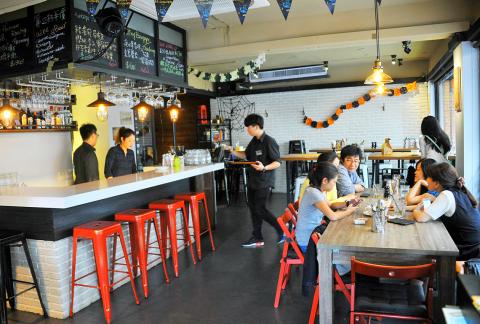
Photo: Han Cheung, Taipei Times

Taiwan’s English education system is being pulled apart by three opposing forces. Bilingual Nation 2030 pulls students toward English and global communication. Artificial Intelligence (AI) readiness pulls them toward digital judgment, verification and AI-mediated work. But Taiwan’s old exam culture pulls them back toward memorization, grammar drills, timed reading and correct answers. If the education system keeps using old exams to define success, it risks producing graduates who are neither genuinely bilingual nor genuinely AI-ready, but trained for tasks machines can already perform. The first force is Bilingual Nation 2030. Launched in 2018, the policy aimed to “help Taiwan’s workforce connect
It seems every few days one bumps into one of those “real man” comments in which Taiwan is urged to “face reality” or similar, and “make a deal,” with the speaker implying that soon it will be too late. “Deal” advocates always present themselves as having a superior grip on reality, and the manly ability to make the “hard choice.” Their testosterone-laden language often echoes that of Taiwan sellout advocates. Note that such commentary always specifies a process (“make a deal, work with, make progress”), never the end state of what occupation by a violent authoritarian colonialist state will entail. In
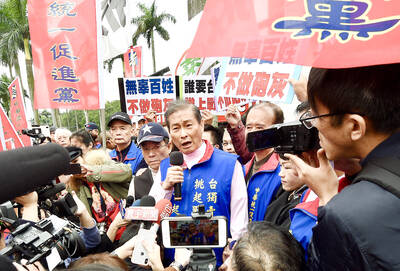
There are shadowy cabals plotting to sell out Taiwan to be annexed by China, by invasion if necessary. Fortunately, they are buffoons. In 2019, former Bamboo Union gangster and founder of the China Unification Promotion Party (CUPP), Chang An-le (張安樂, colorfully known as “White Wolf”), led a protest at the Legislative Yuan against comments made by then-premier Su Tseng-chang (蘇貞昌) that in the event of an attack by China, he would never surrender, but would protect the nation by fighting to the end, even if he only had a broom. Chang had party members bring a wooden casket that they
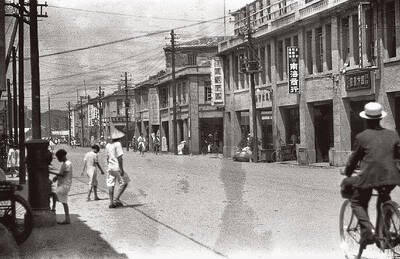
June 1 to June 7 "If all Taiwanese were as afraid of dying as you, then what would happen?” Physician Shih Chiang-nan (施江南) reportedly said this to his wife Chen Chiao-tung (陳焦桐) after she urged him to stop intervening on behalf of Taiwanese soldiers stranded overseas after serving in the Japanese Army during World War II. Shih had clashed with high-ranking officials over the issue, engaged in several heated arguments with Taiwan governor-general Chen Yi (陳儀) and allegedly shouted at general Ko Yuan-fen (柯遠芬), chief of staff of the Taiwan Garrison Command, over


 RSS
RSS