


Fresh from their widely praised performances of Nushu (女書) at the Edinburgh Festival Fringe, the 15-year-old Water Reflection Dance Ensemble (水影舞集) will give two performances tomorrow of choreographer Tan Hui-chen’s (譚惠貞) latest work, Flower of Life (繁花).
Tan, whose choreography fuses ballet and modern dance techniques, has created a repertoire of works centered on female consciousness.
While Nushu was inspired by the centuries-old secret language of Chinese women, Flower of Life celebrates the work of several female Taiwanese poets in a blend of dance, poetry, the music of Luo Si-rong (羅思容) and visual imagery.
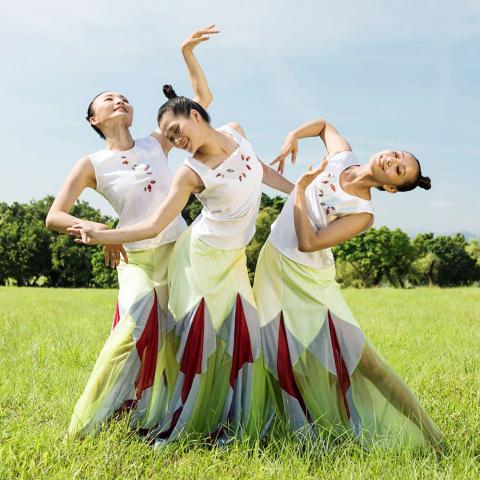
Photo Courtesy of WRDE
■ Tomorrow at 2:30pm and 7:30pm at Taipei Hakka Cultural Park (台北客家文化主題公園), 2, Tingzhou Rd Sec 3, Taipei City (台北市汀州路三段2號)
■ Admission is NT$400, available at NTCH box offices, online at www.artsticket.com.tw, convenience store ticketing kiosks or at the door.
■ Additional performance on Oct. 22 at 7:30pm at New Taipei City Arts Center (新北市藝文中心演藝廳), 62 Jhuangjing Rd, Banciao Dist, New Taipei City (新北市板橋區莊敬路62號). Admission is NT$400 to NT$800 available as above.
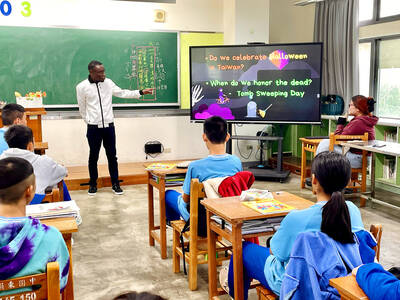
For many people, Bilingual Nation 2030 begins and ends in the classroom. Since the policy was launched in 2018, the debate has centered on students, teachers and the pressure placed on schools. Yet the policy was never solely about English education. The government’s official plan also calls for bilingualization in Taiwan’s government services, laws and regulations, and living environment. The goal is to make Taiwan more inclusive and accessible to international enterprises and talent and better prepared for global economic and trade conditions. After eight years, that grand vision is due for a pulse check. RULES THAT CAN BE READ For Harper Chen (陳虹宇), an adviser

Traditionally, indigenous people in Taiwan’s mountains practice swidden cultivation, or “slash and burn” agriculture, a practice common in human history. According to a 2016 research article in the International Journal of Environmental Sustainability, among the Atayal people, this began with a search for suitable forested slopeland. The trees are burnt for fertilizer and the land cleared of stones. The stones and wood are then piled up to make fences, while both dead and standing trees are retained on the plot. The fences are used to grow climbing crops like squash and beans. The plot itself supports farming for three years.
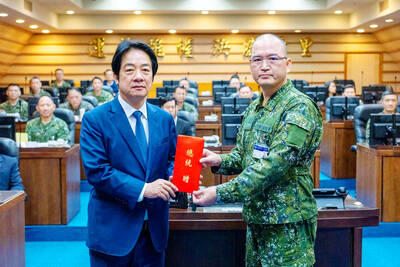
President William Lai (賴清德) on Nov. 25 last year announced in a Washington Post op-ed that “my government will introduce a historic US$40 billion supplementary defense budget, an investment that underscores our commitment to defending Taiwan’s democracy.” Lai promised “significant new arms acquisitions from the United States” and to “invest in cutting-edge technologies and expand Taiwan’s defense industrial base,” to “bolster deterrence by inserting greater costs and uncertainties into Beijing’s decision-making on the use of force.” Announcing it in the Washington Post was a strategic gamble, both geopolitically and domestically, with Taiwan’s international credibility at stake. But Lai’s message was exactly

May 4 to May 10 It was once said that if you hadn’t performed at the Sapphire Grand Cabaret (藍寶石大歌廳), you couldn’t truly be considered a star. Taking the stage at the legendary Kaohsiung club was more than just a concert. Performers were expected to entertain in every sense, wearing outlandish or revealing costumes and staying quick on their feet as sharp-tongued, over-the-top hosts asked questions and delivered jokes that would be seen as vulgar, even offensive, by today’s standards. Opening in May 1967 during a period of strict political and social control, Sapphire offered a rare outlet for audiences in


 RSS
RSS