


The Pengs’ Restaurant is the first Cantonese restaurant in Taipei’s East District. Established 30 years ago near Yanji Street (延吉街), it is often confused with another restaurant bearing the same name and a similar menu on Dongfong Street (東豐街). Though the owners of the two restaurants are relatives, and diners distinguish them by calling them the “Yanji outlet” and “Dongfong outlet,” they operate independently.
Peng’s is about a five-minute walk from Exit 2 of the Sun Yat-sen Memorial Hall Station MRT (國父紀念館站). Arriving for weekend lunch, the restaurant was about three-quarters full. In addition to a few large round tables, there are smaller ones for parties of two to four and a basement area for groups. It is clean and bright, although the decor is plain and a little outdated.
The restaurant’s signature dish is “crispy duck with mashed taro” (芋泥香酥鴨, NT$270). Chef-owner, Peng Chuang-ta (彭壯達) says the boneless duck meat with skin is sliced and steamed with eight varieties of Chinese herbs, various spices and ginger, garlic and soy sauce, while the steamed taro is mashed and mixed with flour.
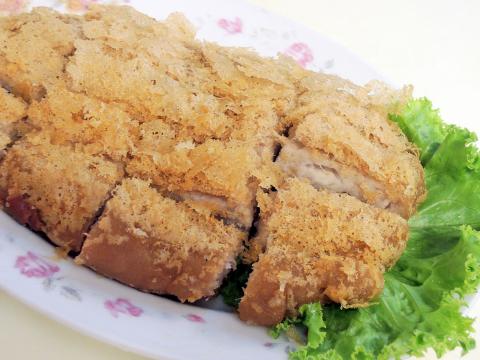
Photo: Eddy Chang, Taipei Times
The taro paste is applied to the duck, which is deep-fried for three minutes until it is golden and crispy on the outside, and tender and juicy on the inside. The natural sweetness of the taro paste and robust duck flavor go well together.
Salt-baked shrimp (鹽焗中蝦, NT$270), one of the restaurant’s most popular dishes, are not in fact “baked.” After cutting off their antennas and legs, the medium-sized shrimp are quickly deep-fried until crispy. They are then stir-fried with some chopped green onions, chili peppers and, of course, salt. The head and shell of the shrimp add a delightful crunch and contrast nicely with the succulent shrimp meat.
Other popular dishes include sweet and sour spareribs (京都排骨, NT$270), scallion oil over tripe (蔥油毛肚, NT$300), crispy fried pig intestines (脆皮炸肥腸, NT$300), scallops atop steamed egg white (瓊山豆腐, NT$270), Chinese spinach with shirasu (小魚莧菜, NT$150), famous crispy skin chicken (當紅脆皮雞, half, NT$300) and Xi Hu beef soup (西湖牛肉羹, NT$130), named after China’s West Lake.
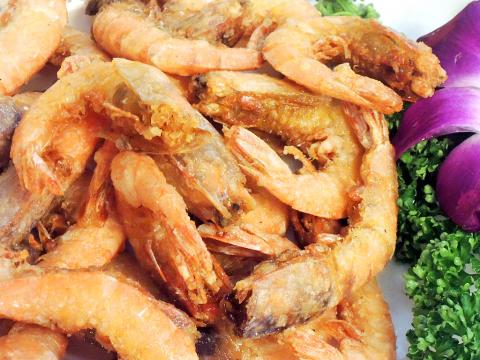
Photo: Eddy Chang, Taipei Times
I strongly recommend the tender and moist spareribs infused with the sweet and sour sauce made from black vinegar, ketchup and white sugar. The perfectly-balanced sauce really hit all the right notes.
The restaurant offers an extensive menu, including some fancier (and pricier) items, such as braised abalone (紅燒鮑魚, $1,800), and combo sets priced between NT$5,000 and NT$8,000.
However, it is slightly confusing to choose from such an extensive menu. For example, there are at least 15 beef items listed on the menu and some of them are quite similar. It would have been better if it could have simplified the ambitious menu and focused on popular items.
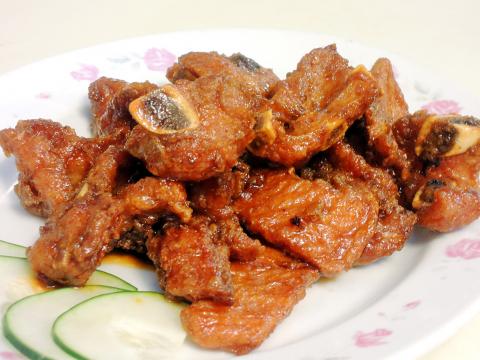
Photo: Eddy Chang, Taipei Times
The lunch for nine people only cost a little more than NT$2,000. Overall, Peng’s is a pleasant and tasty dining experience that is authentic and affordable.
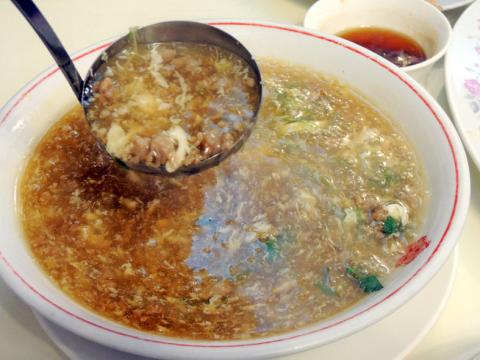
Photo: Eddy Chang, Taipei Times

Taiwan’s English education system is being pulled apart by three opposing forces. Bilingual Nation 2030 pulls students toward English and global communication. Artificial Intelligence (AI) readiness pulls them toward digital judgment, verification and AI-mediated work. But Taiwan’s old exam culture pulls them back toward memorization, grammar drills, timed reading and correct answers. If the education system keeps using old exams to define success, it risks producing graduates who are neither genuinely bilingual nor genuinely AI-ready, but trained for tasks machines can already perform. The first force is Bilingual Nation 2030. Launched in 2018, the policy aimed to “help Taiwan’s workforce connect

It seems every few days one bumps into one of those “real man” comments in which Taiwan is urged to “face reality” or similar, and “make a deal,” with the speaker implying that soon it will be too late. “Deal” advocates always present themselves as having a superior grip on reality, and the manly ability to make the “hard choice.” Their testosterone-laden language often echoes that of Taiwan sellout advocates. Note that such commentary always specifies a process (“make a deal, work with, make progress”), never the end state of what occupation by a violent authoritarian colonialist state will entail. In

There are shadowy cabals plotting to sell out Taiwan to be annexed by China, by invasion if necessary. Fortunately, they are buffoons. In 2019, former Bamboo Union gangster and founder of the China Unification Promotion Party (CUPP), Chang An-le (張安樂, colorfully known as “White Wolf”), led a protest at the Legislative Yuan against comments made by then-premier Su Tseng-chang (蘇貞昌) that in the event of an attack by China, he would never surrender, but would protect the nation by fighting to the end, even if he only had a broom. Chang had party members bring a wooden casket that they
June 1 to June 7 "If all Taiwanese were as afraid of dying as you, then what would happen?” Physician Shih Chiang-nan (施江南) reportedly said this to his wife Chen Chiao-tung (陳焦桐) after she urged him to stop intervening on behalf of Taiwanese soldiers stranded overseas after serving in the Japanese Army during World War II. Shih had clashed with high-ranking officials over the issue, engaged in several heated arguments with Taiwan governor-general Chen Yi (陳儀) and allegedly shouted at general Ko Yuan-fen (柯遠芬), chief of staff of the Taiwan Garrison Command, over


 RSS
RSS