


If there’s one show that you don’t want to miss this summer, it’s LAB Space’s presentation of Yasmina Reza’s God of Carnage, playing over the next two weekends.
In Carnage, which won the Tony Award for best play in 2009, director Jaime Zuniga has put together a strong, talented cast to meet the demands of a play where there are no small parts and no heroes. Two sets of parents, who meet to resolve a fight between their sons, quickly expose their own dysfunctional marriages in a loser-take-all match where all are basically on stage for a full 90 minutes.
Yong Hui-shurn (楊慧珊) plays Veronica, a writer determined to preserve civilization, its values and symbolic books. She drives the play by arranging the meeting. Derek Kwan (關顯揚) plays Michael, her husband, and a “Neanderthal-type” blue collar.
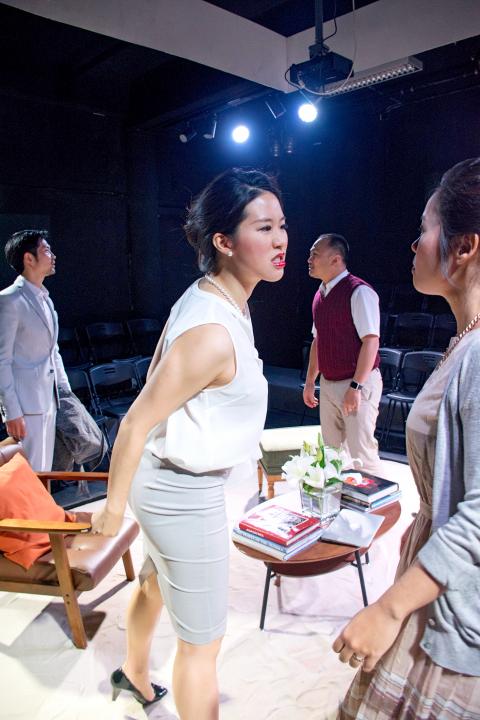
Photo courtesy of Cheng Yi Lee
On the opposing team is Alan, a busy lawyer played by Lawrence Ong (翁書強). He wants the mundane incident to be settled in 15 minutes so he can get back to his more important clients and work. Lesley Hu (胡世恩) plays Annette, his demure wife. Despite her initial reserved poise, she wreaks carnage by the play’s end.
The lines come fast and furious, and the play dissects not just marriage, but children, families and the point of existence. Each actor and actress has their moment of revelation and vulnerability as all four alternately contest in couple vs couple and gender vs gender battles where the veneer of civilization crumbles and even the symbolic books take a beating.
Making use of LAB Space’s flexible space, Zuniga skillfully stages this one-set play as a close, intimate theatre in the round where any seat is good as the four combatants move about as boxers in a ring. With four-letter words flying in criticism and retaliation, this is not a show for children.
We are “lumps of clay,” Michael jokes at the beginning, but what these four adult enfants terribles fashion by the play’s end is not the most promising. You will laugh, but also be forced to reflect.
■ The LAB Space (實演場), 3F, 9, Beitou Rd Sec 1, Taipei City (台北市北投路一段9號3樓). Remaining shows are tomorrow and Sunday and July 1-3. All shows begin at 8pm, doors open 7:30pm. Tickets are available from NT$600 at: www.accupass.com/go/carnage; for more information, check: thelabtw.com.
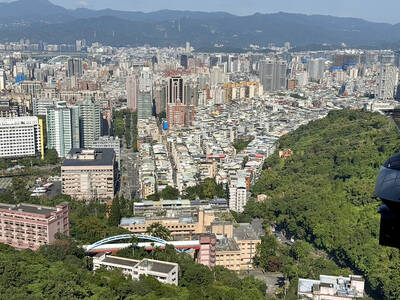
A recent report from the Environmental Management Administration of the Ministry of Environment highlights a perennial problem: illegal dumping of construction waste. In Taoyuan’s Yangmei District (楊梅) and Hsinchu’s Longtan District (龍潭) criminals leased 10,000 square meters of farmland, saying they were going to engage in horticulture. They then accepted between 40,000 and 50,000 cubic meters of construction waste from sites in northern Taiwan, charging less than the going rate for disposal, and dumped the waste concrete, tile, metal and glass onto the leased land. Taoyuan District prosecutors charged 33 individuals from seven companies with numerous violations of the law. This

As mega K-pop group BTS returns to the stage after a hiatus of more than three years, one major market is conspicuously missing from its 12-month world tour: China. The omission of one of the group’s biggest fan bases comes as no surprise. In fact, just the opposite would have been huge news. China has blocked most South Korean entertainment since 2016 under an unofficial ban that also restricts movies and the country’s popular TV dramas. For some Chinese, that means flying to Seoul to see their favorite groups perform — as many were expected to do for three shows opening
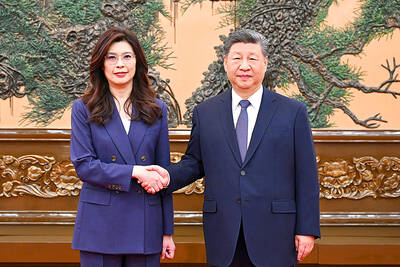
What is the importance within the Chinese Nationalist Party (KMT) of the meeting between Xi Jinping (習近平), the leader Chinese Communist Party (CCP), and Cheng Li-wun (鄭麗文), the leader of the KMT? Local media is an excellent guide to determine how important — or unimportant — a news event is to the public. Taiwan has a vast online media ecosystem, and if a news item is gaining traction among readers, editors shift resources in near real time to boost coverage to meet the demand and drive up traffic. Cheng’s China trip is among the top headlines, but by no means
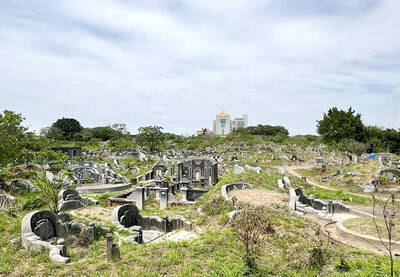
Apr. 13 to Apr. 19 From 17th-century royalty and Presbyterian missionaries to White Terror victims, cultural figures and industrialists, Nanshan Public Cemetery (南山公墓) sprawls across 95 hectares, guarding four centuries of Taiwan’s history. Current estimates show more than 60,000 graves, the earliest dating to 1642. Besides individual tombs, there are also hundreds of family plots, one of which is said to contain around 1,000 remains. As the cemetery occupies valuable land in the heart of Tainan, the government in 2018 began asking families to relocate the graves to make way for development. That


 RSS
RSS