


Japanese pork cutlet curry over rice has been long one of my favorite comfort foods — though I have always found Japanese-style curry a bit lacking in flavor when compared to the punchier and more complex offerings from, say, Thailand or Malaysia.
Ren seemed like the perfect solution to my gastronomic quandary — it serves traditional Japanese set meal dishes, but the main attraction is its coconut-infused curry.
The restaurant is on the second floor, and the canteen-style interior is as unassuming as its hole-in-the-wall entrance. It is just one room with an open kitchen in the back, with no more than 25 seats.
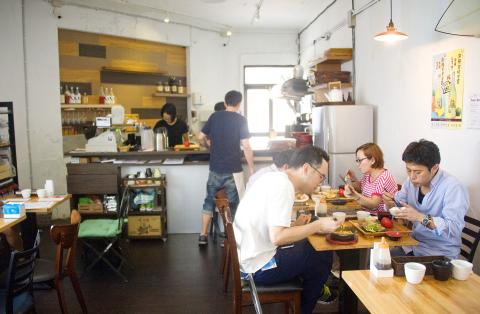
Photo: Han Cheung, Taipei Times
Reservations are strongly recommended. When we were there, the staff kept turning hungry office workers away.
Also, beware that the menu is only in Japanese and Chinese, with random English phrases here and there — but not enough for comprehension if you don’t read the aforementioned languages.
Though the fried pork cutlet with vegetable curry broth (NT$240) is Ren’s signature dish, we decided to try the fried pork cutlet set meal (NT$220) and a sliced pork and vegetable curry (NT$190), along with some a la carte items. After all, I could take the cutlet from the set meal and eat it with the curry — two dishes in one.
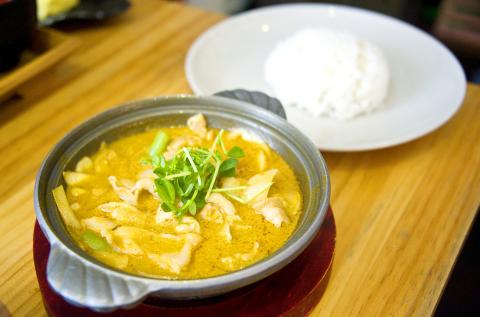
Photo: Han Cheung, Taipei Times
If you do not like sweet-tasting food, Ren is probably not the place for you. First up was the kimchi pork (NT$190), which had more of a sweet, sukiyaki-esque taste that overpowered the usually sharp kimchi flavors. The pork was tender, the kimchi was firm yet juicy, and it made for a satisfying dish despite being slightly greasy.
The tamagoyaki (NT$120), a fluffy scrambled egg roll, was nothing special, and also leaned toward the sweet side.
Japanese fried pork cutlets can vary widely from store to store — and there is nothing more disappointing than receiving a thin slice that is more breading than meat.
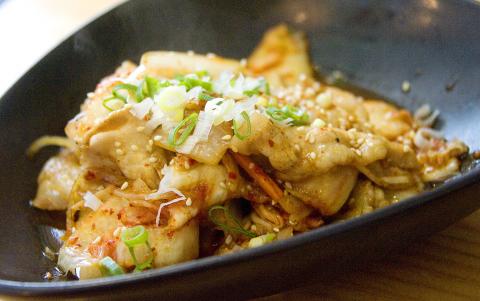
Photo: Han Cheung, Taipei Times
Ren’s culet is among the most generous I have eaten in Taipei. The bread crumb coating is light but crunchy, and the meat, despite being thick, is evenly prepared and is tender without any tendons or fat.
After eating two sweet dishes, the cutlet’s savory taste was welcomed. We returned to sweetness with the curry, which had layers and layers of different flavors held together by the coconut milk base that provides a pleasant, lingering aftertaste — exactly what was lacking in everyday Japanese curry. If there was one complaint, it would be that the broth was slightly on the greasy side.
The textures were also plentiful, with sliced pork (the same kind as the kimchi dish), corn, green beans and thinly-sliced mushrooms each providing something of their own.
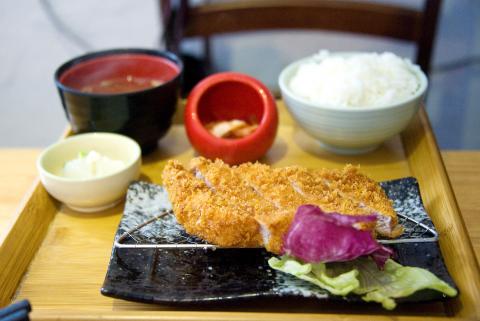
Photo: Han Cheung, Taipei Times
The soup-style curry worked much better with the rice than regular Japanese curry, which is thicker and sometimes clumps up the rice.
After sampling the dish in its original form, I took a slice of pork cutlet and dipped it in the curry. They were perfect together — the cutlet’s savoriness complemented the spicy, sweet and milky broth, which softened the crunchy exterior just to the right degree. The broth then seemed to almost seep through the cutlet, creating a whole new sensation.
I guess there is a reason why that combination is the restaurant’s signature dish. But if you do not like fried food, the regular sliced pork is still an excellent choice.
Ren also has locations in Neihu District (內湖) at 8, Ln 71, Jiangnan St (台北市江南街71巷8號) and New Taipei City’s Sansia District (三峽) at 22, Ta-kuan Rd (新北市三峽區大觀路22號).

Taiwan’s English education system is being pulled apart by three opposing forces. Bilingual Nation 2030 pulls students toward English and global communication. Artificial Intelligence (AI) readiness pulls them toward digital judgment, verification and AI-mediated work. But Taiwan’s old exam culture pulls them back toward memorization, grammar drills, timed reading and correct answers. If the education system keeps using old exams to define success, it risks producing graduates who are neither genuinely bilingual nor genuinely AI-ready, but trained for tasks machines can already perform. The first force is Bilingual Nation 2030. Launched in 2018, the policy aimed to “help Taiwan’s workforce connect

It seems every few days one bumps into one of those “real man” comments in which Taiwan is urged to “face reality” or similar, and “make a deal,” with the speaker implying that soon it will be too late. “Deal” advocates always present themselves as having a superior grip on reality, and the manly ability to make the “hard choice.” Their testosterone-laden language often echoes that of Taiwan sellout advocates. Note that such commentary always specifies a process (“make a deal, work with, make progress”), never the end state of what occupation by a violent authoritarian colonialist state will entail. In

There are shadowy cabals plotting to sell out Taiwan to be annexed by China, by invasion if necessary. Fortunately, they are buffoons. In 2019, former Bamboo Union gangster and founder of the China Unification Promotion Party (CUPP), Chang An-le (張安樂, colorfully known as “White Wolf”), led a protest at the Legislative Yuan against comments made by then-premier Su Tseng-chang (蘇貞昌) that in the event of an attack by China, he would never surrender, but would protect the nation by fighting to the end, even if he only had a broom. Chang had party members bring a wooden casket that they
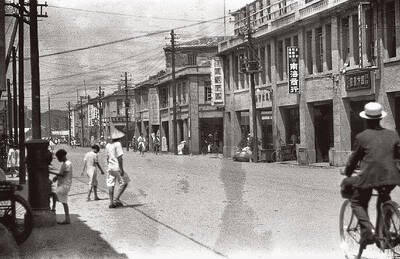
June 1 to June 7 "If all Taiwanese were as afraid of dying as you, then what would happen?” Physician Shih Chiang-nan (施江南) reportedly said this to his wife Chen Chiao-tung (陳焦桐) after she urged him to stop intervening on behalf of Taiwanese soldiers stranded overseas after serving in the Japanese Army during World War II. Shih had clashed with high-ranking officials over the issue, engaged in several heated arguments with Taiwan governor-general Chen Yi (陳儀) and allegedly shouted at general Ko Yuan-fen (柯遠芬), chief of staff of the Taiwan Garrison Command, over


 RSS
RSS