


When I showed a friend a picture I took of eight bottles of craft beer lined up on a patio, he said that from afar, they might as well have been bottles of soy sauce. It wasn’t that the photo was a bit blurry — mind you, it was taken after taste-testing a couple batches of homebrewed stouts, all with an alcohol content above 10 percent — but my friend could not read the Chinese characters on the labels.
That was the intention of the brewers — well, sort of. Not to have their beer mistaken for soy sauce, but rather, to cater to a Chinese-speaking clientele.
Founded in May of last year, Taiwan Head Brewers (啤酒頭) makes ales and stouts with teas produced from Taiwan such as Oolong (烏龍), Jasmine (茉莉花) and Oriental Beauty (東方美人). The color and design on the labels — baby blue with water droplets, lush green with rays of sunshine — evoke the calm water surrounding Taiwan’s Pacific coastline, as well as the rice fields during harvest season.
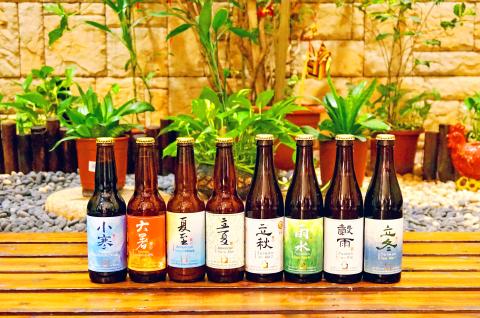
Photo: Dana Ter, Taipei Times
Earlier this month, I met up with Ray Sung (宋培弘) and Leo Yeh (葉奕辰) at their homebrew headquarters on a rooftop in New Taipei City’s Sanchong District (三重) where they experiment with new recipes – mostly barrel-aged stouts and other drinks deemed “too strong” to make it to the market, at least for now. The third co-founder, Jay Duan (段淵傑), was manning one of their two breweries in Taoyuan.
Like many other craft brewers in Taiwan, the co-founders met through a homebrew group on Facebook. They participated in homebrewing competitions before launching Taiwan Head Brewers and releasing their first two beers, the Taiwan Tea Ale (穀雨, gu yu) and the American Pale Ale (立夏, li xia), almost a year ago. Since then, they’ve been releasing a new brew nearly every month.
24 SEASONS
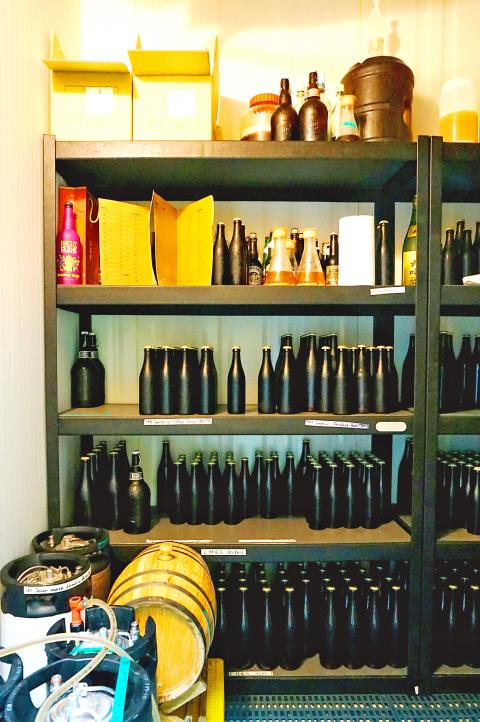
Photo: Dana Ter, Taipei Times
The trio knew from the onset that they wanted to create a brand of craft beer that one would associate as being from Taiwan, and generally speaking, from East Asia.
“When people think of craft beer, they think of something Western or American, so we decided to do something different,” Sung tells me.
The Chinese names of the beer are derived from the “24 solar terms” (二 十 四節氣) that farmers in ancient China used to guide their agricultural activities while the English names simply state what style of beer it is. The literal translation of the Taiwan Tea Ale (穀雨), for instance, is “grain rain,” a time of the year which generally takes place around the middle to end of April, when heavy rains in the region enable grain to grow. The American Pale Ale (立夏), meanwhile, means “start of summer” and is light and citrusy.
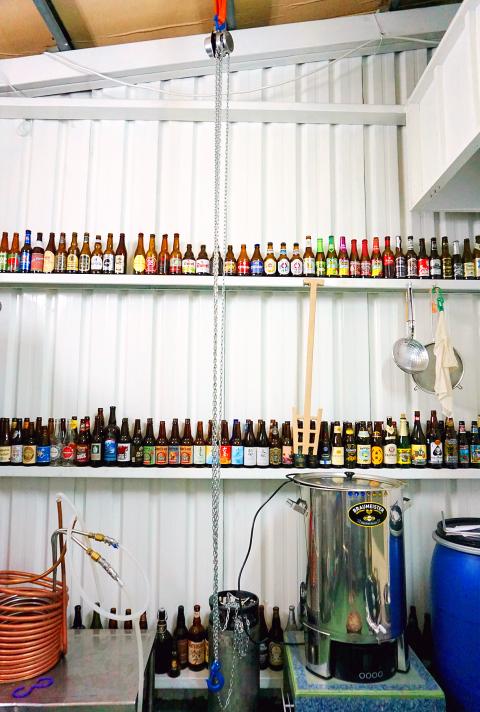
Photo: Dana Ter, Taipei Times
Rather than try to re-create the flavors of North American craft beer, the co-founders, being Taiwanese, are constantly experimenting with local ingredients, save for the hops and malt which are imported from the US, Europe and New Zealand (Taiwan’s subtropical climate makes it ill-suited to grow hops and malt).
Their Taiwan Tea Ale 2 (立秋, li qiu) is a spin on the classic 19th century English Pale Ale blended with Oriental Beauty tea leaves. The result is a delightfully bitter yet honeyed brew with crisp and buttery tones, one that is evocative of its literal translation, “start of autumn.”
The Taiwan Tea Ale 4 (雨水, yu shui), whose literal name means “rainwater,” also boasts a buttery flavor, though stronger, as it is brewed with Jing Xuan tea (金萱), a type of milk Oolong tea. The base is a sweet and malty Scottish ale.
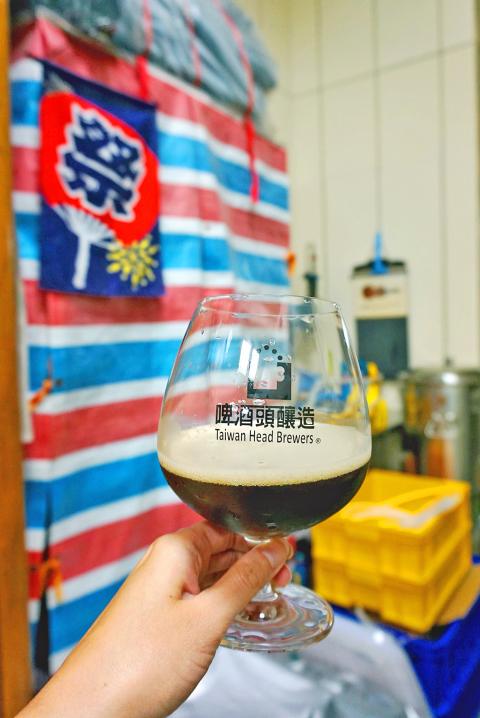
Photo: Dana Ter, Taipei Times
Besides various types of tea, Taiwan Head Brewers also sources wheat from Taichung for their American Taiwan Wheat beer (夏至, xia zhi), which is a refreshing, light body with a slightly fruity aroma that makes it perfect for mid-summer drinking. It’s fitting, too, because its Chinese name is “summer solstice.”
My favorite, the Taiwan Chocolate Stout (小寒, xiao han), which means “minor cold,” uses cocoa sourced from Pingtung and is an ideal winter brew. It boasts a strong, chocolatey body and does not need to be drank cold. Sung and Yeh says that their winter brews were initially more difficult to market as Taiwanese don’t normally drink beer during the winter.
“We’re not like Westerners — they drink beer all year round!” Sung jokes.
LIKE BEER, LIKE TEA
According to Sung and Yeh, people who drink their beers are generally well-traveled Taiwanese in their late 20s to mid-30s. It is precisely this demographic that can afford craft beer and are able to truly appreciate it.
“When customers see our beers, they might not be able to fully understand the English words, but they’ll understand the Chinese characters and the type of taste that the name of the season conjures up,” says Sung.
The same goes for English-speaking consumers — despite not being able to read the characters, they would be somewhat familiar with the style of brew whether a light pale ale or a frothier stout.
“We want each type of brew to conjure up a different type of feeling, or evoke a certain memory,” Yeh says.
For instance, since a lot of Taiwanese drink tea, Sung and Yeh hope that the tea-infused flavors in their brews will help awaken fond memories they may have of drinking tea with their families or friends.
Though non-Taiwanese consumers can relate to this sentiment as well. Taiwan Head Brewers currently exports to Hong Kong, Macau and Singapore and they plan to expand into China, South Korea and Japan. The idea is to tap into the Asian market and in particular, to reach out to drinkers who can read Chinese characters and understand the 24 solar terms.
It’s also created a lot of pressure for the co-founders — they’ve brewed eight beers so far, and still have 16 more to go.
“It can be exhausting,” Yeh says. “People expect there to be 24 types of beer so we’re constantly brewing and making sure that we’re launching the beers around the same time the particular season is supposed to start.”
BOTTOMS UP
But Sung and Yeh also know how to kick back and have a good time experimenting with new brews.
We end our evening sampling some of their homebrewed stouts on the rooftop. They show me their cold storage where test batches are stored and their warehouse containing homebrew equipment. There’s also a basketball hoop in the corner and a small kitchen area with a huge refrigerator.
They’re a bit shocked when I mention that I love stouts (not many girls like stouts, they say), but I immediately regret my words when they open the refrigerator, grab a couple bottles and pour me glass after glass of vanilla flavored barrel-aged stouts and imperial stouts brewed with sake (it’s really more sake than beer).
When I ask them why these are not sold at bars, they reply that local consumers might find the flavors too strong and too bitter. Instead, they just enjoy these brews themselves on their rooftop.
Noticing me staring at the logo on my glass, Sung explains that it’s an outline of a beer glass blowing a kiss.
“It’s because we feel the happiest when we’re drinking craft beer,” Sung says.
Warning: Excessive consumption of alcohol can damage your health.
Drinking Taipei: Taipei is a city that has positioned itself as being cheap and fast, but the revolution for craft drinks is taking wind and alcohol aficionados are thirsty for more. Drinking Taipei is a monthly column devoted to spotlighting chic, conceptual bars that aren’t your typical watering hole.

Yesterday, the Democratic Progressive Party (DPP) nominated legislator Puma Shen (沈伯洋) as their Taipei mayoral candidate, the Chinese Nationalist Party (KMT) put their stamp of approval on Wei Ping-cheng (魏平政) as their candidate for Changhua County commissioner and former legislator Tsai Pi-ru (蔡壁如) of the Taiwan People’s Party (TPP) has begun the process to also run in Changhua, though she has not yet been formally nominated. All three news items are bizarre. The DPP has struggled with settling on a Taipei nominee. The only candidate who declared interest was Enoch Wu (吳怡農), but the party seemed determined to nominate anyone
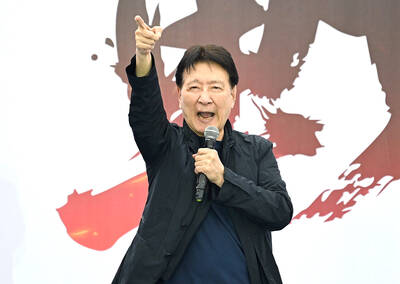
In a sudden move last week, opposition lawmakers of the Chinese Nationalist Party (KMT) and Taiwan People’s Party (TPP) passed a NT$780 billion special defense budget as a preemptive measure to stop either Chinese leader Xi Jinping (習近平) or US President Donald Trump from blocking US arms sales to Taiwan at their summit in Beijing, said KMT heavyweight Jaw Shaw-kong (趙少康), speaking to the Taipei Foreign Correspondents Club on Wednesday night in Taipei. The 76-year-old Jaw, a political talk show host who ran as the KMT’s vice presidential candidate in 2024, says that he personally brokered the deal to resolve
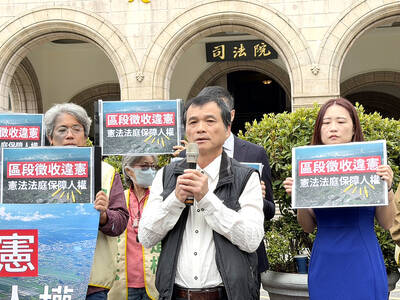
What government project has expropriated the most land in Taiwan? According to local media reports, it is the Taoyuan Aerotropolis, eating 2,500 hectares of land in its first phase, with more to come. Forty thousand people are expected to be displaced by the project. Naturally that enormous land grab is generating powerful pushback. Last week Chen Chien-ho (陳健和), a local resident of Jhuwei Borough (竹圍) in Taoyuan City’s Dayuan District (大園) filed a petition for constitutional review of the project after losing his case at the Taipei Administrative Court. The Administrative Court found in favor of nine other local landowners, but
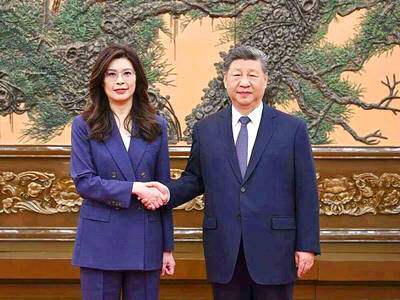
The Chinese Nationalist Party (KMT), alongside their smaller allies the Taiwan People’s Party (TPP), are often accused of acting on behalf of the Chinese Communist Party (CCP). Some go so far as to call them “traitors.” It is not hard to see why. They regularly pass legislation to stymie the normal functioning of the ruling Democratic Progressive Party’s (DPP) administration, and they have yet to pass this year’s annual budget. They slashed key elements of the government’s proposed NT$1.25 trillion (US$40 billion) special military budget, and in the smaller NT$780 billion package they did pass, it is riddled with provisions that


 RSS
RSS