


The scent of burnt crust and fresh mozzarella is discernible from Zhongxiao Dunhua MRT Station (忠孝敦化捷運站). Follow it and you’ll find yourself at Otto Pizza Bar. Outside is a bright red sign and a window allowing passersby to peep into the kitchen. The interior decor threads rustic and industrial. Grayish walls are lit up by light bulbs affixed to pipes, while long wooden tables encourage family-style dining. Though they just celebrated their soft opening last month, the small and cozy pizza bar looks like it’s been a fixture of this neighborhood, with its boheme cafes and quirky clothing stores, for a while.
The centerpiece is a huge oven made of Vesuvian stone imported from Italy. The owner, Paolo Wu (吳保羅), wanted that particular style oven as it sucks the humidity from the crust, allowing it to be crispy on the outside. Such a result is not possible with small electrical ovens used by many pizzerias in Taiwan, which, according to Wu, turns the crust biscuit-like.
Otto, which means “eight” in Italian, is Wu’s lucky number. He was born in 1988 and graduated high school with 88 points (out of 90). His Italian cellphone number is 338 2888887. Raised by Taiwanese parents in Venice, Wu says he’s always had two passions: fashion and food. After working a stint in Milan’s fashion industry, he moved to Shanghai to try his hand in the food business, before opening Otto Pizza Bar in Taipei.
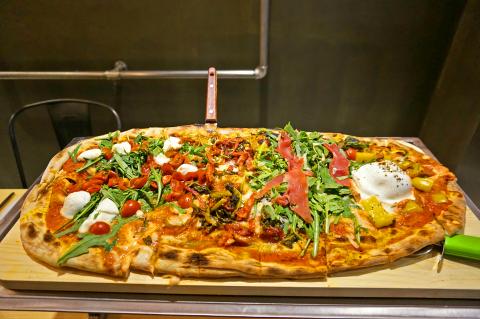
Photo: Dana Ter, Taipei Times
“I saw the food industry as more of a mission,” Wu tells me.
Given his background in couture, he’s had numerous people ask him why not open a fine dining Italian restaurant. But Wu was insistent on introducing to customers the type of food that Italians ate every day at home — especially, the healthy, easy-to-digest Milanese-style cuisine he was used to (so don’t expect a Hawaiian or teriyaki pizza).
Besides the vegetables which are sourced locally and delivered daily to the pizza bar (including, ironically enough, the Italian basil), the ingredients, including the flour, tomato and mozzarella, are all imported from Italy. Wu jokes that even the chef — Giuseppe “Beppe” Villani, a fourth-generation pizza maker from Naples who grew up in northern Italy — is also imported.
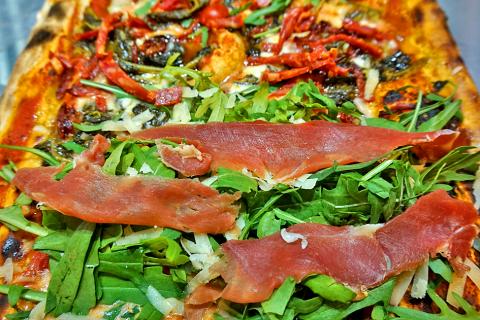
Photo: Dana Ter, Taipei Times
Customers have a choice between one of the eight specialty pizzas on the soft opening menu for NT$390 each. There’s also the marinara for NT$190 and the Margherita for NT$290. If sharing with a group of friends, Wu suggests the half-meter-long pizza (NT$1,200) where customers can choose among four types of specialty pizzas. The half-meter is good for four people and is served on a raised tray on the table. The purpose, Wu says, is to mimic the tradition in Italy where people stand up to reach for their pizza. It encourages more banter.
Of course, my crew and I order a half-meter-long pizza, choosing the “doc” (cherry tomatoes, arugula, fresh buffalo mozzarella), “burrata” (arugula, bell peppers, burrata), “raw” (raw Italian-style ham, arugula, freshly-grated Parmesan), and “flavor” (salami, friarielli, sun dried tomatoes) as our four specialty pizzas.
The “doc,” a classic Italian pizza, boasts simple, refined flavors and is light and easily digestible. The bits of fresh buffalo mozzarella has a smooth, milky texture that blends well with the crunchiness of the arugula and the softness and sweetness of the cherry tomatoes. It’s also a welcome taste from the chunky, packaged mozzarella used by other pizzerias. Best of all are the subtle hints of olive oil, noticeable through the layers of ingredients, and tomato sauce base, both of which make the bread not too dry nor too soggy.
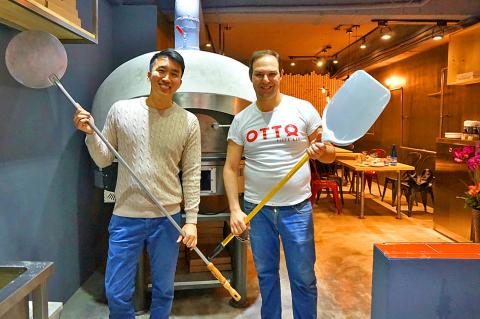
Photo: Dana Ter, Taipei Times
There’s no such thing as too much cheese, and the “burrata” proves that. This pizza is best eaten fresh from the oven so that the creamy layers of burrata — a type of Italian cheese made with mozzarella and cream on the inside and a layer of mozzarella on the outer shell — can drip down the crust. The texture is creamier and runnier than the fresh buffalo mozzarella. We were given bell peppers as there weren’t enough sun dried tomatoes, but honestly, burrata tastes good with anything.
My favorites were the “raw” and the “flavor.” I highly recommend the “raw” for those with savory palates. The mild saltiness of the thinly-sliced raw Italian-style ham complements well with the peppery and pungent arugula, while the freshly grated Parmesan cheese adds a savory kick.
The “flavor,” is as its name suggests, a complex mixture of various flavors. The mildly spicy, peppery taste of the salami and the sweetness of sun dried tomatoes are a delectable pairing, though the tastiest ingredient, in my opinion, is the friarielli (more commonly known as broccoli rabe), which boasts a pungent, bitter flavor.
Wu says he used to get a little indignant by people claiming that Hawaiian pizzas and pizza topped with corn are “real” pizzas, though now he sees this as an opportunity to introduce to customers the pizza that he grew up eating in Italy. He thinks it’s going well so far. For instance, most customers were not put off by the friarelli as he thought they would be.
He’s certainly got me convinced. After dining at Otto, I’m afraid I might not enjoy the city’s other pizzerias as much. It’s the crust and the cheese that does it — especially the creamy, runny Italian mozzarella and burrata, but also the freshness of the toppings, particularly the local vegetables.
On that note, Wu is hopeful Italian pizza will become more and more popular in Taiwan.
“Authentic American food has been a wave here in Taipei,” Wu says. “I hope that authentic Italian pizza will be the next wave.”

Taiwan’s English education system is being pulled apart by three opposing forces. Bilingual Nation 2030 pulls students toward English and global communication. Artificial Intelligence (AI) readiness pulls them toward digital judgment, verification and AI-mediated work. But Taiwan’s old exam culture pulls them back toward memorization, grammar drills, timed reading and correct answers. If the education system keeps using old exams to define success, it risks producing graduates who are neither genuinely bilingual nor genuinely AI-ready, but trained for tasks machines can already perform. The first force is Bilingual Nation 2030. Launched in 2018, the policy aimed to “help Taiwan’s workforce connect
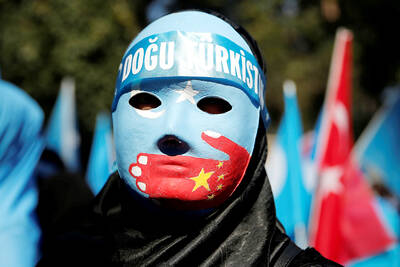
It seems every few days one bumps into one of those “real man” comments in which Taiwan is urged to “face reality” or similar, and “make a deal,” with the speaker implying that soon it will be too late. “Deal” advocates always present themselves as having a superior grip on reality, and the manly ability to make the “hard choice.” Their testosterone-laden language often echoes that of Taiwan sellout advocates. Note that such commentary always specifies a process (“make a deal, work with, make progress”), never the end state of what occupation by a violent authoritarian colonialist state will entail. In
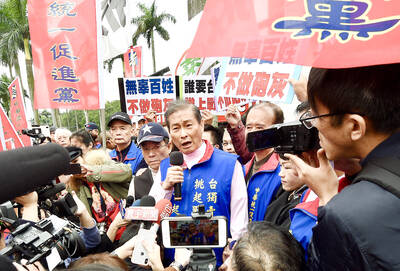
There are shadowy cabals plotting to sell out Taiwan to be annexed by China, by invasion if necessary. Fortunately, they are buffoons. In 2019, former Bamboo Union gangster and founder of the China Unification Promotion Party (CUPP), Chang An-le (張安樂, colorfully known as “White Wolf”), led a protest at the Legislative Yuan against comments made by then-premier Su Tseng-chang (蘇貞昌) that in the event of an attack by China, he would never surrender, but would protect the nation by fighting to the end, even if he only had a broom. Chang had party members bring a wooden casket that they
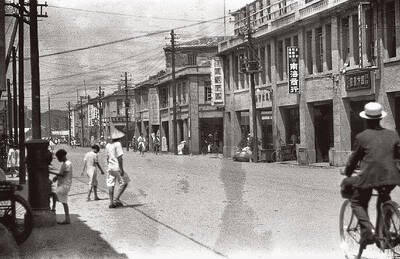
June 1 to June 7 "If all Taiwanese were as afraid of dying as you, then what would happen?” Physician Shih Chiang-nan (施江南) reportedly said this to his wife Chen Chiao-tung (陳焦桐) after she urged him to stop intervening on behalf of Taiwanese soldiers stranded overseas after serving in the Japanese Army during World War II. Shih had clashed with high-ranking officials over the issue, engaged in several heated arguments with Taiwan governor-general Chen Yi (陳儀) and allegedly shouted at general Ko Yuan-fen (柯遠芬), chief of staff of the Taiwan Garrison Command, over


 RSS
RSS