


In Spain’s historic port of Santander, parking is no longer a headache, rubbish bins never overflow and grass is watered only when needed since this northern resort became a testing ground for “smart cities” around the world.
Thousands of sensors have transformed the metropolis, known for the grand hotels and high-end casinos lining its beach on Spain’s northern Atlantic coast, into a high-tech laboratory.
Four hundred alone are buried beneath streets in the city’s busy heart to monitor whether parking spots are free or occupied. Light panels at intersections and GPS devices direct drivers to the nearest available parking spaces, reducing traffic congestion.
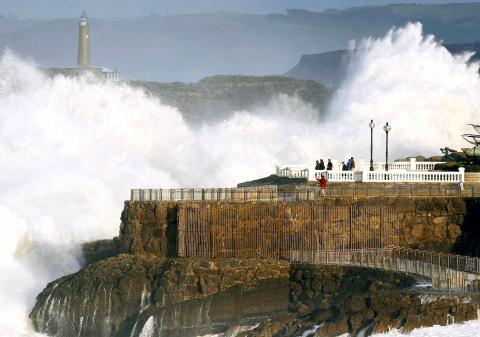
Photo: EPA/Esteban Cobo
“An app allows you to pay for the parking with your smartphone and when the time runs out, you can extend it directly without having to go down to the street to put more coins in the meter,” said Cristina Munoz, a 32-year-old journalist.
When Luis Munoz, an IT professor at the University of Cantabria, pitched the idea of creating a “smart city” to Santander officials back in 2009, he remembers the first thing they told him: “We have a huge problem with parking.”
Seven years later, Santander, with some 175,000 residents, is a kind of living laboratory. With funding from the European Commission and a handful of foreign universities, around 20,000 sensors are up, down and all around — under the asphalt, affixed to street lamps and riding on top of city buses.
The devices, about the size of a shoebox with four antennae, collect data on rainfall and road traffic which is sent to a control center to help the city provide services more efficiently and cheaply.
The pilot project has made Santander the most connected city in Europe “in terms of installed infrastructure,” said Munoz, and has even peaked foreign curiosity. On a recent day, the professor welcomed a delegation from Singapore that wants to share in the Spanish city’s experience.
Other cities such as Boston in the US and Aarhus in Denmark have also shown interest in working with Santander.
The city is taking part in a dozen international projects whose results are being closely monitored at a time when cities across the world, such as London and Tel Aviv, are deploying IT to deliver services.
INTELLIGENT STREETLIGHTS
Sensors installed in bins for inorganic waste warn when they are full and ready to be collected.
The city receives 180 days of rainfall per year and the sensors ensure the automatic irrigation system in public parks only starts working when the soil is dry.
Santander will soon use sensors to ensure that its elegant wrought-iron streetlights reduce the light they emit when no one is nearby.
With a perennial smile, 49-year-old Angel Benito tweaks the display in the window of his shoe shop on one of Santander’s main pedestrian thoroughfares. On the glass is a QR barcode which can be scanned by a smartphone to provide information about the shop along with a link to its online sales page.
Back in 2012, he was the first shopkeeper to display such a code. Now there are 1,500 throughout the city.
“Customers can learn about our opening hours, our products, special offers,” he said of the system which even allowed him to take an order from a tourist who visited Santander on a Sunday when the shop was closed.
A smartphone app allows residents and tourists to find shops, libraries, medical centers and transportation. Another provides residents information about their water consumption in real time and sends an alert to their phone if there is a leak.
Santander Mayor Inigo de la Serna acknowledges that the sensors raise concerns about privacy and the risk of cyber-attacks, but he said the goal is to further develop the system.
“There is a data protection law which we must follow and that is a guarantee,” he said.
“A smart city is one where if anything happens, all services start to act automatically. For example, if there is a crack in the pavement, a smart city should boost lighting on that street, send an alarm to locals and automatically detour traffic,” he said.
The University of Cantabria holds regular meetings with local residents to hear their ideas for apps and also helps put them into practice. It helped a pregnant woman create an app that outlines the easiest route for someone with a baby buggy, for example.
But most of the city’s residents are unaware of the extent of the technological innovations in this ancient port.
Some only use the app which lets them know when the bus arrives. Others don’t even use that. “They have to make it better known, I had no idea, and older people who use buses more also don’t know,” said Marina Garcia, a 19-year-old student as she waited at a bus stop with her grandmother.

This month the government ordered a one-year block of Xiaohongshu (小紅書) or Rednote, a Chinese social media platform with more than 3 million users in Taiwan. The government pointed to widespread fraud activity on the platform, along with cybersecurity failures. Officials said that they had reached out to the company and asked it to change. However, they received no response. The pro-China parties, the Chinese Nationalist Party (KMT) and Taiwan People’s Party (TPP), immediately swung into action, denouncing the ban as an attack on free speech. This “free speech” claim was then echoed by the People’s Republic of China (PRC),

Exceptions to the rule are sometimes revealing. For a brief few years, there was an emerging ideological split between the Democratic Progressive Party (DPP) and Chinese Nationalist Party (KMT) that appeared to be pushing the DPP in a direction that would be considered more liberal, and the KMT more conservative. In the previous column, “The KMT-DPP’s bureaucrat-led developmental state” (Dec. 11, page 12), we examined how Taiwan’s democratic system developed, and how both the two main parties largely accepted a similar consensus on how Taiwan should be run domestically and did not split along the left-right lines more familiar in

Specialty sandwiches loaded with the contents of an entire charcuterie board, overflowing with sauces, creams and all manner of creative add-ons, is perhaps one of the biggest global food trends of this year. From London to New York, lines form down the block for mortadella, burrata, pistachio and more stuffed between slices of fresh sourdough, rye or focaccia. To try the trend in Taipei, Munchies Mafia is for sure the spot — could this be the best sandwich in town? Carlos from Spain and Sergio from Mexico opened this spot just seven months ago. The two met working in the
Many people in Taiwan first learned about universal basic income (UBI) — the idea that the government should provide regular, no-strings-attached payments to each citizen — in 2019. While seeking the Democratic nomination for the 2020 US presidential election, Andrew Yang, a politician of Taiwanese descent, said that, if elected, he’d institute a UBI of US$1,000 per month to “get the economic boot off of people’s throats, allowing them to lift their heads up, breathe, and get excited for the future.” His campaign petered out, but the concept of UBI hasn’t gone away. Throughout the industrialized world, there are fears that


 RSS
RSS