


Garlic is a kitchen staple, and it really doesn’t matter which part of the world you come from. The absence of garlic is as likely to have a Spanish or a Chinese cook throw up their arms in dismay. It is the most powerfully flavored member of the onion family, and its pungent aroma and taste is at the heart of many classic dishes from around the world. But it is not without its detractors, and its robust character has made it socially controversial over the very long period of its use.
There is literary evidence from China, Greece and the Middle East for the use of garlic for almost as long as there has been writing. As they embarked on their exodus, the Israelites, according to Numbers 11:5, looked back with longing on the garlic available in Egypt, a country that remains a major producer to this day.
The fact that everyone has not looked favorably on garlic need look no further than the Roman poet Horace (65BC to 8BC), who, according to Alan Davidson in The Penguin Companion to Food, lamented that “garlic could drive one’s lover to refuse a kiss and to retreat to the far side of the bed.” Making sure that said lover indulges in garlic as well seems a simple enough remedy to this romantic embarrassment. After all, garlic, almost without exception, makes food taste better, from the simplest of stir fried vegetables to the more contentious pleasures of garlic ice cream (a dish developed as a showpiece at the Gilroy Garlic Festival, a celebration of garlic at the self-proclaimed garlic capital of the world in California).
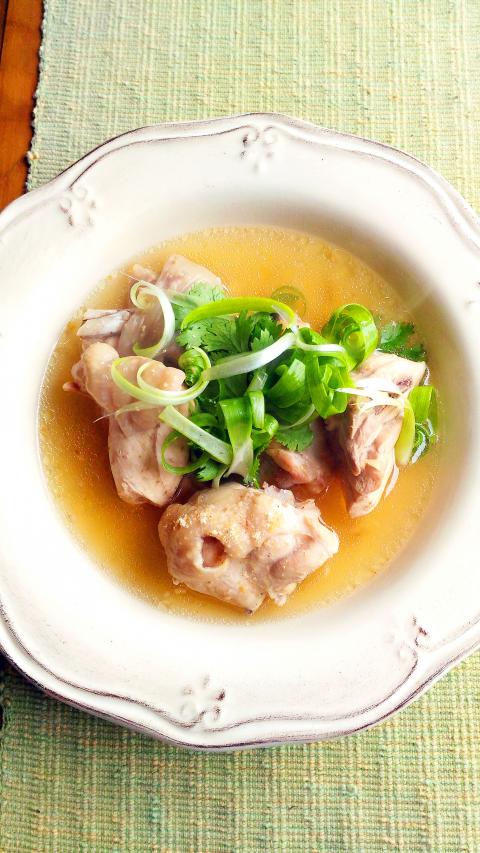
Photo: Ian Bartholomew
It is in fact China that is the world’s largest producer of garlic, and a suggestion of its huge popularity in that country can still be appreciated in old style beef noodle and dumpling restaurants around Taipei, where a bowl of raw garlic is generally available at every table as a accompaniment.
Garlic has massive health benefits that have long been recognized if not generally understood. For that reason, garlic as been credited with many magical properties, particularly warding off evil, and anyone familiar with vampire lore will know that this species of undead, while enjoying supernatural strength, speed and sartorial chic, have never been able to enjoy aioli (a kind of garlic mayonnaise that is a special kind of heaven to garlic lovers) or indulged in garlicy skordalia, a paste of potatoes and garlic which is the best thing that roast lamb has ever seen. Bella Swan, eat your heart out.
Speaking of heart, this is an organ that benefits particularly from the regular eating of garlic. In addition to its prodigious anti-bacterial and anti-fungal properties, garlic contains compounds that prevent blood clotting (anti-thrombotic), which is important in the context of heart problems.
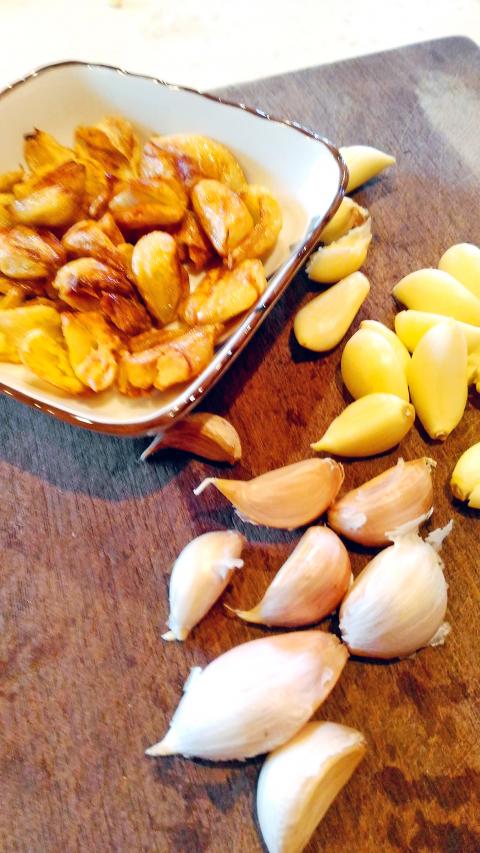
Photo: Ian Bartholomew
The health benefits of garlic could easily fill this page, but the difference to many other vegetables, as Davidson asserts, is that they “have probably not yet been fully explored.” Some of the more enthusiastic nutritional web sites will have you believe that garlic is a cure for all ills, but health aside, its magic works to make pretty much everything taste better.
It is also easy to incorporate into all aspect of your diet. Mince some garlic into an oil and vinegar salad dressing, or if feeling a bit more ambitious, roast whole garlic in their skin and squeeze the pulp into your salad. I have found this method particularly yummy with wilted spinach and bacon, but it works brilliantly with any combination of roasted vegetables; just don’t put them in the oven too early, or they will burn and turn bitter.
Frying garlic until golden brown (as in the recipe below) is also a splendid way of taming their favor, finding a caramel richness to replace the pungency of the raw vegetable. Fried garlic can be easily tossed into salad or roast vegetables to add flavor. Steamed or boiled with a fatty meat such as mutton, garlic can really cut through the grease and lift the flavor to a whole new level.
Certainly, other than people like the poet Horace, whose interests where more amatory than nutritional, garlic is clearly good for your health on all sorts of levels, but putting that aside, it is also just incredibly versatile, whether used as a foundational element barely discerned in the background, or right up their in your face, pungent, strong, and bad for kissing. Steamed, roasted, pureed, minced, or slow cooked for days-on-end, as with the new fad for black garlic (now widely available at some of the better dry goods stores on Taipei’s Dihua Street), this is an incredible gift from mother nature.
Garlic Chicken Soup
Recipe
(serves 8-10)
During the cold wet weather that has blanketed Taiwan in recent weeks, the soul calls out for chicken soup. The addition of copious amounts of garlic — I use about 30 to 40 cloves, about 2-3 heads of garlic, for a whole chicken — is perfect to give the chicken soup an extra anti-viral oomph (forgive the technical language). Flavor-wise, the addition of fried and raw garlic to the soup gives it splendid depth. You can replace the Shaoxing wine with regular rice wine, or leave the wine out all together, but this is just another level of flavor to fight off the rainy weather blues. This is a classic of Chinese home cooking, easy to put together, but the subject of great contention in regard to the best ways of maximizing the flavor of the soup and ensuring tender chicken.
Ingredients
1 chicken, chopped into medium sized pieces
About 40 large cloves of garlic, peeled
1/4 cup vegetable oil
1 cup Shaoxing
2cm nub of ginger
1 small bunch coriander, leaves only
4 stems spring onions, julienned
Salt and white pepper to season
Directions
1. Divide the garlic into two equal portions. Pour the oil into the frying pan and add one portion of the garlic and fry over low heat, stirring occasionally, until the garlic is golden brown. Set aside.
2. Wash the chicken pieces thoroughly. Place in a pot and cover with cold water. Over medium heat, bring the pot to a boil. Thick scum will rise to the top at this point.
3. Discard the water and wash the chicken under cold water. Place in a pot and once again cover with cold water. Bring to a boil over medium heat. Reduce heat and cook the chicken at a gentle simmer for 5 minutes.
4. Add the fried garlic and simmer for 10 minutes.
5. Add the raw garlic and ginger and simmer for 10 minutes.
6. Add Shaoxing wine, and season with salt and pepper. Simmer for a further 5 minutes.
7. Serve topped with plenty of fresh coriander leaves and julienned spring onions. Serve with hot steamed rice or over noodles.
Ian Bartholomew runs Ian’s Table, a small guesthouse in Hualien. He has lived in Taiwan for many years writing about the food scene and has decided that until you look at farming, you know nothing about the food you eat. He can be contacted at Hualien202@gmail.com.

The breakwater stretches out to sea from the sprawling Kaohsiung port in southern Taiwan. Normally, it’s crowded with massive tankers ferrying liquefied natural gas from Qatar to be stored in the bulbous white tanks that dot the shoreline. These are not normal times, though, and not a single shipment from Qatar has docked at the Yongan terminal since early March after the Strait of Hormuz was shuttered. The suspension has provided a realistic preview of a potential Chinese blockade, a move that would throttle an economy anchored by the world’s most advanced and power-hungry semiconductor industry. It is a stark reminder of
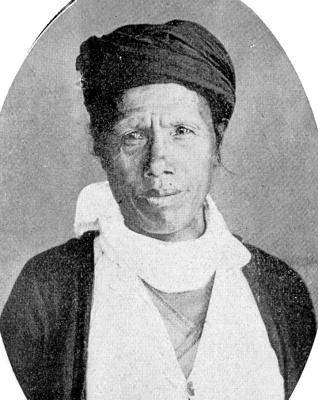
May 11 to May 17 Traversing the southern slopes of the Yushan Range in 1931, Japanese naturalist Tadao Kano knew he was approaching the last swath of Taiwan still beyond colonial control. The “vast, unknown territory,” protected by the “fierce” Bunun headman Dahu Ali, was “filled with an utterly endless jungle that choked the mountains and valleys,” Kano wrote. He noted how the group had “refused to submit to the measures of our authorities and entrenched themselves deep in these mountains … living a free existence spent chasing deer in the morning and seeking serow in the evening,” even describing them as

As a different column was being written, the big news dropped that Chinese Nationalist Party (KMT) caucus whip Fu Kun-chi (傅?萁) announced that negotiations within his caucus, with legislative speaker Han Kuo-yu (韓國瑜) of the KMT, party Chair Cheng Li-wun (鄭麗文), Taichung Mayor Lu Shiow-yen (盧秀燕) and Taiwan People’s Party (TPP) Chair Huang Kuo-chang (黃國昌) had produced a compromise special military budget proposal. On Thursday morning, prior to meeting with Cheng over a lunch of beef noodles, Lu reiterated her support for a budget of NT$800 or NT$900 billion — but refused to comment after the meeting. Right after Fu’s

Yesterday, the Democratic Progressive Party (DPP) nominated legislator Puma Shen (沈伯洋) as their Taipei mayoral candidate, the Chinese Nationalist Party (KMT) put their stamp of approval on Wei Ping-cheng (魏平政) as their candidate for Changhua County commissioner and former legislator Tsai Pi-ru (蔡壁如) of the Taiwan People’s Party (TPP) has begun the process to also run in Changhua, though she has not yet been formally nominated. All three news items are bizarre. The DPP has struggled with settling on a Taipei nominee. The only candidate who declared interest was Enoch Wu (吳怡農), but the party seemed determined to nominate anyone


 RSS
RSS