


Toward the end of Tsai Ming-liang’s (蔡明亮) Goodbye Dragon Inn (不散), an aged film star half whispers to another: “No one goes to the movies anymore. And no one remembers us anymore.”
Tsai’s 2003 film, which takes place entirely inside Taipei’s historic Fu Ho theater shortly before its demolition, mourns the death of an older cinematic culture, a time before laptops and multiplex chains, when cinema meant a community of strangers coming together to inhabit an intimate world.
MOVIE HOUSES
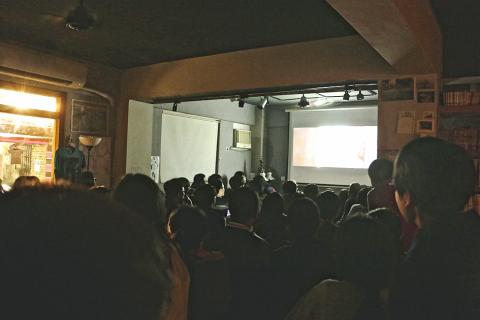
Photo courtesy of Wang Xueli
But Tsai’s nostalgia was perhaps premature. The Fu Ho theater may not have survived a new age of endless screens and shrinking attention spans, but Taiwanese cinephilia did not disappear. Indeed, for years now the love of cinema has lived on in Taipei — not in the hyper-commercial multiplex, nor the sterile white cube gallery, but in cozy and convivial cafes.
On weeknights in the cultural hub of Taipei’s Gongguan (公館) and Shida Night Market (師大夜市), it is not unusual to find crowds of locals perched together in cafes, their faces lit up by scenes from an art-house or cult film. Fueled in large part by the vibrant community of cinephiles from National Taiwan University and National Taiwan Normal University, cafes have in recent years made film screenings a regular part of their weekly programming.
Admission to these films is typically a cup of coffee — arrive early to secure a seat — and range from European art films, early Taiwanese New Wave, Korean horror movies and independent cinema from China.
HALFWAY CAFE (半路咖啡)
At Halfway Cafe, the screenings feature an eclectic mix of all of the above. The space, like most Taipei cafes, is the size of a living room. On any given Friday night, one will find it filled with filmgoers.
Past screenings have included the Coen brothers’ debut Blood Simple (1984), Park Chan-wook’s infamous thriller Old Boy (2003), Werner Herzog’s darkly humorous Even Dwarves Start Small (1970) and most recently, a curious North Korean revolutionary opera called The Flower Girl (1972). Most Chinese-language films are shown with English subtitles, though usually Chinese subtitles only come with non-Chinese films.
According to Halfway’s film organizer, Ba Tun (巴頓), the point of the cafe format is in part to move away from passive spectatorship and encourage greater viewer interaction and participation.
“Here, everyone can sit and drink coffee, and afterwards stay and chat about the film,” Ba says.
In the coming weeks, Ba looks forward to sharing works by Chinese auteurs Jia Zhangke (賈樟柯) and Zhang Yuan (張元).
■ Address: 9, Alley 51, Ln 269 Roosevelt Rd, Sec 3, Taipei City (台北市羅斯福路三段269巷51弄9號)
■ On the Net: www.facebook.com/半路咖啡-766746760013130/
INSOMNIA CAFE (睡不著咖啡)
A two-minute walk from Halfway is Insomnia Cafe. Compared to its neighbors, most of which have only recently arrived on the underground film scene, Insomnia can be considered a veteran film space. According to the cafe’s owner, Insomnia has been holding screenings for at least five years. Its films are curated by a Taiwanese writer who prefers for each series to focus on a specific auteur. Past series have showcased the oeuvres of Yasujiro Ozu, Bela Tarr and the Dardenne brothers. Currently there is a comprehensive retrospective on the Polish art-house master Krzysztof Kieslowski.
Insomnia’s screening room is on a lower level below the cafe area, where art-house enthusiasts spread themselves comfortably across couches and armchairs every Wednesday evening, coffee in hand. If you arrive late, order a drink at the bar and head downstairs through the sliding door. The barista will bring the drink down to you when it’s ready.
With its impeccable film selection and elegant decor, Insomnia Cafe matches in charm and character New York’s Film Forum, Paris’ Le Champo, and London’s Barbican Center, without any of the formality and pretension that sometimes pervade these other art-house cinemas.
In his 2003 elegy to cinema as a social form, Tsai could not have imagined that cinephilia would thrive on in a new setting over 10 years later. In the space of the cafe, one gets the sense of being at home among friends. For a younger generation of film lovers, the cafe screening has breathed new life into the cinematic experience, by restoring to it perhaps its most essential — and most forgotten — aspect: human interaction.
■ Address: Insomnia Cafe (睡不著咖啡), 8, Taishun St, Ln 60, Taipei City (台北市泰順街60巷8號)
■ On the Net: www.facebook.com/insomnia.cafe
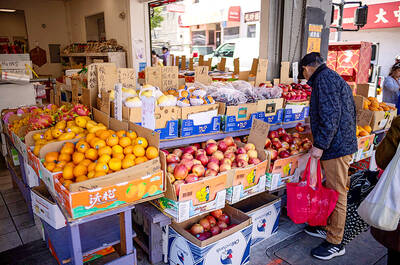
Ajay Verma, a consultant gastroenterologist at Kettering general hospital in Northamptonshire, says our gut is a “complex machine.” “It is constantly providing us with the nutrition we need, initially to grow and develop, and then for us to survive, thrive and repair from injury and illness.” How can we keep it functioning well? Put simply: “Make sure what you put into it is balanced, and that you clear out its waste products adequately,” Verma says. “In a general gastroenterology clinic, the most common conditions we see are irritable bowel syndrome (IBS), gastroesophageal reflux disease, inflammatory bowel disease and constipation,” says Nisha
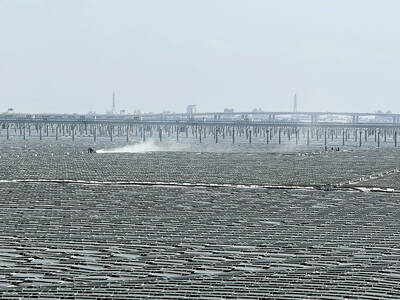
The arithmetic is straightforward and uncomfortable. By the end of 2025, Taiwan had committed itself to a 50-30-20 electricity mix — half natural gas, 30 per cent coal, 20 per cent renewables. The Ministry of Economic Affairs’s (MOEA) own monthly energy reports tell a different story. Natural gas reached 47.8 per cent of generation last year. Coal stood at 35.4 per cent, comfortably above its target ceiling. Renewables came in at 13.1 per cent, well short of the 20 per cent Taipei had pledged a decade earlier. Installed renewable capacity reached roughly half of the 12 gigawatts (GW) the government
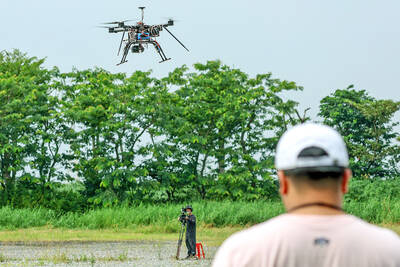
Taiwan’s drone exports are taking off, fuelled by the war in Ukraine, as Taiwanese companies seek a stake in the fast-growing global market for unmanned aerial vehicles (UAV). Low-cost drones used for reconnaissance and strikes are in high demand as governments around the world boost defense spending in the face of intensifying conflicts. A relative new player in the increasingly competitive industry, Taiwan’s pitch is to be an “Asian hub” for the production of UAVs and components free of Chinese materials, or “non-red.” That means its UAVs can be up to three times more expensive than their Chinese competitors, like the world’s biggest

There are shadowy cabals plotting to sell out Taiwan to be annexed by China, by invasion if necessary. Fortunately, they are buffoons. In 2019, former Bamboo Union gangster and founder of the China Unification Promotion Party (CUPP), Chang An-le (張安樂, colorfully known as “White Wolf”), led a protest at the Legislative Yuan against comments made by then-premier Su Tseng-chang (蘇貞昌) that in the event of an attack by China, he would never surrender, but would protect the nation by fighting to the end, even if he only had a broom. Chang had party members bring a wooden casket that they


 RSS
RSS