


The spring break holiday weekend, which is April 1 to April 4 this year, is known for parties in beaches around Kenting. But this year will be the time a major spring weekend music festival is planned for Taipei, with the Spring Wave Festival (春浪音樂節), a mainstream Mando-rock festival, saying it will double its scale and take place at Dajia Riverside Park (大佳河濱公園).
Spring Wave made the big announcement yesterday, and all sorts of political debates have erupted.
The festival, which has averaged 15,000 visitors per year for the last 10 years, claims it is moving because Kenting National Park denied it use of the lot near the Kenting Airport, where it has been held in recent years. Despite it’s normal lineup of A-list talent -— this year’s headliners will include A-Yue (張震嶽), MC Hotdog, and Luantan’s A-hsiang (亂彈阿翔) — the event has been lackluster in recent years. This is in no small part due to the event site, a windswept lot next to the highway far removed from the beaches and natural beauty of the region.
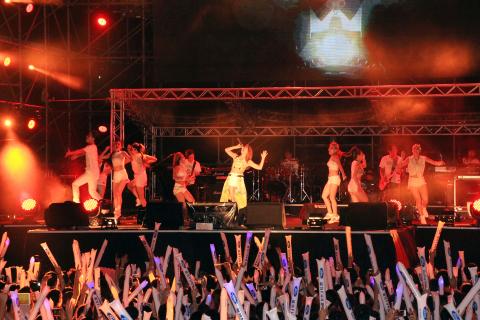
Photo: Chen Yan-ting, Taipei Times
Spring Wave started 10 years ago near the pristine beach at Baishawan (白沙灣), but moved to the Kenting Airport site eight years ago, when Kenting National Park tried to rein in the mushrooming party scene on Taiwan’s southern peninsula, almost all of which falls within park boundaries.
At the time, three sites were designated for holding parties, including the airport site (taken by Spring Wave), the Oluanbi lighthouse site (occupied by Spring Scream) and a coastal site near Jialeshui, which no one has ever used.
Kenting National Park’s alleged refusal to Spring Wave this years seems almost comic, as they are now more large-scale than you can count up and down Kenting’s main drag, Highway 26. There’s the foam party, the big beach party, the little beach party, the reggae party and so on. These have sprouted up through various loopholes, mostly because anyone with private property is trying to grab a piece of the action, while the rationale for enforcement is really anybody’s guess. The sad fact is that the larger events, which obey the law, incur the most financial risk and receive the most scrutiny, are often the ones in most danger.
Now in case you really don’t care about the politics and are just wondering what’s going to be the biggest party this year, it will be Spring Break on the Beach, run by the guys at Brickyard in Kaohsiung, with two world top-100 DJs, Danny Avila and Tujamo, as headliners. They saw attendance of several thousand people a day last year and are now plastering pictures of naked people all over Facebook — yes, they literally did a nude promotion on the streets of Kenting — so odds are you already know about this one.
The original Kenting party, Spring Scream, meanwhile continues to shift to a Burning Man-style vision, with an emphasis on a general participatory experience over any particular artists. If you’re a first timer, the info seems more and more cryptic, so it helps to attend with an initiate.
Against these mainstays, a competing spring weekend music festival in Taipei will be interesting. Lots of young people in northern Taiwan tend to stay put on the weekend anyway, as Kenting hotels have jacked up prices to the point that a vacation in the Philippines would be cheaper.
Other parties in Taipei’s riverside parks have recently seen success, notably Road to Ultra last fall, and a new EDM fest with headliner Hardwell slated for April 9, the weekend after Spring Scream. Mayor Ko Wen-je (柯文哲) said he wanted to support such events as part of his campaign platform, and so far he’s been generally true to that pledge.
Which is not to say that Spring Wave’s move north comes without controversy. Democractic Progressive Party Taipei City Councilor Liang Wen-chieh (梁文傑) was quick to criticize the city because the festival’s application for a discounted rental fee had not been finalized. But that’s just nitpicking. Generally speaking, Taiwan needs good events, and I am glad to see viable concert sites near Taipei. Now had Liang framed it as an aesthetic debate and said, “But the music sucks!”, then there might have been room for discussion.
■ Spring Wave Festival (春浪音樂節) takes place on April 3 and 4 in Taipei’s Dajia Riverside Park (大佳河濱公園). Tickets are NT$900 through www.friendlydog.com.tw

Taiwan’s English education system is being pulled apart by three opposing forces. Bilingual Nation 2030 pulls students toward English and global communication. Artificial Intelligence (AI) readiness pulls them toward digital judgment, verification and AI-mediated work. But Taiwan’s old exam culture pulls them back toward memorization, grammar drills, timed reading and correct answers. If the education system keeps using old exams to define success, it risks producing graduates who are neither genuinely bilingual nor genuinely AI-ready, but trained for tasks machines can already perform. The first force is Bilingual Nation 2030. Launched in 2018, the policy aimed to “help Taiwan’s workforce connect
It seems every few days one bumps into one of those “real man” comments in which Taiwan is urged to “face reality” or similar, and “make a deal,” with the speaker implying that soon it will be too late. “Deal” advocates always present themselves as having a superior grip on reality, and the manly ability to make the “hard choice.” Their testosterone-laden language often echoes that of Taiwan sellout advocates. Note that such commentary always specifies a process (“make a deal, work with, make progress”), never the end state of what occupation by a violent authoritarian colonialist state will entail. In
June 1 to June 7 "If all Taiwanese were as afraid of dying as you, then what would happen?” Physician Shih Chiang-nan (施江南) reportedly said this to his wife Chen Chiao-tung (陳焦桐) after she urged him to stop intervening on behalf of Taiwanese soldiers stranded overseas after serving in the Japanese Army during World War II. Shih had clashed with high-ranking officials over the issue, engaged in several heated arguments with Taiwan governor-general Chen Yi (陳儀) and allegedly shouted at general Ko Yuan-fen (柯遠芬), chief of staff of the Taiwan Garrison Command, over

“Taiwan’s Opposition Leader Comes to US With a Message Straight Out of Beijing” read a May 31 headline in the Wall Street Journal. Top US administration officials and members of Congress almost certainly read the WSJ, and if there was a bullet point takeaway that people in Washington should absorb ahead of Chinese Nationalist Party (KMT) Chair Cheng Li-wun’s (鄭麗文) arrival in DC on June 9, that headline is it. The last few columns have discussed this very topic, and the timing is not coincidental. While those top officials likely do not read the Taipei Times, judging by the number


 RSS
RSS