


U-Theatre (優人神鼓) makes a triumphant return to the National Theater in Taipei tonight, almost five years since its last show at the venue, Beyond Time (時間之外), which premiered in November 2011.
For local fans of the Muzha District (木柵)-based Zen drumming group, this weekend has been a very long time in coming.
U-Theatre founder and artistic director Liu Ruo-yu (劉若瑀) announced on May 9, 2012, that the company was going on a kind of hiatus. While it would continue to meet its contractual obligations and accept invitations to perform at home and abroad and its teaching programs, it would not create any new works for the next three years, nor would it apply for an annual stipend from the Council of Cultural Affairs’ (now Ministry of Culture) for three years, starting in 2013.
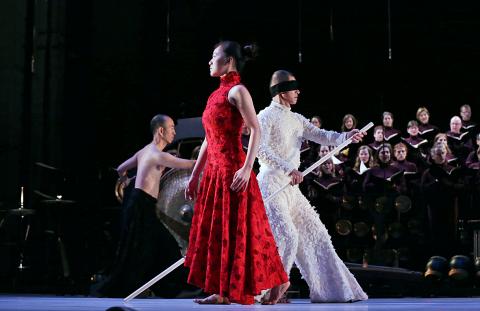
Photo courtesy of U-Theatre
Liu cited operational problems and her own exhaustion for the decision to go dormant as far as new shows were concerned. And without a new show annually, the troupe would not qualify for the government stipend for performing arts groups.
So while Taiwanese audiences had to go largely without, the company appeared in Hong Kong and Dusseldorf in 2012, Adelaide and Singapore in 2013 and Berlin in 2014. Last year saw the company in the US, China and France, and the start of its return to Taipei’s performance calendar, with shows at its Laoquanshan (老泉山) base in August and September and then the musical Town of Gold (黃金鄉) in New Taipei City’s Jiufen District (九份) in December and last month.
Tonight U-Theatre is opening the National Theater Concert Hall’s (NTCH) eighth Taiwan International Festival of Arts (TIFA) with the Taiwan premiere of Lover (愛人), a collaboration with German composer Christian Jost and the Grammy Award-winning Rundfunkchor Berlin (the Berlin Radio Choir, founded in 1925), with an a cast of more than 80 dancers, drummers and singers.
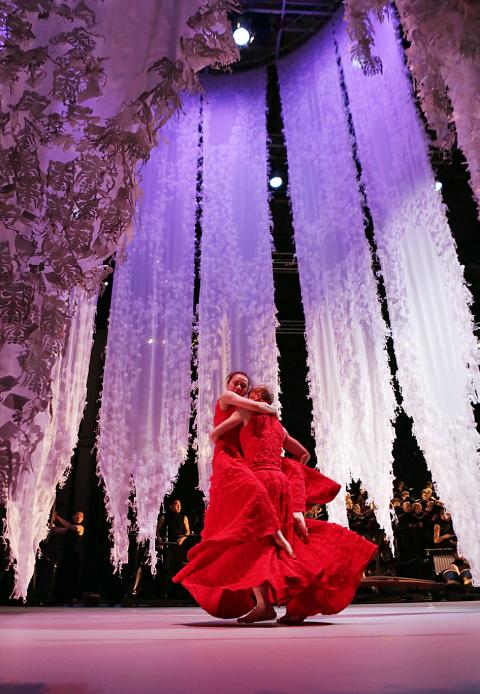
Photo courtesy of U-Theatre
The Berlin-based Jost is no stranger to Taiwan, having collaborated several times with the National Symphony Orchestra (NSO, 國家交響樂團), for which he has served as resident composer. The NTCH also paired him up with Taipei Chinese Orchestra (臺北市立國樂團) conductor and composer Chung Yiu-kwong (鍾耀光) and theater director Li Huan-hsiung (黎煥雄) for the 2013 TIFA production Fall for Eileen Chang (落葉‧傾城‧張愛玲).
As Liu tells it, U-Theatre’s collaboration with Jost began with one of his trips to Taipei to work with the NSO, when he was introduced to several other performing groups, and he was shown a video of the company’s Sound of Ocean (聽海之心) production.
“He said: ‘Wow, I want to work with them,’ but we were in New Zealand to perform and when we came home, he was back in Germany. So we talked by computer and he asked to work together. He had already been invited by the choir [Rundfunkchor Berlin] to work with them and compose a piece, so he had the idea to put them together with us and had the idea of love, of connection, as the title,” Liu said in a telephone interview on Saturday last week.
Liu said she agreed and the end result was a joint production — by Rundfunkchor Berlin, U-Theatre and the National Chiang Kai-Shek Cultural Center — that became the biggest cross-border cooperation by a Taiwanese performing arts group, with a NT$40 million (US$1.19 million at current exchange rates) budget.
Jost and the choir’s managing director, Hans-Hermann Rehberg, visited Taipei the following January to meet with Liu and U-Theatre drumming master Huang Chih-chun (黃誌群, Adan).
“We talked about what poems to use [as a storyline]. Christian likes EE Cummings [I Like My Body When it is With Your Body], but also wanted a Chinese poem. Adan and I started to think about love — about Tiger, Tiger from India. It’s about love and God, but Christian wanted love between two humans, so we found two Chinese poems,” Liu said.
“The first is a Han Dynasty poem about two lovers who promise to love one another, to be together forever or until the land and the sky are joined [the Yuefu folk poem God! (上邪)]. Christian liked it very much. We used it for the last part [of Lover]. The second is from the earliest poems for Chinese [the Book of Poetry (詩經)], Guan Ju (關雎). Christian also likes it very much,” she said.
The show’s theme is mankind’s universal need for love and, as Liu said, love is not a topic that U-Theatre has done before. They had also never worked with a conductor.
“We didn’t know how to watch him,” she said of the early rehearsal periods in Berlin and Taipei.
The production was also a first for Jost in terms of using the instruments so associated with U-Theater, such as big gongs and drums.
“He has a very precise melody for the choir, for the big gongs, small gongs,” Liu said. “It is so funny, he used the big gong for very small sound … even the big drum had to have a reduced sound from normal.”
Liu said the show has three parts: movement, drumming and choir.
“It is a challenge, but it is good,” she said.
Lover, an epic about love across time, space, literature and music, premiered in April 2014 at Kraftwerk Berlin, a former power station turned performance space in the German capital. Liu said the long space “was good for the boys.”
The staging for Lover is by one of the company’s frequent collaborators, famed theater designer Lin Keh-hua (林克華), while the very un-U-Theatre-like costumes are by London-based Taiwanese designer Johan Ku (古又文), who has become the go-to guy for many Taiwanese dance and theater groups ever since the NTCH paired him with Kafig Company founder Mourad Merzouki for Yo Gee Ti (有機體) as part of the 2012 TIFA.
The show runs about 70 minutes without an intermission.
There will be pre-show talks at 7pm in the theater lobby tonight, tomorrow and Saturday afternoon and a post-show on Sunday afternoon.
After the National Theater, U-Theatre, the choir and Jost take Lover to Hong Kong for the 44th Hong Kong Arts Festival , with the first show there on Saturday next week.
As for U-Theatre, now that it is back to a full schedule at home and abroad, Liu said more new works are in the pipeline.
“We are working on a new piece — Adan and I, for next year, May I think,” she said.

It seems every few days one bumps into one of those “real man” comments in which Taiwan is urged to “face reality” or similar, and “make a deal,” with the speaker implying that soon it will be too late. “Deal” advocates always present themselves as having a superior grip on reality, and the manly ability to make the “hard choice.” Their testosterone-laden language often echoes that of Taiwan sellout advocates. Note that such commentary always specifies a process (“make a deal, work with, make progress”), never the end state of what occupation by a violent authoritarian colonialist state will entail. In

There are shadowy cabals plotting to sell out Taiwan to be annexed by China, by invasion if necessary. Fortunately, they are buffoons. In 2019, former Bamboo Union gangster and founder of the China Unification Promotion Party (CUPP), Chang An-le (張安樂, colorfully known as “White Wolf”), led a protest at the Legislative Yuan against comments made by then-premier Su Tseng-chang (蘇貞昌) that in the event of an attack by China, he would never surrender, but would protect the nation by fighting to the end, even if he only had a broom. Chang had party members bring a wooden casket that they
June 1 to June 7 "If all Taiwanese were as afraid of dying as you, then what would happen?” Physician Shih Chiang-nan (施江南) reportedly said this to his wife Chen Chiao-tung (陳焦桐) after she urged him to stop intervening on behalf of Taiwanese soldiers stranded overseas after serving in the Japanese Army during World War II. Shih had clashed with high-ranking officials over the issue, engaged in several heated arguments with Taiwan governor-general Chen Yi (陳儀) and allegedly shouted at general Ko Yuan-fen (柯遠芬), chief of staff of the Taiwan Garrison Command, over

Food prices have often played a major role in Taiwan’s history. The first major wave of migration from China occurred in 1628. A moderate drought, the Ming Dynasty maritime ban that prohibited fishing and trading (intended to reduce piracy) and a temporary tax, conspired to exhaust local resources, leading to famine in Fujian Province. The famed pirate and trader Zheng Zhilong (鄭芝龍), scooped up starving people from Fujian and transported them across the Taiwan Strait, where they settled under the Dutch. Two factors enabled Zheng. First, by 1624 he had settlements around today’s Beigang (北港) in Yunlin County with a small


 RSS
RSS