


Kanpai Classic (老乾杯) seemed like a promising Japanese barbecue restaurant. Its Chinese name had the word ganbei (乾杯) in it, which means to “empty your glass.” The establishment boasts a world-class chef who participated as a finalist in the Washoku World Challenge in Tokyo last year.
The process of finding the restaurant took me and a friend on a wild goose chase from the intersection of Zhongxiao Dunhua (忠孝敦化) to Sun Yat-sen Memorial Hall (國父紀念館). The fact that Kanpai has over a dozen branches with different variations of the name and some just a block away from each other, only confused us. The branches are a mixture of casual joints with open-air seating and wooden benches, as well as fancier dining — meat served on stoneware adorned with delicate garnishing rather than meat slapped straight on the grill. Of course, we chose the latter.
One server signals another waiter who shows us to our table. Both seem puzzled at the sight of customers. But perhaps we’ve just arrived early for dinner. The interior, while sleek, is a bit odd — inside is a large communal table in the center and four-seaters to the side. By the time we peek at the prices, our waiter has already set up the grill and poured our complimentary roasted barley tea. NT$1,480 was the cheapest set.
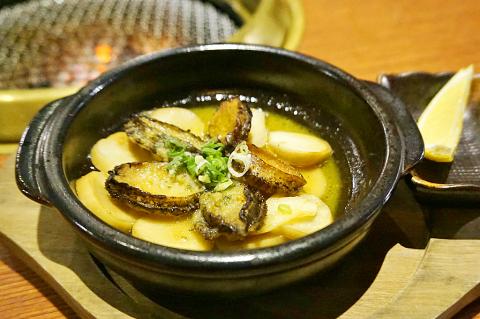
Photo: Dana Ter, Taipei Times
So much for being connoisseurs. We settle for the NT$1,480 wagyu set, which consists of four types of wagyu beef. To pair with it, we order the seasonable vegetable plate (NT$220) and the boiled abalone with escargot butter (NT$320).
The wagyu came served on a stoneware plate with leafy garnishing — some edible and others not. The four types of beef we ordered included dried wagyu beef with wasabi and butter, the kanpai classic with barbecue sauce, the wagyu intercostal and a brisket topped with Japanese radish and vinegar.
The dried wagyu beef was tender and juicy with buttery undertones that made it very delectable. On the other hand, the wasabi was barely discernable. That didn’t matter though, as the beef was tasty as it was. We had also cooked it such that it was slightly charred on the outside and tender on the inside. My favorite, however, was the kanpai classic. It was leaner than the first beef and thinly sliced, making it soft and chewy, while the barbecue sauce added an extra flavorful kick.
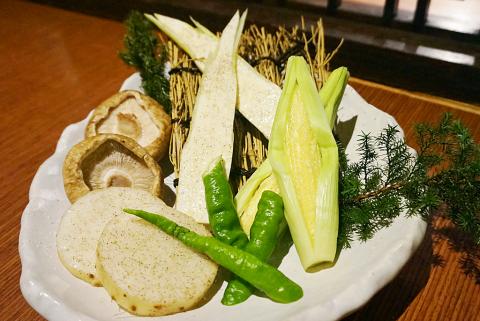
Photo: Dana Ter, Taipei Times
I didn’t care too much for the intercostals. The sauce it had been marinating in when it arrived on our plate was far too saccharine sweet. Not only that, the meat was so fatty that it was difficult to digest. The brisket fared slightly better. It was a bit dry, in contrast to the fatty intercostals, but it was still tender, with the vinegar lending a savory kick. So it was two-for-two for the wagyu, which was a bit disappointing, but at least next time, I’ll know to stick with the dried wagyu beef and the kanpai classic.
The vegetable plate was quite standard, consisting of mushrooms, baby corn, chili pepper, bamboo and Chinese yam. The veggies provided a nice complement to the meat, giving it a variety of flavor and texture. The baby corn and chili peppers were my favorite, as the corn was delicate yet crunchy, while the spice from the chili pepper helped to enliven the palate.
Probably the tastiest dish we ordered was the boiled abalone. Succulent and chewy with garlicy undertones, it simmered in the escargot butter sauce. The bits of garlic accentuated the aromatic taste and the squeezed lemon added a tangy dimension. Meanwhile, the mushrooms from the veggie plate was a good complement to the abalone, providing for a blander, burnt taste.
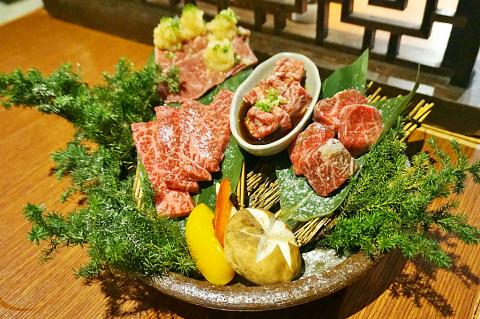
Photo: Dana Ter, Taipei Times
The meal, while decent, wasn’t worth over NT$2,000 a head. That being said, winter is a good time to eat Japanese barbecue, and patrons are better off trying one of the cheaper Kanpai branches where there’s no need to fork out money for frills. As for myself, I think I need to lay off the fatty meat for a bit.
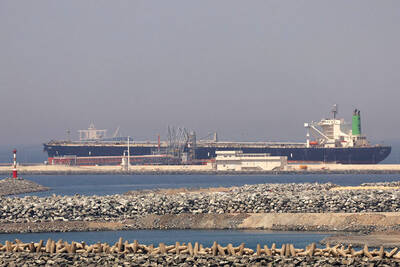
The breakwater stretches out to sea from the sprawling Kaohsiung port in southern Taiwan. Normally, it’s crowded with massive tankers ferrying liquefied natural gas from Qatar to be stored in the bulbous white tanks that dot the shoreline. These are not normal times, though, and not a single shipment from Qatar has docked at the Yongan terminal since early March after the Strait of Hormuz was shuttered. The suspension has provided a realistic preview of a potential Chinese blockade, a move that would throttle an economy anchored by the world’s most advanced and power-hungry semiconductor industry. It is a stark reminder of
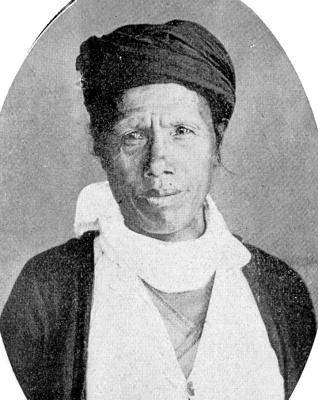
May 11 to May 17 Traversing the southern slopes of the Yushan Range in 1931, Japanese naturalist Tadao Kano knew he was approaching the last swath of Taiwan still beyond colonial control. The “vast, unknown territory,” protected by the “fierce” Bunun headman Dahu Ali, was “filled with an utterly endless jungle that choked the mountains and valleys,” Kano wrote. He noted how the group had “refused to submit to the measures of our authorities and entrenched themselves deep in these mountains … living a free existence spent chasing deer in the morning and seeking serow in the evening,” even describing them as
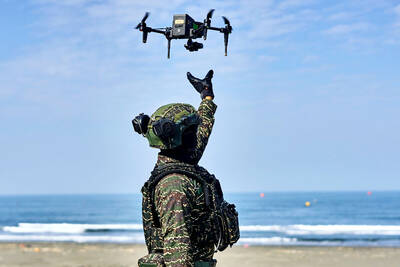
The last couple of weeks spectators in Taiwan and abroad have been treated to a remarkable display of infighting in the Chinese Nationalist Party (KMT) over the supplementary defense budget. The party has split into two camps, one supporting an NT$800 billion special defense budget and one supporting an NT$380 billion budget with additional funding contingent on receiving letters of acceptance (LOA) from the US. Recent media reports have said that the Taiwan People’s Party (TPP) is leaning toward the latter position. President William Lai (賴清德) has proposed NT$1.25 trillion for purchases of US arms and for development of domestic weapons
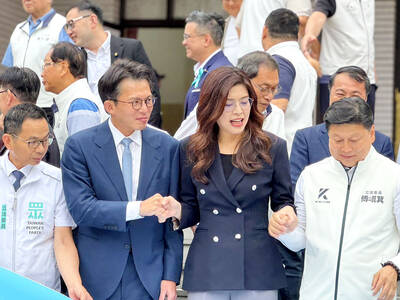
As a different column was being written, the big news dropped that Chinese Nationalist Party (KMT) caucus whip Fu Kun-chi (傅?萁) announced that negotiations within his caucus, with legislative speaker Han Kuo-yu (韓國瑜) of the KMT, party Chair Cheng Li-wun (鄭麗文), Taichung Mayor Lu Shiow-yen (盧秀燕) and Taiwan People’s Party (TPP) Chair Huang Kuo-chang (黃國昌) had produced a compromise special military budget proposal. On Thursday morning, prior to meeting with Cheng over a lunch of beef noodles, Lu reiterated her support for a budget of NT$800 or NT$900 billion — but refused to comment after the meeting. Right after Fu’s


 RSS
RSS