


Taiwan in Time: Jan. 4 to Jan. 10
On Jan. 8, 1975, nearly 30 years after the end of World War II, former Imperial Japanese Army soldier Nakamura Teruo finally returned home.
It was a different place from what he had known. His native land was no longer part of Japan. His son, who was an infant when he left, was now a father of four children, and his wife had remarried. Everyone was calling him Lee Kuang-hui (李光輝) — a name he had never even heard of when he departed for Indonesia with the Takasago Volunteer Unit in 1944.
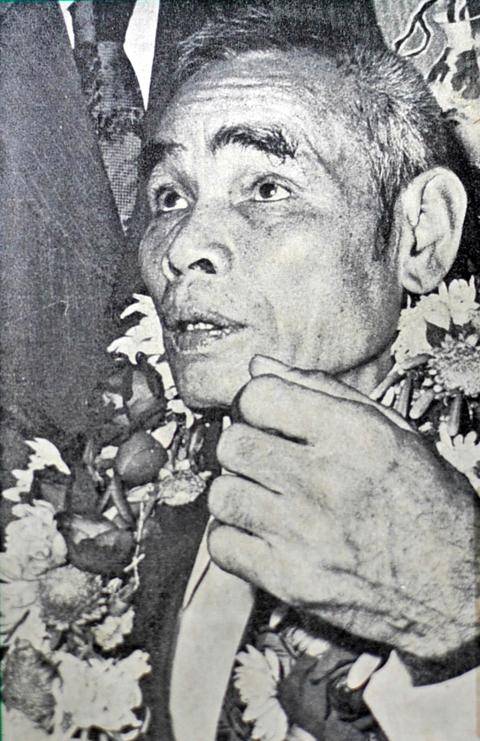
Photo: Wikimedia Commons
A member of the Amis people, Western reports have his Aboriginal name as Attun Palalin, while local sources call him Suniuo, which is what this article will go with.
Even though the Takasago were a volunteer army in name, Suniuo says he was forced to enlist. Shortly after he landed on Morotai Island in Indonesia, the Allies arrived and secured it as a base. Suniuo lost contact with his group during this time.
Armed with an assault rifle, a helmet, knife, cooking pot and a mirror, Suniuo built a hut and remained in the jungle alone, surviving by hunting and farming. He did not know that the war had already ended, as the Japanese army declared him dead on Nov. 13, 1944.
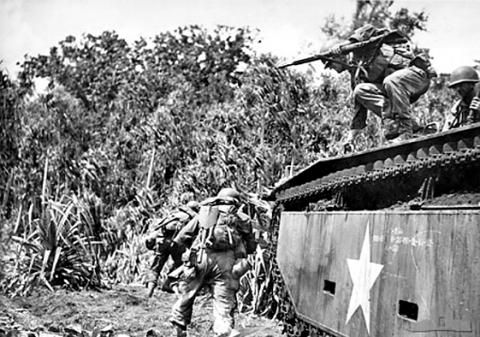
Photo: Wikimedia Commons
Unsure of the situation outside of the jungle, Suniuo stayed hidden at all costs, cooking only in the dark so people wouldn’t see the smoke. In a first-hand account published shortly after his return titled Struggle in the Jungle for 30 Years (叢林掙扎三 十年), Suniuo recalls counting the days by the moon and recording each cycle by tying a knot in a rope. He says his upbringing in the mountains in relative poverty provided him the will and ability to survive for so long.
“I calmly stayed alive there,” he says. “Although I didn’t have anybody to talk to, buried deep in my heart seemed to be a glimmer of hope and expectation. The only trace of happiness during this time came from the fact that I was still alive and I hadn’t lost my sense of existence yet.”
As Suniuo’s only clothes deteriorated over time, he says he became used to being naked most of the time, only using a US Army jacket he found to cover himself at night.
Most of his time was devoted to finding food, he says. He grew sweet potatoes, beans, bananas and sugar cane in his garden, gathered roots and fruits and trapped boar, pheasant and other birds.
“Not to lose my life became my only goal, and that exhausted almost all of my time,” he says.
The only two forms of entertainment he had was fishing and fiddling with a home-made abacus. In order to keep himself from thinking of his family at home, he stayed busy exploring his surroundings and undertaking various improvement projects around his hut.
Suniuo says he made a grave error in assuming that war wasn’t over from the planes that flew by above him each day, only later to find out that it was because the jungle was near an Indonesian air force base. As aviation technology improved over time, planes became faster and sleeker, and Suniuo thought it was the result of an arms race between the two warring sides.
“I made one simple wrong judgment, and it cost me 30 years,” he says.
In November 1974, local reports surfaced of a “naked wild man” in the mountains, prompting the Indonesian army to send an expedition force, which, after 30 hours, found Suniuo chopping wood outside his hut.
This brought up the question of whether he should be repatriated to Japan or Taiwan. Suniuo was given the choice, and he chose his homeland.
According to this biography, his back pay as a soldier over 30 years only amounted to about NT$7,000. But after some commotion in the media, the Japanese government decided to give him over NT$380,000 instead. He later received various donations from Japanese, Indonesian and local sources.
Yet, a return after so long has to be bittersweet. His parents were dead, and only two siblings survived — all going by Chinese names now. Suniuo’s wife’s new husband (of more than 10 years) was originally willing to move out and let the couple reunite, but Suniuo decided not to disturb their life and bought an apartment nearby. Just four years after his return, he died of lung cancer.
Taiwan in Time, a column about Taiwan’s history that is published every Sunday, spotlights important or interesting events around the nation that have anniversaries this week.
Taiwan has next to no political engagement in Myanmar, either with the ruling military junta nor the dozens of armed groups who’ve in the last five years taken over around two-thirds of the nation’s territory in a sprawling, patchwork civil war. But early last month, the leader of one relatively minor Burmese revolutionary faction, General Nerdah Bomya, who is also an alleged war criminal, made a low key visit to Taipei, where he met with a member of President William Lai’s (賴清德) staff, a retired Taiwanese military official and several academics. “I feel like Taiwan is a good example of
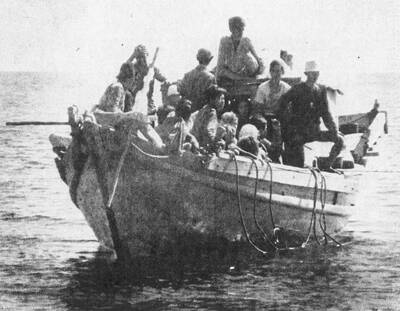
March 2 to March 8 Gunfire rang out along the shore of the frontline island of Lieyu (烈嶼) on a foggy afternoon on March 7, 1987. By the time it was over, about 20 unarmed Vietnamese refugees — men, women, elderly and children — were dead. They were hastily buried, followed by decades of silence. Months later, opposition politicians and journalists tried to uncover what had happened, but conflicting accounts only deepened the confusion. One version suggested that government troops had mistakenly killed their own operatives attempting to return home from Vietnam. The military maintained that the
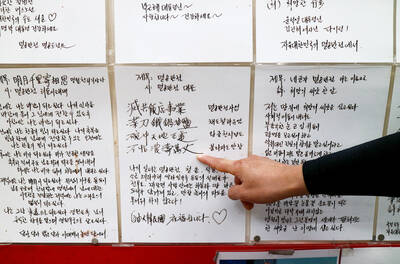
“M yeolgong jajangmyeon (anti-communism zhajiangmian, 滅共炸醬麵), let’s all shout together — myeolgong!” a chef at a Chinese restaurant in Dongtan, located about 35km south of Seoul, South Korea, calls out before serving a bowl of Korean-style zhajiangmian —black bean noodles. Diners repeat the phrase before tucking in. This political-themed restaurant, named Myeolgong Banjeom (滅共飯館, “anti-communism restaurant”), is operated by a single person and does not take reservations; therefore long queues form regularly outside, and most customers appear sympathetic to its political theme. Photos of conservative public figures hang on the walls, alongside political slogans and poems written in Chinese characters; South
Taipei Mayor Chiang Wan-an (蔣萬安) announced last week a city policy to get businesses to reduce working hours to seven hours per day for employees with children 12 and under at home. The city promised to subsidize 80 percent of the employees’ wage loss. Taipei can do this, since the Celestial Dragon Kingdom (天龍國), as it is sardonically known to the denizens of Taiwan’s less fortunate regions, has an outsize grip on the government budget. Like most subsidies, this will likely have little effect on Taiwan’s catastrophic birth rates, though it may be a relief to the shrinking number of


 RSS
RSS