


Standing alone at Miaoli County’s Yingtsai Academy (英才書院), looking at a neon plastic bow and arrow behind a thick pane of glass that is supposedly an artifact of Taiwan’s Confucian education tradition, I suddenly begin to feel I’ve just wasted my NT$50.
“Before we began charging for admission, the Yingtsai Academy used to receive over 30 tour buses a day. Now, we’re lucky to have 10 on the weekend,” said a lonely security guard working double duty at the information counter, who gave his surname as Lai (賴).
Following revelations that the county’s debt had reached an untenable level and would require a bailout due to years of unbridled spending under former county commissioner Liu Cheng-hung (劉政鴻), it has begun to charge admission to recoup losses on the pricey new tourist spots.
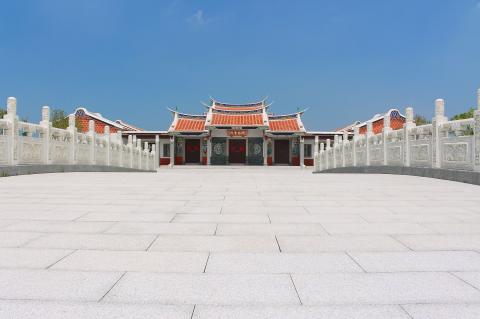
Photo: Aaron Wytze Wilson
But a recent visit by this reporter to these Liu-era attractions was a depressing showcase of unsustainable tourism development, with most having little historical or even general interest for either local or foreign tourists. Now, they face an uncertain future as visitor numbers plunge.
MOSQUITO BUILDINGS
Miaoli County is known for its striking natural beauty, with the Houlong River (後龍溪) snaking its way through the county, and the mountains of Shei-Pa National Park (雪霸國家公園) looming large in the distance.
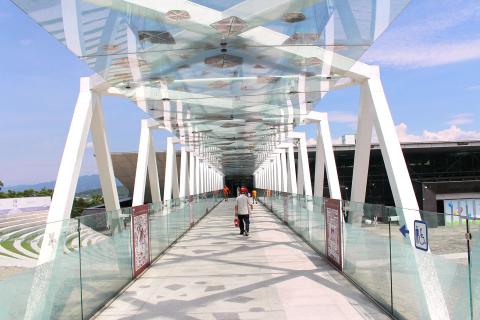
Photo: Aaron Wytze Wilson
In the past few years, the county has earned an unfortunate reputation for being Liu’s personal fiefdom, one where, during his nine-year tenure, he tripled the local debt to NT$64.8 billion on questionable construction projects that have sometimes spoiled the county’s natural beauty.
Liu has sought to capitalize on Miaoli’s status as a hotbed of Hakka culture, where 64.6 percent of the county claims Hakka heritage. He ordered the construction of a series of grandiose tourist attractions — the mammoth Hakka Courtyard and Culture Development Center (苗栗客家文化園區, thcc.hakka.gov.tw), the faux-historic Hakka Roundhouse (客家圓樓, hakkaroundhouse.mlc.gov.tw) and Yingtsai Academy. A museum, the Urban Planning Exhibition Center (城市規劃館, mcupec.mlc.gov.tw/), was also built as a kind of tribute to all of Liu’s public construction projects.
However, many of the above tourist spots do not seem designed with convenient transportation, quality exhibition content, or even enjoyment in mind. Reaching many of the attractions is a trying affair, with some being located at great distances from each other. Signs directing tourists to the attractions are often nowhere to be seen.
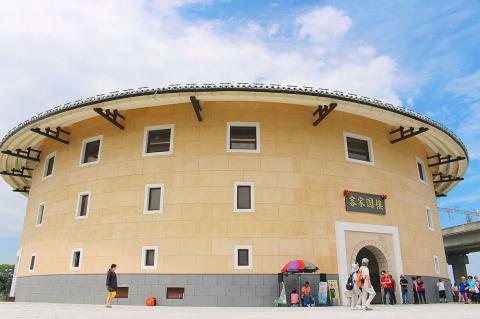
Photo: Aaron Wytze Wilson
Miaoli’s Hakka roundhouse, a modern reconstruction of a traditional tulou (土樓) earth-brick building native to China’s Fujian province, certainly appeared busy when I first visited on a Saturday morning.
Tour buses full of pensioners were paying the NT$30 entrance fee to take a look inside. But just as soon as they came in, they were out. Aside from a performance stage, a few miniature models of tulou buildings in China, there is nothing to engage a visitor longer than 20 minutes.
“It’s mostly just a place for retirees to sit in an air-conditioned building for an hour. There’s nothing else there [to do],” said Alice Wang (王美惠), a Miaoli resident who chuckled when asked what she thought of the roundhouse.
The Urban Planning Exhibition Center located in downtown Miaoli was an even sadder affair. On our weekend visit to the center, my partner and myself were the only visitors.
Upon entering the front doors, a seemingly overstaffed front desk of four receptionists were startled when we came in. They were slightly confused why we wanted to traipse around a two-storey building filled with miniature models of development projects approved by Liu.
“They call most of these new tourist attractions mosquito (蚊子館) buildings — they are totally empty, and all they’re good for is raising mosquitoes,” Wang said.
The only bright spot of these monuments to Liu is the Hakka Culture Development Center, a beautiful museum that explores the historical impact of Hakka peoples throughout China, Taiwan and Southeast Asia.
Meticulously researched, with excellent display explanations in both Chinese and English, and interactive and fun exhibits for both children and adults, the culture center is truly worth the 14km trip to the outskirts of Miaoli’s Tongluo Township (銅鑼).
LOOKING FOR A MIAO-XIT
Liu’s tourist site building extravaganza likely had an ulterior motive: land speculation. Over a span of two decades as both a legislator and a county commissioner in Miaoli, Liu benefited from a number of real estate plots he owned in Houlong Township (後龍鎮).
As building projects like the roundhouse and the new high-speed rail station sent property prices skyrocketing, Liu made millions on property sales.
But such extravagance comes at great expense to the county’s finances, the cost of building the Hakka culture center alone was a staggering NT$220 million, with construction still ongoing.
Similar building costs can be seen for the Yingtsai Academy, roundhouse and urban planning center, at NT$91 million, NT$130 million and NT$164 million respectively.
With dwindling tourist numbers, and mounting construction debts and IOUs, Miaoli’s new county commissioner, Hsu Yao-chang (徐耀昌), has began to charge admission and parking.
Needless to say, many residents are less than sanguine about the changes.
“I’ve already gone once when it’s free. I don’t know if I’d go again now that there’s an entrance fee,” said Lin Chi-yan (林季妍 ), when asked about the Hakka Roundhouse.
“I didn’t think anyone outside of Miaoli even knew these places existed. There’s nothing fun about those places,” said Miaoli resident Hsu Chia-chen (許家禎).
Attractions that have not enacted admission and parking fees are now in a catch-22 situation. If they charge a fee, no one will come. If they don’t charge, they slide further into debt. But with annual operation costs of NT$42 million for the combined Liu-era tourist spots, the financial pain is sure to continue. County commissioner Hsu may be seeing more mosquito buildings in the near future, thanks to his predecessor.

It seems every few days one bumps into one of those “real man” comments in which Taiwan is urged to “face reality” or similar, and “make a deal,” with the speaker implying that soon it will be too late. “Deal” advocates always present themselves as having a superior grip on reality, and the manly ability to make the “hard choice.” Their testosterone-laden language often echoes that of Taiwan sellout advocates. Note that such commentary always specifies a process (“make a deal, work with, make progress”), never the end state of what occupation by a violent authoritarian colonialist state will entail. In
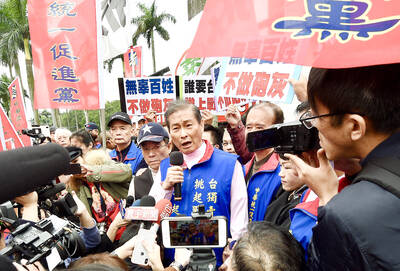
There are shadowy cabals plotting to sell out Taiwan to be annexed by China, by invasion if necessary. Fortunately, they are buffoons. In 2019, former Bamboo Union gangster and founder of the China Unification Promotion Party (CUPP), Chang An-le (張安樂, colorfully known as “White Wolf”), led a protest at the Legislative Yuan against comments made by then-premier Su Tseng-chang (蘇貞昌) that in the event of an attack by China, he would never surrender, but would protect the nation by fighting to the end, even if he only had a broom. Chang had party members bring a wooden casket that they
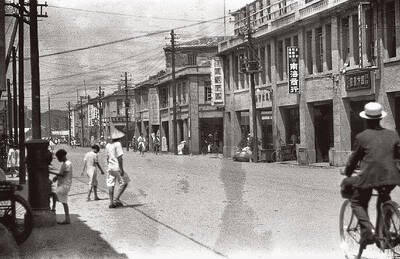
June 1 to June 7 "If all Taiwanese were as afraid of dying as you, then what would happen?” Physician Shih Chiang-nan (施江南) reportedly said this to his wife Chen Chiao-tung (陳焦桐) after she urged him to stop intervening on behalf of Taiwanese soldiers stranded overseas after serving in the Japanese Army during World War II. Shih had clashed with high-ranking officials over the issue, engaged in several heated arguments with Taiwan governor-general Chen Yi (陳儀) and allegedly shouted at general Ko Yuan-fen (柯遠芬), chief of staff of the Taiwan Garrison Command, over
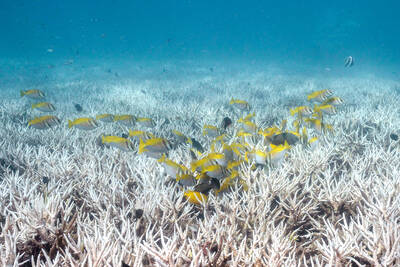
Food prices have often played a major role in Taiwan’s history. The first major wave of migration from China occurred in 1628. A moderate drought, the Ming Dynasty maritime ban that prohibited fishing and trading (intended to reduce piracy) and a temporary tax, conspired to exhaust local resources, leading to famine in Fujian Province. The famed pirate and trader Zheng Zhilong (鄭芝龍), scooped up starving people from Fujian and transported them across the Taiwan Strait, where they settled under the Dutch. Two factors enabled Zheng. First, by 1624 he had settlements around today’s Beigang (北港) in Yunlin County with a small


 RSS
RSS