


Remember a time when you were really jealous of that popular kid whose rich parents bought them a sleek black Nokia cellphone with Snakes and other cool games? Interactive designer/digital artist Elim Cheng’s (鄭以琳) latest exhibition transports viewers back to a pre-smartphone, pre-selfie, pre-swiping time in the early 2000s when pressing buttons and making phone calls brought much joy to our humdrum lives. A graduate of New York University, Cheng’s artwork combines contrasting themes of humanity and technology. She reveals to viewers the twisted side of their co-dependent relationships with gadgets. Entitled A Practice for Not-So-Smart Life (不智慧生活練習), her latest interactive exhibition takes place at Treasure Hill Artist Village’s Cross Gallery.
■ Treasure Hill Artist Village, Cross Gallery (寶藏巖國際藝術村十字藝廊), 2, Aly 14, Ln 230, Dingzhou Rd Sec 3, Taipei City (台北市汀州路三段230巷14弄2號), tel: (02) 2364-5313. Open Tuesday to Sundays from 11am to 6pm
■ Until Aug. 23
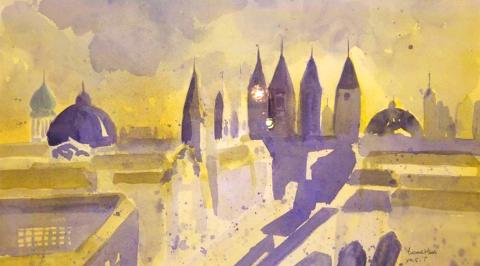
Photo courtesy of Cafe Vergismeinnich
Cafe Vergismeinnich, a German vintage-themed bistro and live music venue decorated with 1950s antique furniture from Berlin, is currently featuring the dreamy watercolor paintings of Yvonne Hsu (許宥閒) who was greatly inspired by her travels through Europe, especially her sixth-month stay in the state of Bavaria, which is known for its stunning landscapes (and Oktoberfest). Traveler x Time (旅人×時光) can be seen as a pictorial document of Hsu’s love affair with the European landscape, from picturesque countryside scenes to haunted-looking clock towers. When she’s not painting shadowy buildings, Hsu is painting prickly hedgehogs and friendly ostriches. If you’re into cute and whimsy, Cafe V — that’s what the cool kids are calling it — is the place to be.
■ Cafe Vergismeinnich, 92, Aiguo E Rd, Taipei City (台北市愛國東路92號), tel: (02)3322-3036. Open Tuesdays to Thursdays from 12pm to 9pm, Fridays from 12pm to 12am, Saturdays from 11am to 12am and Sundays from 11am to 9pm
■ Until Aug. 30
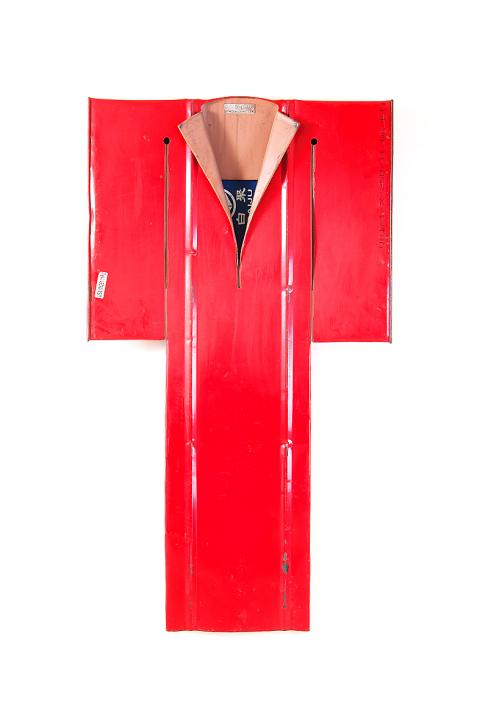
Photo courtesy of ArtDoor Gallery
Postwar Chinese Abstract Art (戰後華人抽象), an exhibition at Taipei’s Lin & Lin Gallery, opens tomorrow and will showcase the works of overseas Chinese artists whose abstract paintings from the postwar period to the present day elegantly combine elements of Asian and Western influences. It includes Chinese-American artist George Chann (陳蔭羆), who used calligraphy as the base for some of his earlier paintings, later addressed social issues, such as harrowing-looking Chinatowns. His works in later decades were more frenzied and abstract. Another artist, Chinese-French Zao Wou-ki (趙無極), has stated that his work is influenced by Paul Klee, Henri Matisse and Pablo Picasso, yet his paintings, which are also on display, are a beautiful blend of Western abstraction, as seen through his use of warm colors, and a Chinese sensibility, which can be made out from the gentle strokes of black ink that outlines the landscapes he paints. Also included in the exhibition are paintings by Chinese-French artist Chu Teh-chun (朱德群) and Shanghai-born artist Hsiao Chin (蕭勤), who lived and worked all over Europe.
■ Lin & Lin Gallery (大未來林舍畫廊), 16, Dongfeng St, Taipei City (台北市東豐街16號), tel: (02) 2700-6866. Open Tuesdays to Sundays from 11am to 7pm
■ Opens tomorrow. Until Aug. 30
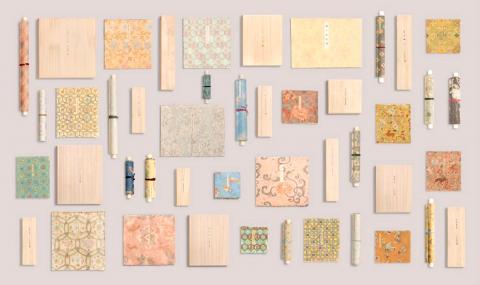
Photo courtesy of Tina Keng Gallery
Gordon Chandler is an artist who makes men’s t-shirts — out of steel and metal that is. From his 8,000 square foot studio in the US state of Georgia, he has created countless “t-shirts” from recycled industrial materials and named them numerically, replicating a mass production, factory-like feel. The vast disconnect between the materials that Chandler uses and his subject is due to his own tendency to see the practical use of objects, rather than their aesthetic value. This is ironic because Chandler’s kimono series are actually strikingly beautiful, albeit minimalistic. The contrast of the idea of the traditional garment and a mass-produced item slapped with a serial number is both sad and humorous. Chandler’s latest exhibition, Object Formation (翻轉空間), opens tomorrow at Taipei’s ArtDoor Gallery.
■ ArtDoor Gallery (藝境畫廊) 639, Ruiguang Rd, Taipei City (台北市瑞光路639號), tel: (02) 2658-5268. Open Tuesdays to Sundays from 11am to 7pm
■ Opens tomorrow. Until Aug. 30
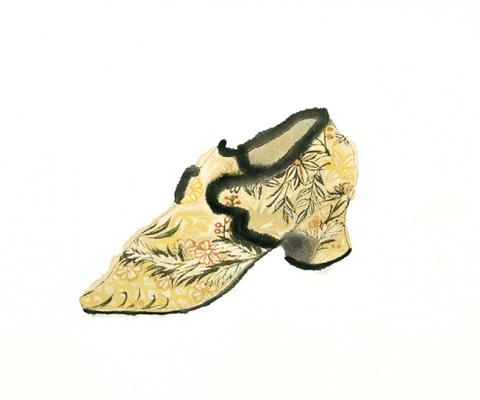
Photo courtesy of Tina Keng Gallery
Chengdu-born Chinese artist Peng Wei (彭薇), who has made a name for herself through her dainty and delicate style, has dabbled in ink paintings, silk embroidery and installation. A selection of her shoe paintings, hand-crafted silk shoes and tiny handmade scrolls, among other works, is currently on display at the National Museum of History in Taipei. Organized by the Tina Keng Gallery Foundation for Arts and Culture and the Art Museum of Beijing Fine Art Academy, Coming Full Circle (圓滿的旅程) is an absolute treat for those interested in women’s fashion and history. Although Peng is known for employing traditional techniques, her artwork contains cheeky undertones. The silk shoes in her Good Things Come In Pairs series depict flirtatious couples dressed in ancient garb caught in some very embarrassing sexual acts.
■ National Museum of History (國立歷史博物館), 49 Nanhai Rd, Taipei City (台北市南海路49號), tel: (02) 2361-0270. Open Tuesdays to Sundays from 10am to 6pm
■ Until Sept. 20
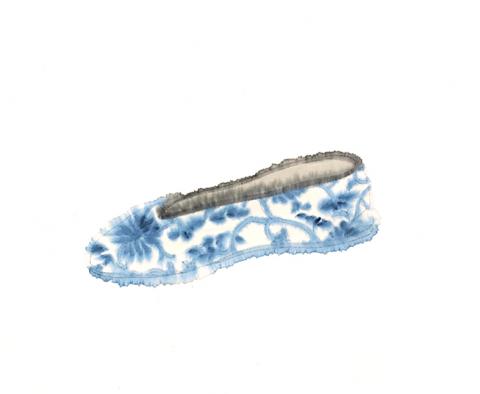
Photo courtesy of Tina Keng Gallery
Those with an affinity for modern-style calligraphy will enjoy the Kuandu Museum of Fine Art’s latest exhibition, The End of Modernity in Calligraphy: From Yuichi Inoue, Lee U-fan to Zhang Yu (書寫的現代主義終結:從井上有一、李禹煥到張羽). Featuring the works of the late Japanese artist Yuichi Inoue, Japanese-educated South Korean artist Lee U-fan and Chinese artist Zhang Yu (張羽), it traces the evolution of modern calligraphy in East Asia over the past half-century. Inoue’s giant-sized child-like characters are playful and expressionistic, while Lee’s monochromatic drips and drops appear more controlled and organized. Lee, who is now 79 years old, is also known for jettisoning, along with other Japanese artists, a minimalistic style combining natural and industrial materials that came to be known as the mono-ha art movement. Zhang’s artwork, meanwhile, is the most colorful and uplifting among the three. In the past, he’s filled entire gallery spaces with his fingerprints, dipping them in pink ink.
■ Kuandu Museum of Fine Arts (關渡美術館), 1 Xueyuan Rd, Taipei City (台北市學園路1號), tel: (02) 2896-1000 ext 2432. Open Tuesdays to Sundays from 10am to 5pm
■ Until Sept. 20
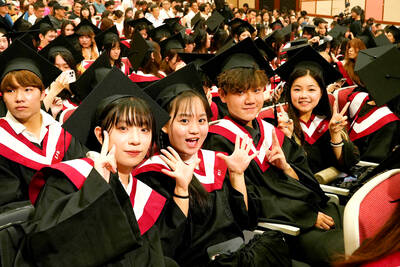
Taiwan’s English education system is being pulled apart by three opposing forces. Bilingual Nation 2030 pulls students toward English and global communication. Artificial Intelligence (AI) readiness pulls them toward digital judgment, verification and AI-mediated work. But Taiwan’s old exam culture pulls them back toward memorization, grammar drills, timed reading and correct answers. If the education system keeps using old exams to define success, it risks producing graduates who are neither genuinely bilingual nor genuinely AI-ready, but trained for tasks machines can already perform. The first force is Bilingual Nation 2030. Launched in 2018, the policy aimed to “help Taiwan’s workforce connect
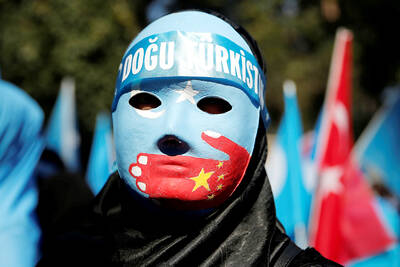
It seems every few days one bumps into one of those “real man” comments in which Taiwan is urged to “face reality” or similar, and “make a deal,” with the speaker implying that soon it will be too late. “Deal” advocates always present themselves as having a superior grip on reality, and the manly ability to make the “hard choice.” Their testosterone-laden language often echoes that of Taiwan sellout advocates. Note that such commentary always specifies a process (“make a deal, work with, make progress”), never the end state of what occupation by a violent authoritarian colonialist state will entail. In
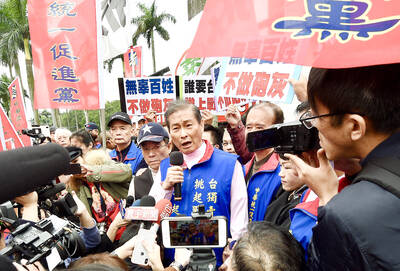
There are shadowy cabals plotting to sell out Taiwan to be annexed by China, by invasion if necessary. Fortunately, they are buffoons. In 2019, former Bamboo Union gangster and founder of the China Unification Promotion Party (CUPP), Chang An-le (張安樂, colorfully known as “White Wolf”), led a protest at the Legislative Yuan against comments made by then-premier Su Tseng-chang (蘇貞昌) that in the event of an attack by China, he would never surrender, but would protect the nation by fighting to the end, even if he only had a broom. Chang had party members bring a wooden casket that they
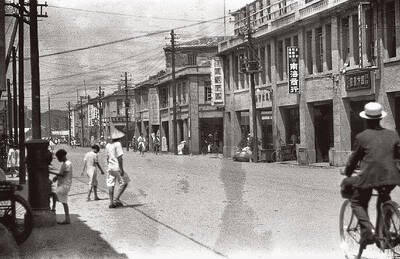
June 1 to June 7 "If all Taiwanese were as afraid of dying as you, then what would happen?” Physician Shih Chiang-nan (施江南) reportedly said this to his wife Chen Chiao-tung (陳焦桐) after she urged him to stop intervening on behalf of Taiwanese soldiers stranded overseas after serving in the Japanese Army during World War II. Shih had clashed with high-ranking officials over the issue, engaged in several heated arguments with Taiwan governor-general Chen Yi (陳儀) and allegedly shouted at general Ko Yuan-fen (柯遠芬), chief of staff of the Taiwan Garrison Command, over


 RSS
RSS