


Watching the last orange rays of the fading sun overtake the blue sky and tint the ocean at Dafo Zen Temple’s (大佛禪寺) lookout over downtown Keelung, I am again reminded that checking the weather beforehand is a futile exercise in Taiwan.
Ninety-five percent chance of thunderstorms? Didn’t even feel a drop during a recent afternoon trip to the city nicknamed “rainy port” (雨港).
Located northeast of Taipei, Keelung isn’t what usually comes to mind for an excursion from the capital, but given its maritime significance, there’s plenty of hidden history and nature to explore, as well as great food and splendid views.
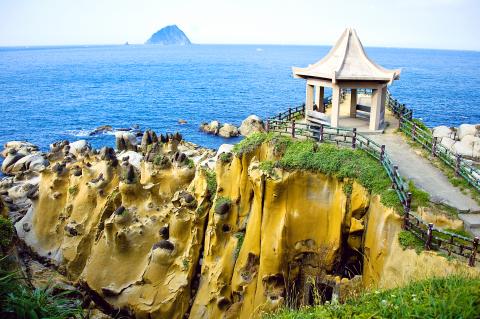
Photo courtesy of Han Cheung
Trains run every 15 to 20 minutes from the Taipei Railway Station, with travel time just over an hour.
The area around Keelung’s train station is just as crowded as Taipei — maybe even worse. Yet the presence of the protected harbor with its multi-colored shipping containers and towering cargo cranes provides respite from the traffic and dense building clusters.
UNIQUE ROCK FORMATIONS
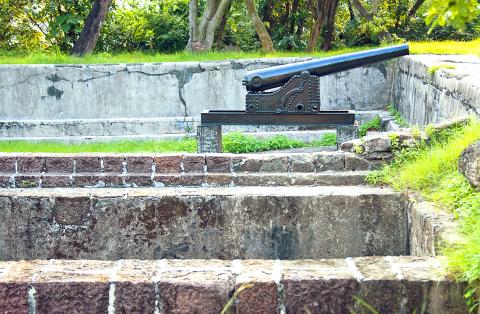
Photo courtesy of Han Cheung
Hop on a 101 bus at the terminal next to the train station and leave the bustle behind for Heping Island (和平島), known for its fresh seafood and fantastic rock formations formed by sea erosion.
The bus loops around another harbor with brightly-colored boats and waterfront buildings in matching hues of blue, orange, red and white. Right after Heping Bridge is the Heping Island Fish Market (和平島觀光魚市) with a number of restaurants serving freshly-caught seafood. The market is also famous for its seaweed dumplings, harvested from underwater rocks.
Get off at the Heping Island bus stop and walk about five minutes to Heping Island Park. This place has drastically changed since I last visited 10 years ago. Now it’s “coastal wonder park” (海角樂園) with an entrance fee of NT$60.
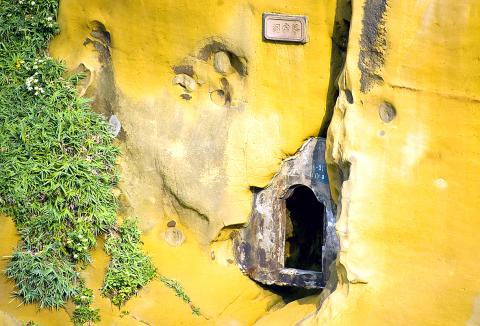
Photo courtesy of Han Cheung
There’s a giant plaza with an entrance stone topped with fake waves. Accompanied by light rock ‘n’ roll and piano music playing from numerous speakers, visitors follow a road decorated with flags from different countries and rainbow columns to a strange, semi-modernist castle which has replaced the run-down visitor center.
The castle draws its inspiration from Fort San Salvador, built by the Spanish in 1626 and destroyed by the Dutch in 1642. It was rebuilt in 1664 and destroyed again in 1668. But the overly geometrical design — punctuated with a bright red structure that reaches out from the second floor and angles inward toward the ground, just seems a bit odd. There’s a seawater swimming pool on the shore, and a restaurant and gift shop inside. To add to the tackiness is a barbecue and picnic area, with an astrology symbol and its corresponding English name painted on each lot.
But that’s not the point of coming here. The rock formations are the main draw, and can be seen by taking a stone path around a hill. To the left of the camping area is a large cluster of mushroom-shaped rocks called the “pile of ten-thousand people” (萬人堆). Along the path are other creatively named rocks such as the “moongazing rhinoceros” (犀牛望月) and “thousand layers of tatami” (千疊敷).
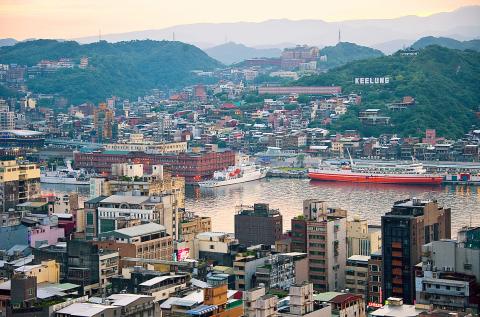
Photo courtesy of Han Cheung
The path continues on to a stone pagoda, where visitors can see the “foreign writing cave” (蕃字洞), allegedly the last point of Dutch resistance against the forces of Ming Dynasty warlor Cheng Cheng-kung (鄭成功), also known as Koxinga, (國姓爺), in 1662. It is said that Dutch writing could once be seen on the cave walls, now lost to erosion.
The path ends at the Ryukyu Fishermen Monument (琉球漁民慰靈碑). During Japanese colonial rule, a village of up to 560 people from the Ryukyu Islands (now Okinawa prefecture) lived here. Unfortunately, the path to the rest of the rock formations is currently blocked off, and visitors can only finish the loop back to the park entrance.
FRENCH CAMPAIGN
Hop on the 101 bus again — but get off at the Haimen Tiansian (海門天險) stop and check out the Ershawan Fort (二沙灣砲台), first built in 1840 in response to the First Opium War. The fort was destroyed during the Sino-French war in 1884 and rebuilt by Liu Ming-chuan (劉銘傳), first governor of the newly established Taiwan Province.
Strategically built into a hill facing the ocean, the barracks are located in a low spot behind the hill with cannon fortifications in the forefront. It’s a quiet, green place, good for a stroll amid the fort’s remains, dotted with replica cannons. Between the trees are some excellent views of Keelung harbor.
Near Ershawan Fort, on the side of busy Jhongjheng Road (中正路) is the Keelung French Cemetery (基隆法國公墓), where between 500 and 700 French soldiers who died during the Sino-French War and the subsequent occupation of Keelung and the Pescadores lie in a mass grave. Originally located by the ocean, the cemetery was moved to its current spot in 1909.
It’s an eerie place, completely shaded by banyan trees and towering residences. You immediately forget that cars and scooters are still whizzing by. Several monuments and two individual graves of higher-ranking officials that were later moved here can be seen. It’s a place for solemn reflection.
If you still have energy and want the best view in Keelung, head to Jhungjheng Park’s (中正公園) Dafo Zen Temple, located at 17 Shoushan Rd (壽山路17號) and accessible by the 206 bus. On an expansive pavilion with panoramic views of downtown Keelung and the extended harbor sits a 22.5m tall white Guanyin with an enormous gold guardian lion on each side. There’s a staircase inside the statue which leads to the top, with various lookout windows facing different directions along the way.
It’s a great place to watch the sunset before taking the bus back to the train station. But before you leave, remember that no trip in Taiwan is complete without food.
FOOD, OF COURSE
Miaokou Night Market (廟口夜市), famous for its variety of food, is walkable from the train station. Despite the chaos of people, vendors and banners, the stalls are neatly numbered and labeled in Chinese, English and Japanese.
I sampled the famous “nutritious sandwich,” (stall 58) which, despite its claims to “strengthen your body and prolong your life,” comes in a deep-fried bun slathered with sweet mayonnaise and topped with cucumbers, tomatoes, a braised egg and chunks of ham. The ingredients balance each other well, and it is quite tasty even though the “nutritious” part is questionable.
The “one bite tempura” (stall 43) was decent but I’m not sure why it’s so popular. My favorite was the “pork thick soup king” (stall 31). Order a bowl of the soup with a bowl of braised pork rice and you’ll be glad you’re in Taiwan. Finish your meal with either some fresh fruit juice or bubble ice.
I headed back to Taipei with tired feet, a full belly and a satisfaction from exploring and learning new things — all signs of a good trip.

Michael slides a sequin glove over the pop star’s tarnished legacy, shrouding Michael Jackson’s complications with a conventional biopic that, if you cover your ears, sounds great. Antoine Fuqua’s movie is sanctioned by Jackson’s estate and its producers include the estate’s executors. So it is, by its nature, a narrow, authorized perspective on Jackson. The film ends before the flood of allegations of sexual abuse of children, or Jackson’s own acknowledgment of sleeping alongside kids. Jackson and his estate have long maintained his innocence. In his only criminal trial, in 2005, Jackson was acquitted. Michael doesn’t even subtly nod to these facts.
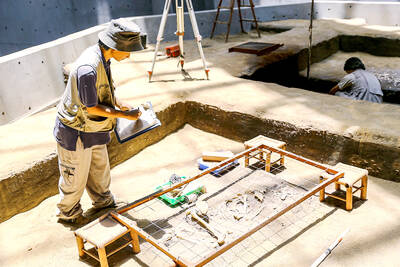
Writing of the finds at the ancient iron-working site of Shihsanhang (十 三行) in New Taipei City’s Bali District (八里), archaeologist Tsang Cheng-hwa (臧振華) of the Academia Sinica’s Institute of History and Philology observes: “One bronze bowl gilded with gold, together with copper coins and fragments of Tang and Song ceramics, were also found. These provide evidence for early contact between Taiwan aborigines and Chinese.” The Shihsanhang Web site from the Ministry of Culture says of the finds: “They were evidence that the residents of the area had a close trading relation with Chinese civilians, as the coins can be

The March/April volume of Foreign Affairs, long a purveyor of pro-China pablum, offered up another irksome Beijing-speak on the issues and solutions for the problems vexing the People’s Republic of China (PRC) and the US: “America and China at the Edge of Ruin: A Last Chance to Step Back From the Brink” rang the provocative title, by David M. Lampton and Wang Jisi (王緝思). If one ever wants to describe what went wrong with US-PRC relations, the career of Wang Jisi is a good place to start. Wang has extensive experience in the US and the West. He was a visiting

The January 2028 presidential election is already stirring to life. In seven or eight months, the primary season will kick into high gear following this November’s local elections. By this point next year, we will likely know the Democratic Progressive Party (DPP) candidate and whether the Taiwan People’s Party (TPP) will be fielding a candidate. Also around this time, the Chinese Nationalist Party (KMT) will either have already completed their primary, or it will be heading into the final stretch. By next summer, the presidential race will be in high gear. The big question is who will be the KMT’s


 RSS
RSS