


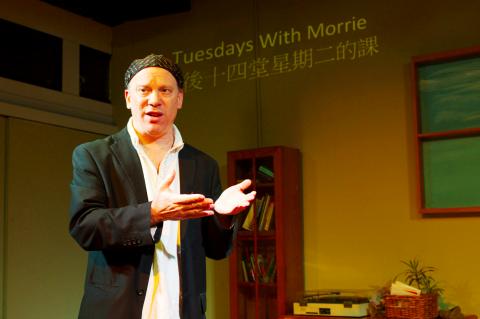
Taiwan gained insight into the Latin aphorism ars longa, vita brevis (art is long, life is short) with LAB Space’s recent production of Tuesdays with Morrie. Directed by Taiwan-based impresario Brook Hall, the play, like the well-known memoir of the same name, treats the relationship of sports writer Mitch Albom and his former professor Morrie Schwartz as the latter faces death. Taiwan, however, got more than just a play in that process; it got an intriguing look into the symbiotic relationships that exist between art, life and serendipity.
Start with the book and biography. Certainly, no one will deny how autobiographical and biographical elements can run through art and fiction. Many of Hemingway’s novels, for example, draw both upon his and the life experiences of his friends for background.
The play differs from the book. In drama, since each production varies in director and cast, the impact will also be different. Taiwan’s production of the play had this one extra feature — Rob Schwartz, the son of Morrie Schwartz, attended performances in the last week and stayed to answer audience questions, biographical and otherwise.
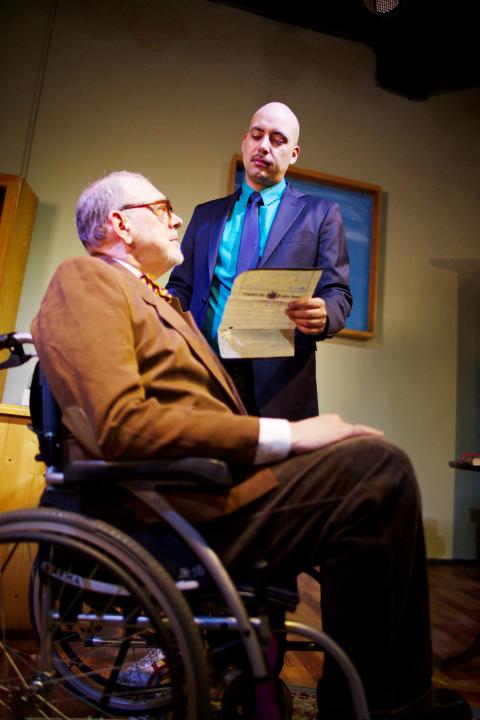
Photo courtesy of Tobie Openshaw
Intermixed is serendipity. Rob Schwartz made a point of using that word in one of his answers. Working in Tokyo as Bureau Chief of Billboard Magazine, he learned of Taiwan’s production via a Facebook posting and volunteered to visit. Serendipity played a big part in the writing of the book as well. If Mitch Albom had not been channel surfing at the time he would not have learned of the debilitating condition of Morrie from Ted Koppel’s Nightline. He would also probably not have had the time for the 14 Tuesday visits with Morrie before his death except that Albom’s paper was on strike freeing up his schedule.
For his part, Hall says he was influenced by the book and wanted LAB Space to be known for more than comedies. He also had the constraints of the small theater space requiring plays with a minimal cast and he had in mind a well-known entertainer, DC Rapier, to fit the lead role. Rapier read the book and was moved by both it and the play, but the lines of the play perhaps had more impact since a friend of his had just died and Rapier himself had had a somewhat life-threatening operation. Victor Stevenson, who played Mitch, used the illness and death of his own father to help identify with his role. He and Rapier developed the needed chemistry for the play.
Rob Schwartz brought other elements in. What was it like growing up with his father? How did the family feel about Mitch? When the Schwartz family sold the house made famous by the book, his mother refused to let that be part of the advertisement, though it would have increased the value. A best seller? Several publishers had originally refused the book; it did not take off until Oprah endorsed it. Did that make it art or more what the general public wanted or both? Some people might have liked the book less if they knew of the left wing politics of Rob’s father. That element was purposely left out. And of course there were unrelated questions like, what do you feel about Doraemon?
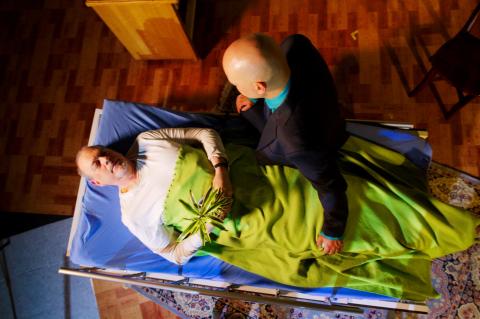
Photo courtesy of Tobie Openshaw
The book allows for pauses and rereading; the play is bounded by a brief time span for digestion but it is live. Those who had read the memoir could make their own judgments. Rob Schwartz obviously preferred the book; it dealt with his father’s life and thought. This writer preferred the play, perhaps because the drama made the learning and change in Albom’s writing direction more poignant. Having read the book nearly a decade ago, the only specific remembrance is how Albom symbolically brought food that Morrie Schwartz could no longer eat.
Morrie Schwartz died before Albom’s book on his final “class” hit bookshelves; he would never know the full reach of the work and certainly could not have envisioned the play being shown in Taiwan. Life, reality, art, serendipity and memoir; it is all here and the LAB Space as community theater is part of it. For future projects by LAB Space, go to www.facebook.com/labspacetw.
Photos courtesy of Tobie Openshaw

Ajay Verma, a consultant gastroenterologist at Kettering general hospital in Northamptonshire, says our gut is a “complex machine.” “It is constantly providing us with the nutrition we need, initially to grow and develop, and then for us to survive, thrive and repair from injury and illness.” How can we keep it functioning well? Put simply: “Make sure what you put into it is balanced, and that you clear out its waste products adequately,” Verma says. “In a general gastroenterology clinic, the most common conditions we see are irritable bowel syndrome (IBS), gastroesophageal reflux disease, inflammatory bowel disease and constipation,” says Nisha
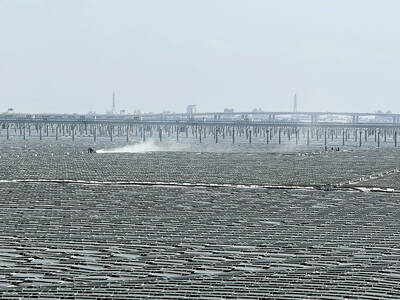
The arithmetic is straightforward and uncomfortable. By the end of 2025, Taiwan had committed itself to a 50-30-20 electricity mix — half natural gas, 30 per cent coal, 20 per cent renewables. The Ministry of Economic Affairs’s (MOEA) own monthly energy reports tell a different story. Natural gas reached 47.8 per cent of generation last year. Coal stood at 35.4 per cent, comfortably above its target ceiling. Renewables came in at 13.1 per cent, well short of the 20 per cent Taipei had pledged a decade earlier. Installed renewable capacity reached roughly half of the 12 gigawatts (GW) the government

Taiwan’s drone exports are taking off, fuelled by the war in Ukraine, as Taiwanese companies seek a stake in the fast-growing global market for unmanned aerial vehicles (UAV). Low-cost drones used for reconnaissance and strikes are in high demand as governments around the world boost defense spending in the face of intensifying conflicts. A relative new player in the increasingly competitive industry, Taiwan’s pitch is to be an “Asian hub” for the production of UAVs and components free of Chinese materials, or “non-red.” That means its UAVs can be up to three times more expensive than their Chinese competitors, like the world’s biggest

There are shadowy cabals plotting to sell out Taiwan to be annexed by China, by invasion if necessary. Fortunately, they are buffoons. In 2019, former Bamboo Union gangster and founder of the China Unification Promotion Party (CUPP), Chang An-le (張安樂, colorfully known as “White Wolf”), led a protest at the Legislative Yuan against comments made by then-premier Su Tseng-chang (蘇貞昌) that in the event of an attack by China, he would never surrender, but would protect the nation by fighting to the end, even if he only had a broom. Chang had party members bring a wooden casket that they


 RSS
RSS