


Chang Hao-jan (張皓然) is very, very good at what he does.
Sometimes, perhaps, too good.
Honing his photography and visual skills since his father gave him his first single-lens reflex camera when he was a second-grader, Chang earned a graduate degree from National Taiwan University of Arts ( 國立臺灣藝術大學) and has developed into one of the nation’s leading visual effect artists.
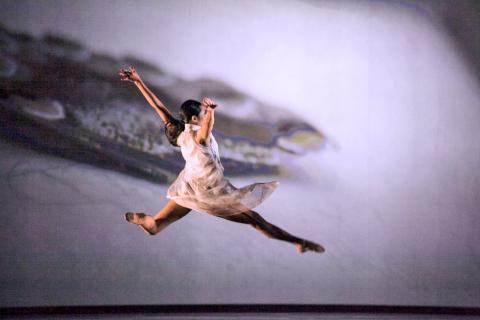
Photo courtesy of National Theater Concert Hall
In recent years, he has become the go-to guy for Cloud Gate Dance Theatre (雲門舞集) founder and artistic director Lin Hwai-min (林懷民) and others.
That is probably why the visual imagery for Leipzig Ballet artistic director and choreographer Mario Schroder’s Wild Butterflies (狂放的野蝶), performed by the Century Contemporary Dance Company (CCDC, 世紀當代舞團) at the National Theater in Taipei last weekend, reminded me of Lin’s stunning 2013 production, Rice (稻禾).
The problem is, in both Rice and Wild Butterflies, Chang’s work is so beautiful, so mesmerizing, that it is too easy to forget to look at what the dancers are doing — and the choreography, after all, is the raison d’etre for a dance production.
That being said, Wild Butterflies was terrific — the icing on the cake of a wonderful evening of dance. The National Theater Concert Hall’s annual Taiwan International Festival of Arts has a mixed record when it comes to cross-cultural productions, but when they work, they are great and the combination of CCDC founder Yao Shu-fen’s (姚淑芬) troupe and the Leipzig Ballet was an inspired one.
Yao and Schroder appear simpatico and he was able to draw new depths from her dancers.
Schroder said he was inspired by the bustle of Taipei and the fragility of butterflies, who can represent both immortality and — through their metamorphosis — rebirth, ideas that Chang captured with his work.
Wild Butterflies begins with the dancers clustered in dim light in the center of the stage, with several light battens suspended just a few meters above their heads. A blurry background that could be flowing water is gradually revealed to be the lights of moving traffic, as the light battens rise and Taipei buildings come into sharper view with the start of day. The day proceeds, there is a beautiful sunset, a close-up of a woman’s eyelashes dissolves into a field of flowers as the woman opens her eyes — and then a reverse scroll through the images until the city fades out and the lights of moving vehicles become a flickering pool of light.
The piece ends as it began: a cluster of dancers, the lowered battens and dimly flickering images on the back screen.
Schroder described butterflies’ movements as a combination of rapid beats and smooth sails, something he sought to evoke with bursts of movements and still tableaus, with lots of fluttering hands and floating arms. The dancing is a mix of solos, group movements and a few partnerings, evocative of butterflies flittering from flower to flower, place to place.
Friday night’s premiere of Wild Butterflies was short one of the 10 listed dancers, who reportedly suffered an injury during rehearsals earlier in the day. However, there did not appear to be an obvious hole in the choreography and the other dancers were in terrific form.
Kudos should also be given to Wang Tien-hung (王天宏) for the lighting and Jasper Huang’s (黃嘉祥) simple white costume designs.
The evening began with a reprise of CCDC founder Yao Shu-fen’s (姚淑芬) Les Noces (The Wedding, 婚禮), first seen at the National Theater in December 2010 and still a powerful work. Yao said she tweaked it a bit, but it was hard to see any changes.
Like Wild Butterflies, much of the power of the piece comes from the visual combination of painter Wang Pan-yuan’s (王潘元) colorful creations projected against a black screen and the stark whiteness of the stage setting and the dancers’ makeup and costumes.
Aside from the paintings, the only color on the stage floor came from a red bouquet carried in by one woman — and then tossed around — and by an extended red veil that one dancer wears as she dashes across the stage.
While most weddings reflect the bridal couple’s finding one another, Yao’s choreography leaves the dancers still searching for love amid cold imagery of isolated solos, a few duets and a repeated motif of a female dancer being buried under shredded white paper — either from the giant pile in the back right side of the stage or from the paper covering the floor that gets torn up by the dancers’ feet as the dance progresses — and then popping up again.
Getting the cold shoulder in a relationship was amply demonstrated by male dancers holding the women up by their ankles with their heads and shoulders on the floor, forcing — or enabling — them to twist around in shoulder rolls by turning one of the ankle in their hands.
Les Noces is dramatic and beautiful, but keeps the both the dancers and the audiences at arms length.
Schroder’s choreographic skills were introduced by Corrente II, the final act of a longer ballet Ein Liebestraum (A Dream of Love), revealing his love of brief pauses and frozen tableaus (as seen again in Wild Butterflies).
Lighting is key to the piece, starting from the single spots that illuminate individual dancers, to the pools of light the dancers run through, to the brightly colored and lit ensemble work, to the large lamps that descend toward the end of the work, as the action shifts from broody solos to pairs and groups The lighting credits go to Schroder, Paul Zoller and Michael Roger.
Ein Liebestraum begins by introducing each dancer in a starkly lit, very brief solo as they uncurl and stretch before closing up again, the harsh lighting emphasizing each dancer’s sinuous muscularity, including the women. The lighting and movements highlighted the dancers’ physicality in a way that Taiwanese choreographers rarely do.
However, the separateness of the solos sets the mood for the rest of Corrente II, for even when the dancers are dancing together, they remain aloof, disconnected.
Seeing this sample of the Leipzig Ballet and Schroder’s work left me hoping that the troupe will be invited back again to the National Theater, perhaps with Chaplin, Schroder’s 2010 homage to the Little Tramp.

Michael slides a sequin glove over the pop star’s tarnished legacy, shrouding Michael Jackson’s complications with a conventional biopic that, if you cover your ears, sounds great. Antoine Fuqua’s movie is sanctioned by Jackson’s estate and its producers include the estate’s executors. So it is, by its nature, a narrow, authorized perspective on Jackson. The film ends before the flood of allegations of sexual abuse of children, or Jackson’s own acknowledgment of sleeping alongside kids. Jackson and his estate have long maintained his innocence. In his only criminal trial, in 2005, Jackson was acquitted. Michael doesn’t even subtly nod to these facts.
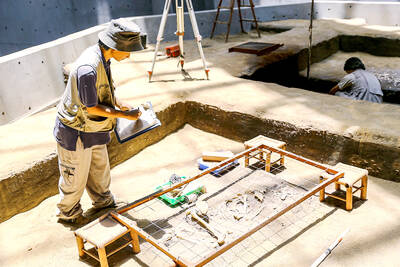
Writing of the finds at the ancient iron-working site of Shihsanhang (十 三行) in New Taipei City’s Bali District (八里), archaeologist Tsang Cheng-hwa (臧振華) of the Academia Sinica’s Institute of History and Philology observes: “One bronze bowl gilded with gold, together with copper coins and fragments of Tang and Song ceramics, were also found. These provide evidence for early contact between Taiwan aborigines and Chinese.” The Shihsanhang Web site from the Ministry of Culture says of the finds: “They were evidence that the residents of the area had a close trading relation with Chinese civilians, as the coins can be
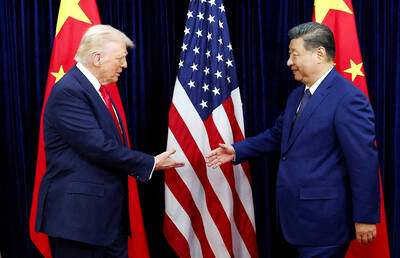
The March/April volume of Foreign Affairs, long a purveyor of pro-China pablum, offered up another irksome Beijing-speak on the issues and solutions for the problems vexing the People’s Republic of China (PRC) and the US: “America and China at the Edge of Ruin: A Last Chance to Step Back From the Brink” rang the provocative title, by David M. Lampton and Wang Jisi (王緝思). If one ever wants to describe what went wrong with US-PRC relations, the career of Wang Jisi is a good place to start. Wang has extensive experience in the US and the West. He was a visiting
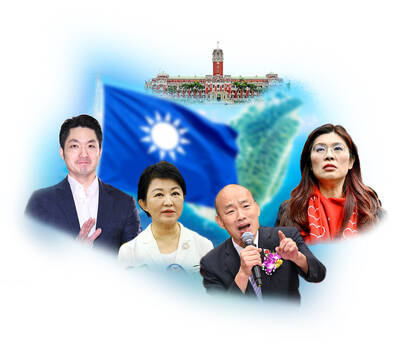
The January 2028 presidential election is already stirring to life. In seven or eight months, the primary season will kick into high gear following this November’s local elections. By this point next year, we will likely know the Democratic Progressive Party (DPP) candidate and whether the Taiwan People’s Party (TPP) will be fielding a candidate. Also around this time, the Chinese Nationalist Party (KMT) will either have already completed their primary, or it will be heading into the final stretch. By next summer, the presidential race will be in high gear. The big question is who will be the KMT’s


 RSS
RSS